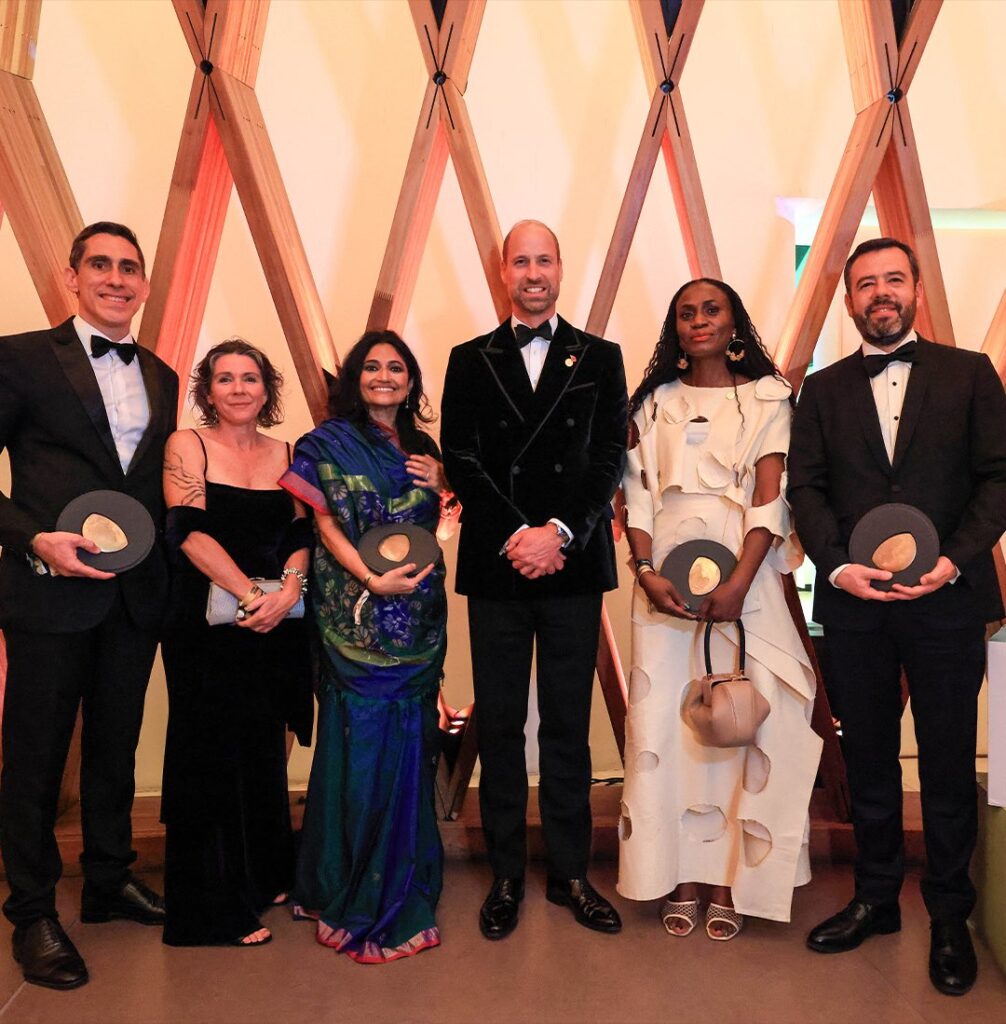
Under the futuristic ceiling of the Museu do Amanhã in Rio de Janeiro, an evening dedicated to five important environmental projects lit up on 5 November. Prince William announced the winners of theEarthshot Prize 2025, the prize he conceived that awards £1 million each year to those who not only talk about saving the planet, but actually try. Halfway through the decade that the Prince calls “the time of transformation,” Earthshot stopped in Brazil, a symbol of biodiversity and contradictions, to celebrate those who work within complexity without giving in to cynicism.
Halfway through the decade that Prince calls “the time of transformation,” Earthshot stopped in Brazil, a symbol of biodiversity and contradictions, to celebrate those who work within complexity without giving in to cynicism.
Reforesting as building an enterprise
In Brazil, start-up re.green won the Protect and Restore Nature category with a simple, scalable idea: make reforestation profitable. Using drones, artificial intelligence and satellite data, the company identifies the most suitable areas for the revival of Amazonian and Atlantic forests, reintroducing native species and creating income through carbon credits and sustainable timber. In three years, it has already planted more than 6 million trees and aims for 65 million by 2032. In a country where the forest is often treated as an open-pit mine, re.green transforms it into an economic infrastructure.
Bogotá, the city that breathes again
The Clean Our Air award went to the city of Bogotá, which has reduced air pollution by 24 per cent in six years. The change came not from technological innovation, but from a coherent urban policy: cycle lanes, electric buses, low-emission zones, trees and urban gardens in the poorest neighbourhoods. In a capital city of eight million inhabitants, the transition has become visible—less traffic, more public health, more space to walk. A replicable example for all cities that face smog as if it were a fate (not a choice).
The treaty that gives rules to the sea
On the ocean front, Revive Our Oceans recognition went to the High Seas Treaty, the first global agreement to protect biodiversity in international waters. After decades of negotiations, it will enter into force in January 2026—a step towards protecting the two-thirds of the seas that belong to no one but on which everyone’s lives depend.
Behind the treaty is the High Seas Alliance, a network of 70 civil organisations that pushed 145 countries to sign and 70 to ratify the agreement.
Lagos and the fashion that stops wasting
From Colombia to the ocean, then to Nigeria: Lagos Fashion Week won the Build a Waste-Free World section for reinventing the African fashion system by imposing sustainability rules on every designer who wants to show.
It is not greenwashing, but a paradigm shift: local materials, natural dyes, waste recovery, and training for artisans and young designers. The result is a more circular and culturally grounded industry that speaks of the future.
Bangladesh: living with change, not against it
Finally, for Fix Our Climate, the award was won by Friendship, an organisation founded on a floating hospital in Bangladesh. Today it provides health care, clean water and education to millions of people while restoring mangrove forests that protect villages from flooding
Where climate change is already present—and not a prediction—Friendship shows that adapting can also mean creating dignity.
Environmentalism as an everyday profession
In the audience, William spoke of “operational optimism”—not a sentiment, but a practice. And in discovering the profiles of the winners, the expression works. None of them promise miracles, all offer methods. re.green makes the forest an economic asset, Bogotá proves that cities can breathe, Lagos Fashion Week rewrites fashion as social infrastructure, Friendship builds resilience where geography punishes, and the High Seas Treaty gives a legal boundary to what had none.