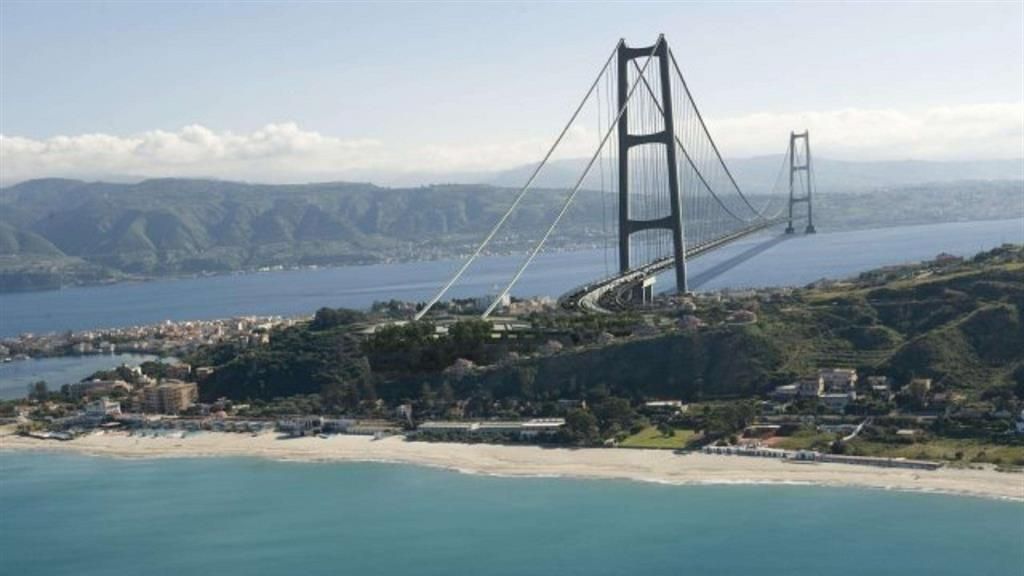
The Strait Bridge project is stumbling again, and the braking is heavy: the Court of Auditors has denied the legitimacy visa to the third additional act of the agreement between the Ministry of Infrastructure, the MEF and the Stretto di Messina company. This is a key step, without which the administrative and financial machinery of the project—already shaken at the end of October by the rejection of the 13.5 billion Cipess resolution—will stall again.
Immediate effect
The accounting judiciary specifies that the reasons will be filed within thirty days. But the effect is immediate: the agreement is not registered and the entire legal framework governing the relationship between the state and the concessionaire remains suspended. In practice, Stretto di Messina cannot proceed as a contracting station, cannot issue new tenders, and cannot tighten the programme agreement with the ministries. The timeline that was supposed to lead to construction sites in 2026 evaporates.
In the government, the nervousness is palpable. And this time Matteo Salvini tries to keep the tone low: he assures that it will go ahead, that “experts are working to clarify all the points,” but he avoids the sharp edges to which he has accustomed us. This time the impression is that there is no room for risk-free forcing.
Oppositions, however, are accelerating. From Avellino, Giuseppe Conte attacks, “Finally the Court of Auditors has said that that Strait project is a poorly constructed, poorly updated and patched up project. Thirteen and a half billion has been allocated and immobilised. Let’s take that money, because in that money they even put the cohesion funds of Calabria and Sicily as well. Let’s take them and use them for the infrastructure that is needed. The road ones, the rail ones, the ones that we really need and allow the people of Campania to gain some benefit.”
Also along the same lines is Elly Schlein, linked with the initiative “Let’s free Sicily from malfeasance, corruption and clientelism”: “The Court of Auditors has once again given a stop. Blocking an unfair, wrong, harmful and old project like the one on the bridge over the Strait of Messina.” And Chiara Braga, leader of the PD group in the Chamber, also intervenes on X: “We are confident: law and common sense will prevail. A million-pound expenditure when basic infrastructure is lacking would be a waste. Stop everything and divert resources to useful works.”
Stia tranquillo Salvini, anche noi determinati a bloccare un ponte inutile e dannoso. E fiduciosi: il diritto e il buon senso avranno la meglio. Una spesa milionaria quando mancano infrastrutture di base sarebbe uno scempio. Bloccate tutto e dirottate le risorse su opere utili. pic.twitter.com/ZzWFzJja7C
— Chiara Braga (@bragachiara) November 17, 2025
The harshest judgment
The harshest judgement comes from Angelo Bonelli, AVS parliamentarian: “The decision of the Court of Auditors not to admit to the legitimacy visa the MIT-MEF decree on the third additional act of the agreement of the Strait Bridge is of an absolute gravity. It means that the Meloni government was committing public funds within a framework deemed not legitimate, for a 14 billion euro work without any technical, environmental or legal certainty: resources taken away from railways, schools, health and territorial safety. I am ready to denounce the government even to the European Public Prosecutor’s Office if it insists.”
On a technical level, the Court confirms that the 1 August 2025 decree—the key to the 2003 convention update—was not allowed for endorsement. And it points out that this additional act is closely related to the Cipess resolution already rejected in October. The two rejections now weld into a single rift that puts everything back on the table.
So the project is frozen, the administrative framework is to be redone, and the government must choose whether to attempt a restart from scratch or to stop and reconsider the entire design. For now, neither Palazzo Chigi nor MIT show any willingness to give up, but the slap in the face from the Court of Auditors has made the road decidedly bumpier. And, as many observers note, the immobility is also weighing on the wallet: 13.5 billion is now stuck between unregistered resolutions and conventions stuck in the pits. A slowdown that threatens to weigh on an economy already in the balance.