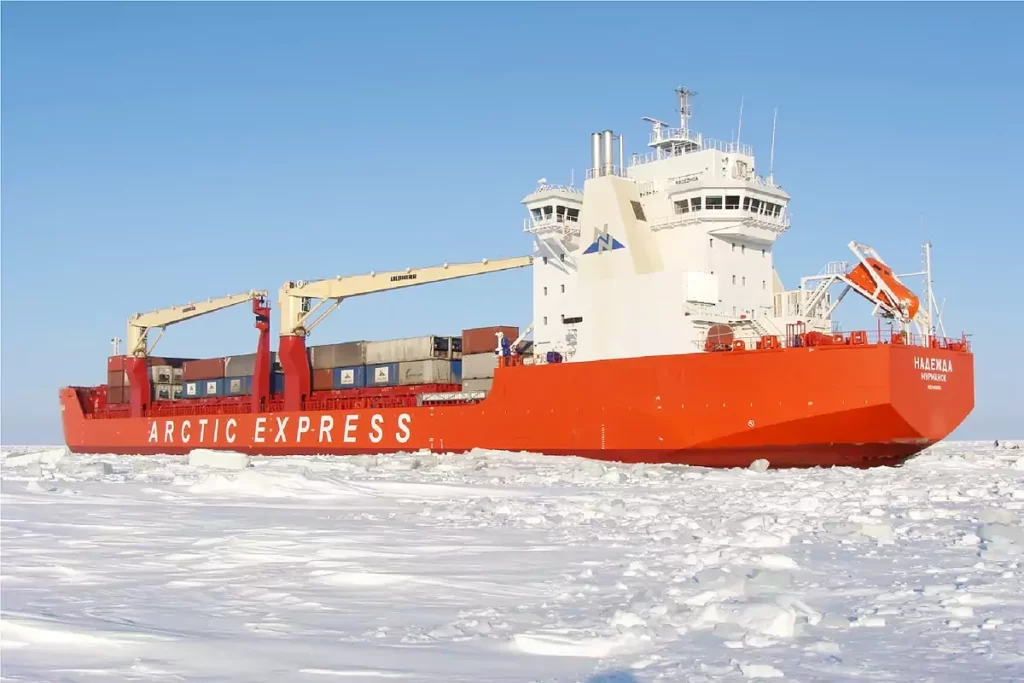
The Silk Road has found a shortcut through what was once called the eternal ice. In ten days the “Arctic Express,” the new container line that will connect Ningbo-Zhoushan, China, with Europe via the Arctic, will take off. A route that halves the time compared to the traditional route via Suez: eighteen days instead of about forty. A revolution in global logistics that bears Beijing’s signature.
The experiment is not improvised. In August, the Istanbul Bridge ship, with a capacity of nearly 5,000 containers, completed the Arctic portion of the crossing in just six days, to connect St Petersburg to Qingdao in a total of 25 days. The route shows China’s ability to move as an independent player on the polar stage. But the geopolitical backdrop also tells something else. Trump’s constant neurotic diktats have welded and broadened the anti-US front. And at the recent Shanghai Cooperation Organisation (SCO) summit, Xi Jinping and Vladimir Putin made it clear that they aim to redraw global trade and economic routes, undermining the order built around Washington and the dollar.
The Arctic as a frontier
Beijing has been studying the Arctic as a ground for commercial and scientific expansion for years. NewNew Shipping Line in 2024 made thirteen voyages along the Arctic route, twice as many as in the previous year. Now the trades are entering a new phase: the Haijie Shipping Company will connect not only Felixstowe in the UK with China, but also Rotterdam, Hamburg, and Gdańsk.
The stakes go beyond the mercantile aspect. From the pandemic to the Suez Canal blockade to the Houthi attacks in the Red Sea, recent years have shown how fragile global logistics are. Opening a new corridor means reducing dependence on strategic bottlenecks whilst strengthening China’s role as a planetary hub.
The project does not travel alone. Since the invasion of Ukraine, Russia has been isolated in the Arctic Council, finding Beijing a natural partner. As Claudio Padice recalls on HuffPost, Russian atomic giant Rosatom has signed a joint venture with Hainan Yangpu NewNew Shipping Co. Ltd, to produce infrastructure and polar-class container ships so as to develop the year-round extreme route in the medium to long term.
Thus is strengthened an understanding that sees energy trade as another essential element. Moscow continues to supply LNG and oil to China, even in forms that escape sanctions, and signs a “legally binding” memorandum with China to build the Power of Siberia 2, a giant pipeline intended to transport up to 50 billion cubic metres of gas per year to the Dragon
It is a picture of a pact that allows both powers to strengthen themselves and present themselves as an alternative to the Western order.
The dark side of the melting ice
Behind the logistical efficiency of the new polar route, however, faces an environmental trap. The gradual melting of Arctic ice, produced by the climate crisis, is the condition that opens this shortcut. According to projections, by 2030 the Arctic could experience its first nearly ice-free summer, with the prospect of year-round routes open by mid-century. But environmentalists warn: more traffic means more black carbon emissions, greater risk of accidents in a delicate ecosystem, and direct threats to fauna and flora. Turning the Arctic into a container corridor is not a harmless detail, but a paradigm shift with global consequences.
For now, the service will only be able to operate during the summer and autumn months, July through November, when the ice recedes. But plans look beyond that: icebreaker ships, year-round operational routes, exploitation of energy and mineral resources. On the other side of the globe, Washington reacts with growing alarm: the United States, strong on Alaska and claims to Greenland, considers the Arctic crucial to its security. The new water motorway between Asia and Europe began as a mercantile shortcut, but it risks becoming the axis along which a decisive part of the new world order will be played out. And of the new climate order.