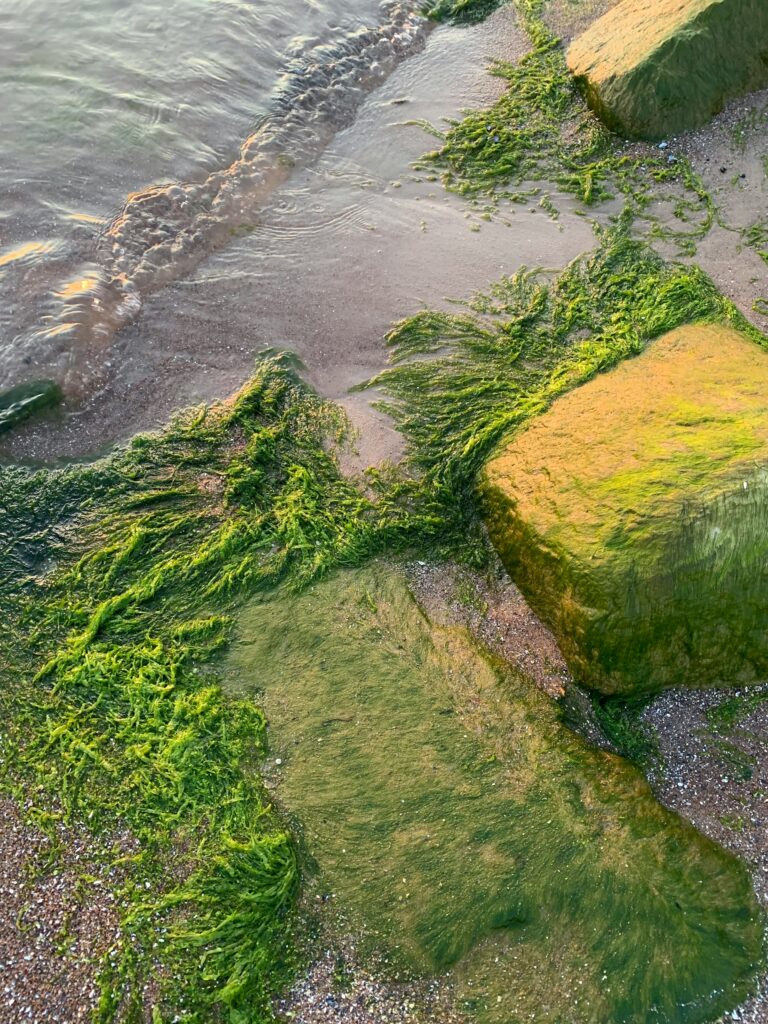
There is something poetic—and why not, also deeply symbolic—in turning the sea into art. Or rather, in transforming its seaweed. And that’s what Alex Glasgow, marine farmer and founder of KelpCrofters, a water farm located near the Isle of Skye, off the west coast of Scotland, has done.
In those very waters, in those very seas, Alex Glasgow collects aboard his boat long ropes laden with algae, characterised by a typical black-orange colour. And, where we would only see algae, he sees the future: “It’s probably the fastest growing biomass on the planet,” he tells The Guardian. And he says this with good reason: in fact, these organisms are currently at the heart of a rapidly expanding industry, and his company already uses them in a variety of areas, from soap making to glass making to fertiliser production. But there is one part of the crop that has a rather curious destination: art.
Seaweed and art: a possible marriage?
Sixteen artists were invited to participate in a unique exhibition project, Art for Your Oceans, an exhibition held in London from 7 to 15 May that featured artwork made with a special ink, that made from Glasgow-grown seaweed.
An ink, this one, that made some participants travel back in time: “It was very thick,” says one of the artists involved in the project, “it had a smell that immediately took me back to childhood, to when I used to dig amongst the rocks on the beach. But today, back in those places, I notice the differences: less seaweed, less anemones, fewer birds.”
In short, the brackish smell of these seaweeds evokes memories, yes, but it also brings up an awareness, that of a changing and suffering sea. And many artists have chosen to represent precisely this tension in their works, a dualism that oscillates between wonder and threat. For example, one of the artists chose to represent the figure of the selkie, a mythological creature that can transform from a seal to a human being, as a metaphor for a new, more fluid and more conscious relationship with nature.
360-degree environment
In this exhibition, then, the oceans are not just the background, they are the protagonists. Or, more precisely, as one of the artists reminded The Guardian, they are the “generative engine of the blue planet”—the oceans, in fact, have enabled the biosphere to survive five extinctions, and they may be crucial as well in the landscape of the complex climate crisis we are facing. Yet we, these oceans, often treat them as open dumps, where we hide plastics, hydrocarbons and waste of all kinds.
And precisely in order to make a 360-degree appreciation not only of the oceans, but also of the environment, the artists chose to work on natural materials: silk, handmade paper, pigments ground from shells collected at the beach. The subjects represented also recall the sea: there are those who, for example, depicted submarines emerging amongst the waves, evoking memories of a childhood, spent observing the sea as a hidden world, and there are those who preferred to be guided by inspiration, letting the brush flow randomly and giving life to liquid and unstable landscapes.
But there is a common thread linking all the works, which is also a warning to observers: the sea is not a postcard landscape, but a living system, powerful and fragile at the same time. In short, a place that deserves respect, protection and listening. “When you are in a boat and you look at the horizon, you realise how small we are,” comments one artist. “And you also understand how real, tangible and concrete nature is. Even though we often forget about it.” And it is so that we do not forget the importance of our planet’s resources that WWF has decided to promote concrete marine conservation projects: donations collected through the “Art for Your Oceans” exhibition are earmarked for crucial activities such as restoring ecosystems, protecting endangered marine species and combating intensive fishing. But each of us can do our part, for example, by starting to respect nature, even with small gestures. Because—to stay on topic—what we do is just a drop in the ocean. But if we didn’t do it, the ocean would be much smaller.