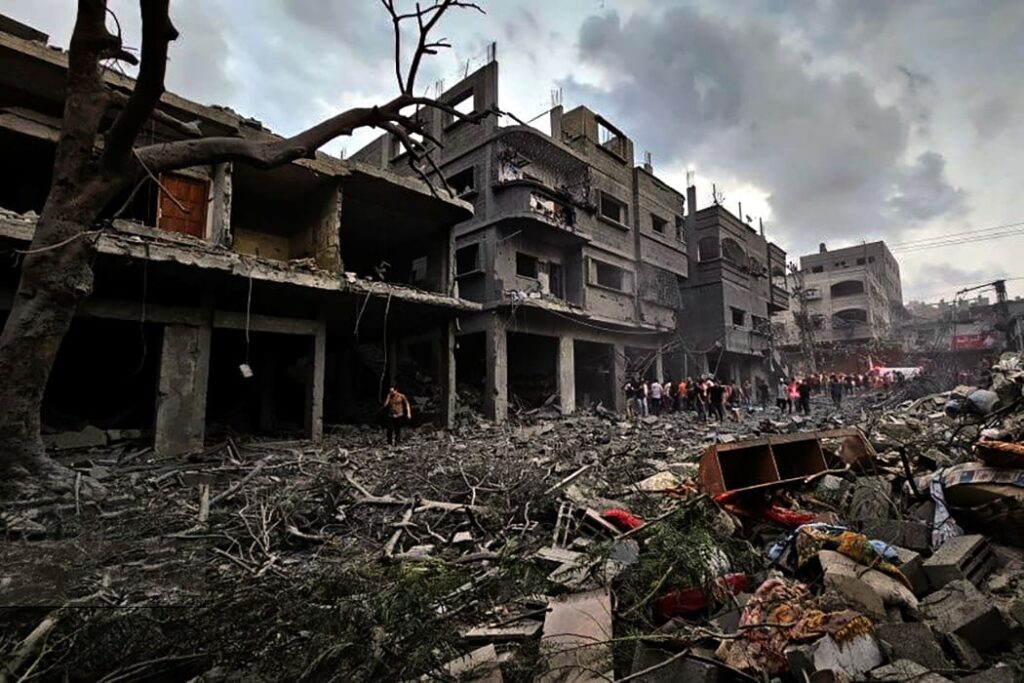
After systematically destroying every civilian infrastructure in Gaza, turning the Strip into one of the most polluted places in the world, with no drinking water and no sewage system, Israel is taking it out on the illegal burning of rubbish and dumping of sewage in the West Bank. The government has called this phenomenon a “threat to national security.”
A number of Palestinian factories south of Hebron ended up in the crosshairs, accused by COGAT–the Israeli body that manages civil affairs in the Territories–of polluting the Hebron River and the air in surrounding areas, even affecting Israeli towns such as Beersheba. Penalties, permit revocations and even the closure of plant sewage systems were triggered. At the same time, Defence Minister Israel Katz and Finance Minister Bezalel Smotrich announced a contingency plan: seizures of Palestinian rubbish lorries, forced removals, and new disposal sites in the West Bank, with the costs charged to the Palestinian National Authority.
Why pollution reaches Israeli cities
In Shoham, in central Israel, the Ministry of Health urged residents to stay indoors overnight, keep windows shut, and turn off air conditioners. It is a rare measure, adopted after a mobile detector recorded benzene and PM2.5 levels, ultra fine particles that can penetrate deep into the lungs, well above legal limits. Benzene is a carcinogenic substance, while PM2.5 is fine particulate matter that can worsen or trigger serious respiratory problems.
According to Israeli authorities, the main cause is illegal burning of waste in the West Bank, particularly plastics and electronic devices. Burning these materials releases heavy metals and toxic substances into the air that do not stop at the Green Line, the border between Israel and the Occupied Territories. The smoke travels, propelled by the wind, and affects Israeli and Palestinian communities without distinction.
However, there is one point often omitted in the public debate: illegal incineration has been going on for at least two decades and is linked to a lack of infrastructure. There are only two functioning landfills in the entire West Bank. For many Palestinian municipalities, getting waste there is expensive and logistically complex. Burning them becomes, in fact, the only available solution.
From environmental emergency to humanitarian crisis
An Israeli auditor’s report criticised the Civil Administration for never creating an effective disposal system. Yet whilst there is talk today of “environmental terrorism,” adequate funds were not allocated for years to prevent the problem. The Ministry of Environmental Protection had requested $41 million to fight the fires, but those resources did not enter the state budget. As Yaniv Bleicher of Citizens for Clean Air denounced, “citizens continue to pay with their health.”
The contradiction becomes even more obvious when looking at Gaza. Whilst in the West Bank pollution is treated as a fault to be repressed, in the Strip the environmental system has simply collapsed. Drinking water, sewage, electricity-everything is beyond repair. In these hours, children are freezing to death in an area that lacks power, heating and adequate facilities. We are not talking about illegal fires here, but about a population trapped without essential services.
Without infrastructure, investment and shared resource management, pollution is not a choice but an inevitable consequence. And whilst security and sanctions are discussed, the environmental and humanitarian crises continue to intertwine, affecting first and foremost the most vulnerable.