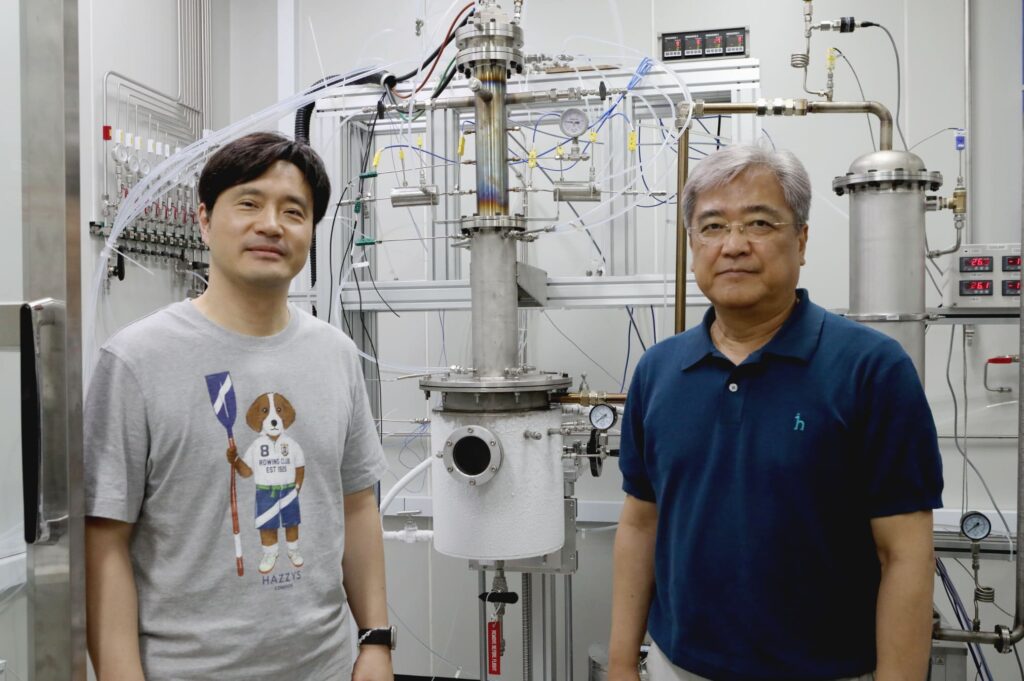
Why break down plastic when you can vaporise it and return it as raw material? That’s the idea-radical and potentially disruptive-behind the new plasma flashlight developed by the Korea Institute of Machinery & Materials (KIMM). Powered only by hydrogen, it annihilates mixed plastic waste in less than a hundredth of a second and converts it into ethylene and benzene, the basic building blocks of plastic chemistry. If it delivers on its promises on an industrial scale, it could “realise the era of zero sorting”: no more lengthy separations per polymer, reduced costs, and, thanks to hydrogen, a near-zero carbon emission profile. It would be a really good one, an egg of Columbus.
“For the first time in the world, we have developed a process that can successfully convert mixed plastic waste into raw materials,” said Young-Hoon Song, the Korean scientist programme director at Kimm. “Our goal is to solve waste and emission problems through continuous demonstrations and commercialisation of this breakthrough discovery.”
The secret of technology
The secret of this technology lies in theuse of plasma, an ionised gas at very high temperature, operating between 1,000 and 2,000 degrees Celsius. Researchers have reportedly succeeded in achieving the controlled transformation of plastics into simpler compounds by precisely regulating the temperature and reaction time, avoiding undesirable reactions (such as material explosion). The results are remarkable: the process recovers between 70 and 90 percent of the desired chemical compounds, with an ethylene yield of 90 per cent. After purification, more than 99 per cent of the product is pure enough to be reused in the production of new plastics.
This approach differs markedly from pyrolysis, the conventional method of plastic disposal that operates at lower temperatures (600 degrees Celsius) and produces more than a hundred byproducts of limited practical use. Although some oil companies claim that some of these byproducts can be recycled as oil, the environmental impact of pyrolysis remains problematic. So much so that activists call it an environmental “fairy tale.”
The most promising aspect
South Korea, despite being considered one of the world’s most advanced economies in terms of recycling, still makes extensive use of pyrolysis. Currently, chemical recycling accounts for less than 1 per cent of the country’s recycling program. Researchers hope this new technology will accelerate the transition to more sustainable methods.
Most promisingly, pilot tests have already demonstrated the economic feasibility of the process. The team plans to start official demonstrations in 2026, with the goal of commercialization.