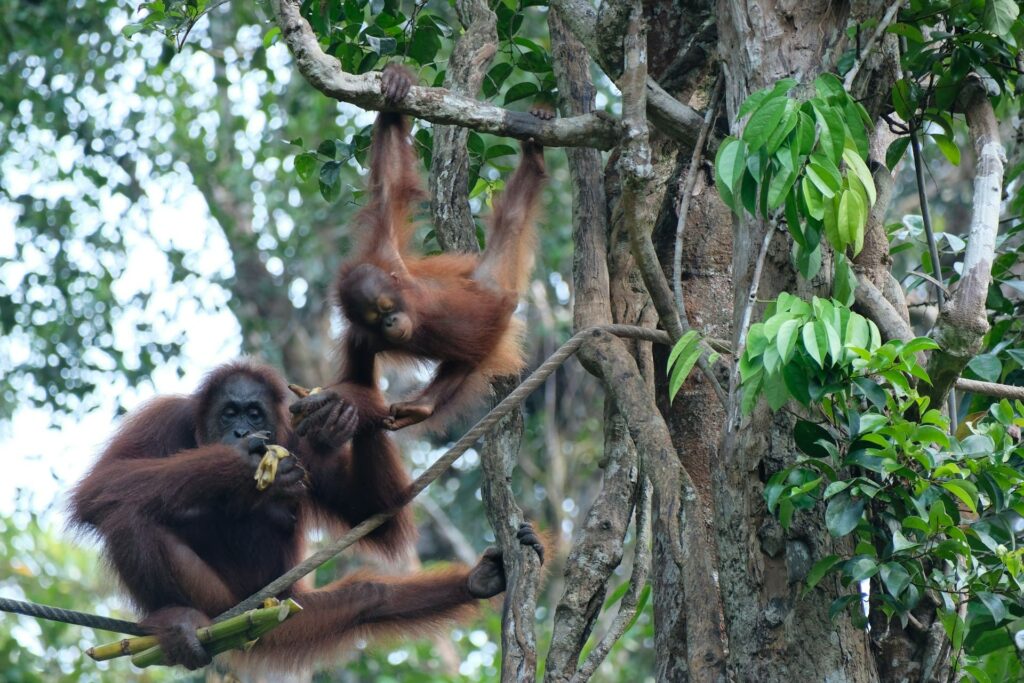
For an orangutan, choosing what to eat is not a matter of instinct at all. It is rather a matter of observation and long patience, of “culture,” we might say. This is stated in a study by the Max Planck Institute for Animal Behavior, published in Nature Human Behaviour, which sheds new light on one of the least intuitive aspects of the great apes‘ lives: their diet.
Wild Sumatran orangutans “bring to the table” an impressive variety of foods-they feed on about 250 different plant and animal species-and, according to researchers, it would be impossible to learn all this by relying only on the trial-and-error mechanism. Too risky, too slow. Some foods are seasonal, others difficult to process, still others potentially toxic if eaten the wrong way. The solution? Learn from others.
The study shows that orangutans’ food knowledge is a true cultural repertoire that is built over time through social learning. The researchers used a simulation model based on 12 years of field observations to find out whether a young orangutan could, on its own, acquire all the necessary skills before becoming independent around the age of 15. The answer? It’s no.
The model included three key social behaviors. The first is peering, the close observation of another orangutan while eating. The second is proximity, the simple proximity to feeding individuals, which stimulates exploration of similar foods. The third is guidance to specific feeding sites. Only when all three of these channels were available were “virtual” orangutans able to develop a complete diet, similar to that of wild adults. By removing even close observation, the dietary repertoire stopped at 85 per cent. By removing even close proximity, the diet became drastically poorer. Without a community to observe, the orangutan does not really become an orangutan.
This finding has implications far beyond conservation biology. According to the authors, the findings suggest that the roots of human cultural accumulation-the ability to pass on complex knowledge from generation to generation-may date back at least 13 million years, to the last common ancestor between humans and great apes. In other words, culture did not originate with Homo sapiens: it has its roots much further back in time.
Then there is a practical, and urgent, implication. Programs to reintroduce orphaned or captive-raised orangutans back into the wild must take this “cultural menu” into account. It is not enough to put an animal back into the wild: if it does not know the full range of edible foods and the proper ways to consume them, the risk is starvation or poisoning. Survival also – and above all – comes from the transmission of knowledge.
A curiosity that reinforces this picture: orangutans are known to have one of the longest periods of maternal dependence in the animal kingdom, up to eight to nine years. A time that now appears in a new light: not just physical growth, but a long “school of life” of observation, imitation and memory. In silence, in the forest canopies, a culture is built that is as valuable as any survival manual.