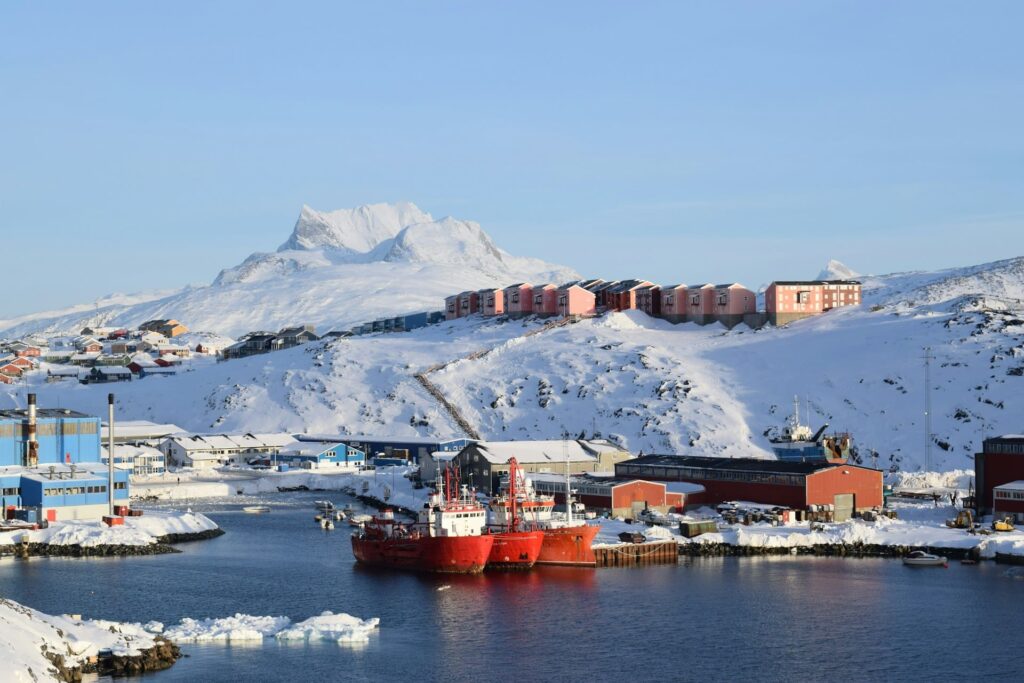
Wanting to get one’s hands on Greenland is an expression of Trumpian neo-imperialism, as Professor Mario Del Pero, professor of international relations at Science Po in Paris, recently observed, that is, the desire to control the entire Western Hemisphere. But it is also an expression of a de facto predatory attitude toward the environment, particularly fragile ecosystems such as the Arctic that advancing climate change makes more accessible to exploitation.
And in this sense, rising temperatures are facilitators of access to new territories, mostly without attention to the delicacy of them and the damage that their use for commercial purposes could cause. Greenland offers two particular risk profiles, one related to the exploitation of its vast mineral resources and one related to the progressive use of the Arctic route for trade between the Far East and the states bordering the North Atlantic.
The treasure under the ice
Since the 19th century, mining exploitation has been the main aspect of Danish colonialism in Greenland. For about 150 years, cryolite (1856-1997), a mineral known as “ice that never melts” and useful among other things in metallurgy because of its extremely high melting point (it is used as a flux agent in the electrolytic process of aluminum extraction), was mined. And coal, lead, zinc and silver have also been mined.
Although more than 140 mining licenses have been granted, as of early 2026, Greenland has only two active mines: a gold mine (Nalunaq) in the south operated by Amaroq Minerals and an anorthosite (feldspar) mine at White Mountain in West Greenland, which is operated by Lumina Sustainable Materials. The European Union, which has identified 25 essential minerals found in Greenland, signed a memorandum of understanding with the local government in 2023 to support the exploitation of mineral resources, thereby strengthening strategic cooperation in the Arctic.
“Greenland’s vast natural riches,” the memorandum of understanding says, “represent a key resource for benefiting from global value chains as it seeks to diversify its economy in a sustainable manner. Twenty-five of the 34 critical raw materials identified by the Commission as strategically important for European industry and the green transition are located in Greenland.”
No one knows how many rare earths there really are
Of particular interest are the so-called“rare earths,” which are strategic materials. According to an estimate by the U.S. Geological Survey in Greenland there would be 1.5 million tons, a small fraction of the 90 million tons of estimated world reserves. That seems relatively small compared to countries such as China (44 million), Brazil (21), India 6.9), Australia (5.7), Russia (3.8), and Vietnam (3.5). But the estimates for Greenland could be increased by a lot when one considers that today only 20 percent of the big island’s territory is ice-free. No one really knows what lies beneath. And now that Greenland’s ice is melting, new opportunities are emerging.
The Europeans have known it from before, and the Americans and Chinese have known it as well. Not coincidentally, Beijing attempted to enter the Kvanefjeld mine project led by Australia’s Greenland Minerals, but the project to mine rare earths, uranium and other minerals was halted by the Greenlandic government due to both concerns about environmental impacts and pressure from the U.S. president at the time, Joe Biden. Certainly, willingness aside, extracting minerals in Greenland is by no means easy, even as the ice continues to melt. There are no roads and no infrastructure, the Arctic environment is harsh and very sensitive.
Arctic mining and pollution
The past teaches. Mining activities at three former mine sites, the cryolite mine in Ivittuut, the lead-zinc mine in Mestersvig, and the lead-zinc mine in Maarmorilik, have resulted in significant environmental pollution, mostly with lead and zinc. In Ivittuut, the first environmental studies conducted in the area in 1982 revealed significant pollution with lead and zinc in Arsuk Fjord due to mining. The pollution was mainly related to the dissolution and transport of lead and zinc from waste rock located on the coast. In 1985, it was estimated that between 400 and 1,000 kg of lead dissolved in waste rock was discharged into Arsuk Fjord, polluting it.
In contrast, in the Mestersvig lead and zinc mine, which was mined from 1956 to 1963, marine and land-based pollution is reported in Kong Oscar fjord with residual ores mainly lead and zinc as well as cadmium and copper ores. The maximum spatial extent of the affected area during the mining period is unknown, but it covers an area of at least 10-15 km from the pollution sources. Significant pollution with metals, mainly lead and zinc and to a lesser extent cadmium, mercury, copper, and arsenic, was also detected at Maarmorlik. High concentrations of metals have been measured in seawater, sediments, and a number of species in both the terrestrial and marine environments.
“Three to five decades after the closure of the mines at Ivittuut, Mestersvig and Maarmorilik,” note Jens Søndergaard, Anders Mosbech of the Department of Ecosciences, Aarhus University, in a 2022 study, “pollution has decreased, but mining has left a legacy of pollution that extends at least 5 to 12 kilometers away from the sources. Pollution is likely to continue for many decades because of the weathering of waste materials left behind by erosion and transport, and these are difficult or impossible to recover. In addition, climate change may alter pollution in affected areas, as landfills and waste rock, now frozen, may thaw and become exposed to weathering and transport of pollutants. This is especially true of the waste rock dumps at Maarmorilik and the deposit near the Tunnel River at Mestersvig, underscoring the need for continued environmental studies at these old mining sites.” As if to say that in perspective mining in Greenland is logistically complex but possible as long as with clear with environmental prescription, and therefore expensive.
On Arctic routes watch out for soot
The second key chapter for Greenland is Arctic routes. Climate change is gradually opening up the Arctic route between China, Korea, Taiwan, and Japan on the one hand and the North Atlantic, primarily Europe, on the other. The latest report on the state of Arctic shipping compiled by the Arctic Council under the Pame (Protection of the Arctic Marine Environment) program shows that the cumulative distance traveled by ships has increased from 6.51 million nautical miles in 2013 to 12.7 million in 2024. The number of individual ships entering the Arctic has also increased by 37 percent to 1,781 in 2024.
On paper, the advantages seem obvious. From a central Chinese port such as Ningbo to England or Holland, the journey through the Arctic route is around 15,000 km long, about 20 percent less than through the Suez Canal and 40 percent less than a detour around South Africa. At 15 knots, a ship could theoretically complete the journey in about 23 days. At an average speed of over 16 knots even less, say 18 days. In addition, most ships sailing on conventional routes use heavy fuel oil (HFO) types, but the International Maritime Organization (IMO) has introduced a ban on HFO use on Arctic routes from July 2024, although with some exceptions until 2029. Thus, shipping is shorter and uses less polluting fuels. But it should be considered that many of the ships undertaking it today are not high ice class, and so for much of the time the route is viable they need a spare icebreaker (which consumes and emits). And not only that.
“Perhaps the most important factor of all, however,” notes the British think tank Opportunity Green, which works extensively on transportation, “is the impact of black carbon emissions. Black carbon, or soot, is a powerful, short-lived climate pollutant with a 100-year global warming potential (GWP) hundreds of times greater than that of CO2. In the atmosphere, soot contributes to global warming by absorbing incoming solar radiation before it falls and is deposited on the Earth’s surface. This deposited soot reduces the reflectivity of the normally white surface of sea ice and snow, further increasing the absorption of solar radiation.”
“Because of its proximity to sea ice and snow,” the think tank continues, “black carbon emitted in the Arctic has a particularly strong climate impact. One study found that when considering climate impacts over the next 150 years and comparing Arctic and conventional shipping routes, the increased warming due to black carbon emissions from Arctic shipping would outweigh the cooling impact from reduced CO2 emissions brought about by the shorter route.” And finally, there is also the issue of potential risks to bringing sensitive cargoes into environments where navigation is difficult. Oil spills pose a particular challenge because of the hazardous nature of the route, the low temperatures, the remoteness of the area, and the severity of the conditions, all of which combine to simultaneously increase the likelihood of a spill while delaying and making cleanup operations difficult and expensive.
Shipping bigwigs call themselves out
The environmental organization Ocean Conservancy has promoted a voluntary commitment by consumer goods and maritime logistics companies not to send ships through Arctic routes. “As companies shipping goods around the world,” the document says, “we are aware that greenhouse gas emissions from global shipping are endangering the Arctic and will continue to do so even if we avoid Arctic shipping routes. As companies deeply concerned about climate risks that already affect or threaten Arctic populations, marine life and ecosystems, we refuse to increase the risk of even greater impacts and are committed to doing so.”
For consumer goods companies, this means that “recognizing the potential impacts, we voluntarily agree not to intentionally allow our products to be transshipped on vessels using Arctic transshipment routes, as shown in the map below. Likewise, no ocean carrier or freight forwarder contracted by us will be allowed to transport our products on vessels that sail or intend to sail along these Arctic transshipment routes.” For logistics service providers, on the other hand, “recognizing the impacts, we voluntarily agree not to intentionally sell services or allow our vessels to use Arctic transshipment routes, as shown in the map below.”
The important thing is that the commitment was signed by the major shipping operators. From the first, Switzerland’s MSC; from the second, Denmark’s Maersk; from the third, France’s CMA-CGM; from the fourth, Germany’s Hapag-Lloyd; from the sixth, Taiwan’s Evergreen Line; and Hong Kong-based operator Li & Fung, a leader in supply chains for global brands. These are joined by companies such as Nike, Gap, H&M, Ralph Lauren, Columbia, and Puma.
So if the threats to the Arctic environment are growing, not everyone has a predatory attitude, quite the contrary. The voluntary commitment of many of the shipping leaders should serve as an example for the IMO, the international maritime organization, to set even stricter standards. Or close the Arctic route altogether, with limited exceptions. The next opportunity for the IMO to issue stricter rules-such as a total ban on heavy HFO fuel-will be in February 2026, during the next meeting of the Subcommittee on Pollution Prevention and Response (PPR). That certainly would not please Trump.