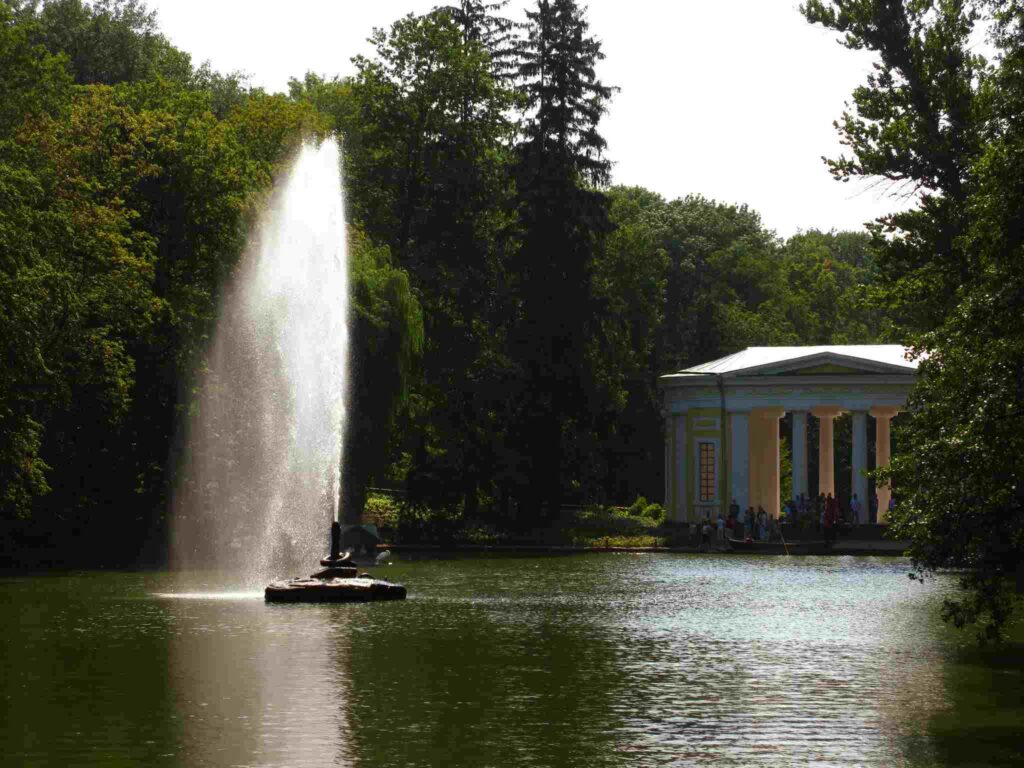
At Sofiyivka National Dendrological Park in Uman, botanical research continues under conditions severely compromised by the Russian invasion. Electricity is not continuous, work times are broken, forcing reorganization of activities from day to day: power outages can last up to fifteen hours and impose forced breaks, restarts, constant adjustments.
Here, scientist Larisa Kolder works to safeguard threatened plant species, using microcloning techniques to conserve genetic material that, in its places of origin, is in danger of being lost.
One of the most closely followed species is the Moehringia hypanica, an endemic plant that grows in the wild only in Ukraine, among the rocks of the Aktovsky Canyon in Buzkyi Gard National Park. It is listed in the Red Book of Threatened Species, and destruction of its habitat would mean the species’ ultimate demise.
Of the twenty-three seeds that arrived at Uman a few months ago, only two germinated. From those two plants the lab managed to obtain dozens of cloned specimens: today about eighty seedlings have taken root. A small number, but enough to prevent a unique genetic heritage from being erased as conflict redraws territories.
A black hole called employment
Ukraine covers less than 6 percent of Europe’s land area but is home to about 35 percent of the continent’s biodiversity. Steppes, wetlands, Black Sea coasts and mountain systems make it a meeting point between the Mediterranean and the Caucasus. However, many of these areas are now in occupied territories.
Following the annexation of Crimea in 2014 and the large-scale invasion of 2022, central sites for scientific research have become inaccessible. The Nikitsky Botanical Garden, for decades a reference of Ukrainian botany, and the Nova Kakhovka experimental station in the Kherson region are no longer in contact with the country’s scientific community. “It’s worse than the Berlin Wall,” scientist Iryna Denysko explained to the Guardian, describing the total breakdown in communication with colleagues who remained across the front line.
According to Volodymyr Hrabovyi, acting director of Sofiyivka, almost all Ukrainian researchers have left those areas. That leaves the collections, or what remains of them.
The war against the soil
The destruction does not only affect laboratories. Oleksii Vasyliuk, a zoologist with the Working Group on the Environmental Consequences of War, points out that about 40 percent of Ukraine’s agricultural land and many of its major national parks are in occupied areas. Areas that, because of mines and environmental damage, will remain inaccessible for decades, perhaps centuries.
That is why Ukraine is systematically documenting environmental damage as cases of ecocide, with the goal of having them recognized as war crimes. Data help to understand the scale of the problem: In the past two decades, animal species listed in the Red Book have increased by 55 percent, plant species by 63 percent. The conflict has accelerated an already ongoing loss.
Saving today to rebuild tomorrow
Despite the difficulties, work continues at Uman. One of the lab’s principal researchers has spent the last few years at the front as a tank commander. He is nearing his 60th birthday and will be able to return to research permanently. A personal trajectory that reflects a collective choice: to continue planning for the future while the present remains uncertain.
With support from the United Nations Development Program (UNDP), Ukraine is drafting its National Biodiversity Conservation Strategy to 2035. The document aims to protect at least 30 percent of the territory, restore degraded ecosystems and align the country with the global goals adopted in Montreal in 2022. According to Tetiana Tevkun, UNDP Ukraine’s environment officer, this pathway provides access to international cooperation and funding that is also crucial for post-conflict reconstruction.
Meanwhile, one of the lab-grown Moehringia hypanica seedlings has been transferred to the Sofiyivka Park arboretum. This is the first time this species has grown outside its native area. It is not a symbolic gesture, but a protective measure: if the natural habitat was compromised, the plant would not disappear.