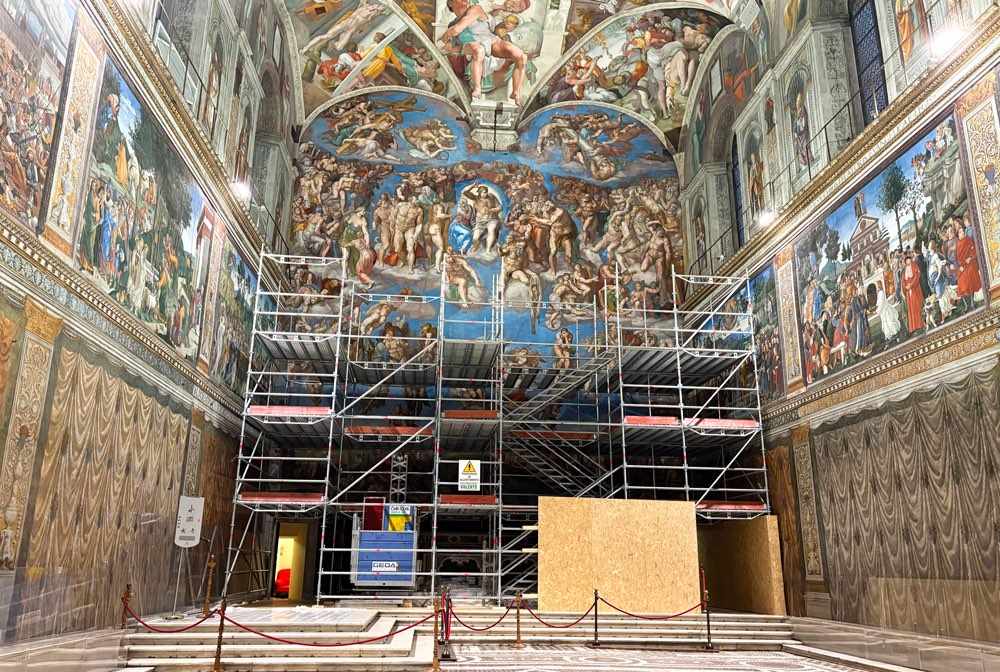
The most important conservation work on Michelangelo’s Last Judgment since 1994 has begun: since early February, Vatican Museum restorers have been setting up scaffolding in the Sistine Chapel for an extraordinary maintenance of the fresco decorating the altar wall, an operation set to last about three months.
The work-painted between 1536 and 1541 by the supreme Tuscan master-will not be isolated from the view of visitors and worshippers: the Sistine Chapel will remain open all the time and, during the work, the wall of the Judgment will be visible in its full image thanks to a high-definition sheet mounted in front of the scaffolding.
Why intervene?
Some 30 years after the last major restoration, the one that led to the removal of centuries of dirt, restoring the original colors to an extraordinary brilliance, Vatican experts have deemed it necessary to carry out a new conservative intervention.
The Vatican Museums ‘ restoration laboratory-a facility with internationally recognized expertise-has revealed a whitish surface veiling on parts of the fresco, caused mainly by the deposition of microparticles carried by air movement and the mass of visitors who crowd the Chapel each year. These thin deposits, while not immediately destructive, attenuate contrast and luminosity of the pictorial surfaces.
Barbara Jatta, director of the Vatican Museums, emphasized that the intervention is designed as preventive and non-invasive maintenance: it is not a new “complete restoration,” but a thorough cleaning using scientifically controlled methods, the result of knowledge that has accumulated precisely over decades of work on this gigantic mass of decorated surfaces.
An open-air construction site, but without closures
The decision to keep the Sistine Chapel open to visitors-even with the presence of scaffolding-reflects a widespread awareness in the world of cultural heritage: a great museum cannot stop, but must guarantee safety and heritage protection. The installation of the reproduction canvas allows the work to continue to be admired, at least visually, without interrupting the flow of millions of people who climb up to the Vatican every year to look at Michelangelo’s masterpiece.
On the technical side, the cleaning phase will affect the pictorial surface by removing the most recent patina that has accumulated in recent decades. It will work with precision tools and substances – non-invasive, non-aggressive – as is already done routinely for the protection of ancient mural works, and constant surveillance of the microclimatic conditions of the room is planned to minimize future alterations.
The masterpiece and its history
The Last Judgment is Michelangelo’s last major work in the Chapel: after painting, between 1508 and 1512, the vault with scenes from Genesis and figures of the prophets and sibyls (including the celebrated Creation of Adam), the master returned more than two decades later to cover the entire altar wall with a powerful vision of the Second Coming of Christ and the destiny of souls.
The work-with more than 300 human and angelic figures-triggered debates even in the decades following its completion. Because of its nudity and unconventional iconography, it was subject to censure and modification (such as the addition of covering draperies by pupils and successors to meet the demands of the Counter-Reformation).
Between preservation and historical reading
The “restoration of the century” of the 1980s and 1990s, directed among others by renowned restorer Gianluigi Colalucci, had already revealed unsuspected color under centuries-old layers of smoke and dust, changing the public visual perception of the entire Sistine Chapel.
Today, these extraordinary maintenance operations not only have technical purposes, but are part of a broader framework of cultural protection: they are about protecting and transmitting to posterity Michelangelo’s original vision as faithfully as possible, without interfering with the public enjoyment of the property.