In the debate about sustainability, nature and innovation, there is a still little-explored territory where scientific research ditches its lab coat and dons the shoes of art. It is that of bioart, a fascinating hybrid field in which living microorganisms become an integral part of the work. Exploring it this time is Enea, the protagonist of a project that brings together microbiology, restoration and contemporary sculpture.
At the center of the experiment are “good” bacteria, selected and studied in ENEA laboratories for the biorestoration of cultural heritage. Environmental, non-pathogenic and non-genetically modified microorganisms that over the years have already proven to work wonders on stone surfaces and works of art. Here, however, the script changes: instead of erasing time, they make it visible.
From restoration to creation
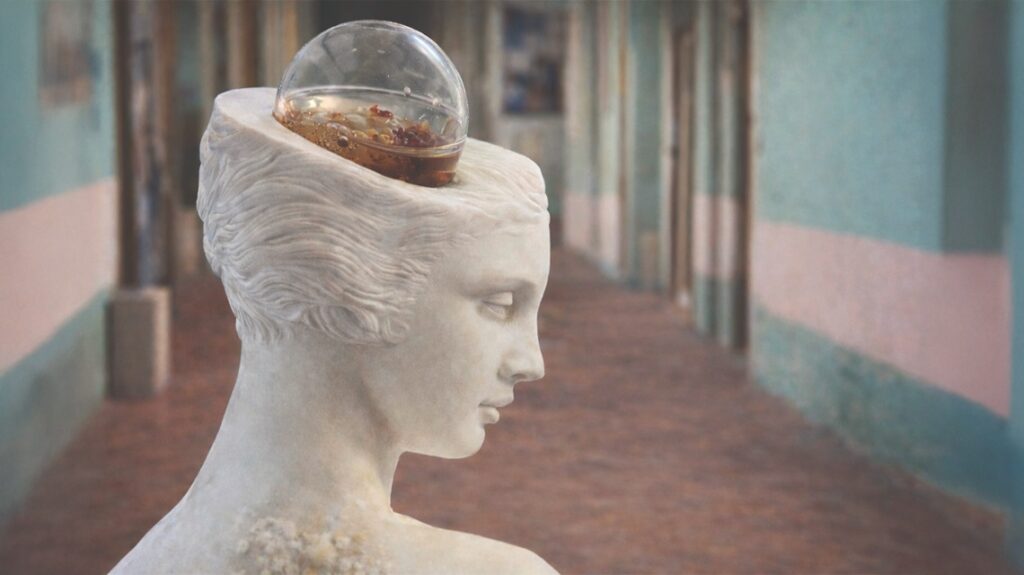
The idea takes shape thanks to artist Alessia Forconi, who has chosen to transform these bacteria from technical tools to true protagonists of the work. Thus two marble sculptures were born, Gea and Linfa, in which the boundary between inert matter and biological life becomes deliberately blurred.
The microbial strains used come from the Enea collection and are the same ones used in biocleaning interventions on contexts of great historical and archaeological value. Bacteria that have “worked” on Etruscan tombs, medieval chapels and monumental surfaces, and are now being called upon to play an unprecedented role: not to preserve the past, but to generate new forms and new readings.
Gea, the sculpture that changes over time
In Gea, symbolically dedicated to the Earth, microorganisms are housed within a sphere placed on the statue’s head. Here they live in a breeding ground that allows them to grow and transform, producing variations in color, texture and form over time. The work is never really finished: it evolves, breathes, and changes appearance following real biological dynamics.
It is an interesting reversal of the very concept of sculpture, traditionally associated with the idea of permanence. Instead, Gea accepts instability as a value, making visible the deep connection between art and natural processes.
Linfa, when the marble is colored with life
Even more experimental is Linfa. In this case, bacteria interact directly with the marble, creating chromatic patinas that function like a living pigment. It is almost a scientific provocation: the same microorganisms that in restorations are used to remove surface alterations are here used to create them.
The work was placed outdoors in a natural setting, allowing the treated marble to dialogue with the environmental microcosm. The result is a sculpture that not only incorporates life, but allows itself to be contaminated by the ecosystem in which it is placed.
Science, art and sustainability
This project shows how environmental research can break out of academic boundaries and speak a new language that can interrogate our relationship with nature. Bacteria, often evoked only as a problem or risk, become allies, mediators and even co-authors.
In times when sustainability is in danger of remaining a slogan, Enea bioart tries to make it tangible: not an abstract concept, but a living process, made up of relationships between humans, matter and microorganisms. And if the idea that bacteria can make art sounds strange, perhaps that is the point. Sometimes, to change our outlook on the world, we need to start with the smallest things.