Like cholesterol clogging an artery: it only took a few years for “quagga” mussels to massively colonize the five kilometers of pipeline under the Swiss Federal Institute of Technology in Lausanne. Technicians noticed them when it was already late last summer. The output of some heat exchangers had dropped by a third, smothered by a mass of shredded shells; the air conditioning was trudging along, and the buildings, which in summer should not have been more than 24 degrees, did not fall below 26 to 27. The invasion had entered from pipes that draw cold water 75 meters deep into Lake Geneva, Lake Léman, to cool the facilities.
They form dense carpets
Quagga mussels are small invasive freshwater bivalves native to the Black Sea and Caspian Sea. Their scientific name is Dreissena rostriformis bugensis. They attach to any hard surface by filaments (byssus), form very dense mats, and filter large volumes of water to eat phytoplankton. Apart from the Institute, any activity that uses deep water is in the crosshairs: the pumping and filtration systems for drinking water in Geneva and Lausanne, the airport connected to the same cooling network, infrastructure along the banks.
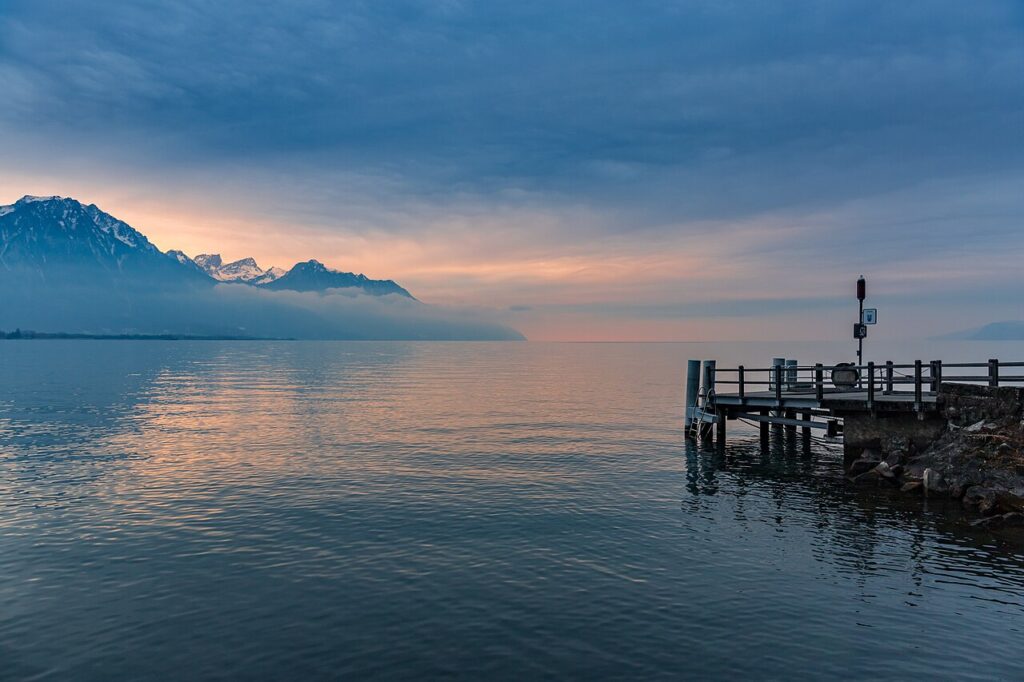
On the surface, Lake Geneva appears unchanged, with snow-capped mountains plunging into the dark water. Below, however, the ecosystem has been completely redesigned. A chain lowered to the bottom rises up after a few weeks covered with mussels. Beaches are littered with sharp shells, boat bottoms have to be scraped every few months. Snails, shrimp and native shellfish have disappeared. According to experts, there is nothing left for Lake Geneva now; every space is occupied by mussels up to 250 meters deep, an almost anoxic environment where few life forms endure.
The collapse of fish populations
Native to the Ponto-Caspian area, quagga have spread along sea routes: they have colonized the North American Great Lakes since 1989 and become the dominant life form, eventually making up more than 99 percent of the invertebrate biomass in some waters, contributing to the collapse of fish populations and covering centuries-old wrecks.
Their presence has also recently been reported in Northern Ireland. In Switzerland, they have been detected since 2014, with record densities in Lake Geneva: an average of 4,000 specimens per square meter, with peaks over 35,000. In 2022, 98.9 percent of the samples were quagga; in 2024, 100 percent. Each filters up to two liters of water a day, devouring the phytoplankton at the base of the trophic chain: less food for microcrustaceans, less prey for fish, a blow to the work of the lake’s 120 professional fishermen. The water becomes clearer, light penetrates deeper, the water warms deeper: toxic cyanobacteria blooms increase, while cold air-driven stirring has not occurred since 2012.
Once entered, there is no cure: one can only prevent colonization of other basins by meticulously cleaning boats and gear. After millennia of stability, Lake Geneva is experiencing rapid and irreversible change. Nature might adapt, some fish might learn to feed on it, but the lake will not return to the way it was.