The first climate migrants from Tuvalu, an archipelago of low-lying atolls in the Pacific where rising seas are already causing daily damage, have arrived in Australia. The first arrivals took place in late November and early December 2025, marking the first internationally recognized collective climate exodus. The goal, Australian officials say, is to offer safe haven without severing ties to home, so called “mobility with dignity” that allows people to live, study and work while climate impacts worsen.
The program, agreed upon two years ago between Canberra and Funafuti, the archipelago’s capital, has elicited a massive response: more than a third of the 11,000 inhabitants have applied for climate visas, which are still awarded on the basis of a draw. However, the selection is limited to 280 entries per year, a cap designed to prevent a haemorrhage of skills from a tiny and vulnerable country, and was established in August 2024 under the “Falepili Union“. The first tranche already already shows the mix of people leaving: there is Tuvalu’s first woman licensed to drive cargo forklifts, a dentist, a young pastor, people needed not only to rebuild their livelihoods, but to hold together communities, families, and identities thousands of miles from home.
The worst case
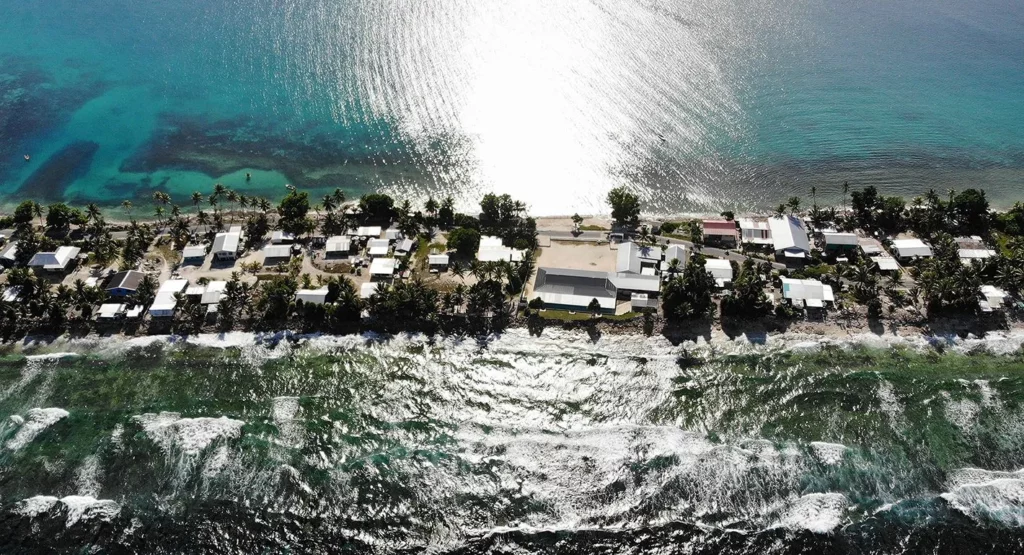
Tuvalu is among the most exposed places to sea-level rise. On the main atoll, Funafuti, in many stretches the land is little wider than the road. Daily life is tightly compressed under palm tree roofs, and space is such that children play soccer on the airport runway. Projections by NASA scientists are unequivocal: by 2050, daily tides will submerge half of the atoll, which is home to 60 percent of its residents. That’s the scenario associated with a one-meter sea rise; in the worst case, double that, 90 percent of Funafuti would end up underwater. Figures that force urgent decisions on issues that elsewhere are still debated.
Even so, no definitive solution can be expected from the UN-developed adaptation plan, the Tuvalu Coastal Adaptation Project (TCAP), developed with the government of Tuvalu and funded by the Green Climate Fund, which focuses on elevated platforms and coastal defenses with at full scale, the goal is to of “raising” 3.6 square kilometers of Funafuti, or 360 hectares, 1 to 2 meters above sea level. But currently completed pilot plots cover just 7.8 hectares. Anti-erosion liners and regenerated mangroves create a hybrid protection, effective against tides and storm surges, but expensive to maintain and unable by itself to neutralize salt intrusion and long-term risks.
Cultural connections
In Australia, according to Reuters, among the first to arrive is Manipua Puafolau, an aspiring pastor of the main church in Tuvalu. After two weeks in the country, he chose Naracoorte, a town in South Australia where several hundred Pacific Islanders already live employed in seasonal farming and meat processing.
Meanwhile, the government of Tuvalu is working on the invisible thread of ties. Premier Feleti Teo visited the Tuvaluan community of Melton, in Melbourne’s urban perimeter, to reiterate the importance of keeping cultural connections strong across borders. It is a call to those who leave and those who stay, not to dissolve the web of relationships that defines a nation even when geography becomes precarious.
The government in Canberra, Australia’s capital city, has set up family settlement support services in the main settlement areas: the east coast of Melbourne, Adelaide in South Australia and northern Queensland. This first group reflects pragmatic choices and modest ambitions. Kitai Haulapi, freshly married and the first woman on her island to qualify as, will move to Melbourne, a city of five million people, with the simple, practical goal of finding a job and continuing to send remittances to relatives left behind in Funafuti. It is the fine line that holds individual plans and collective support together, a thread of money that bridges the distance.