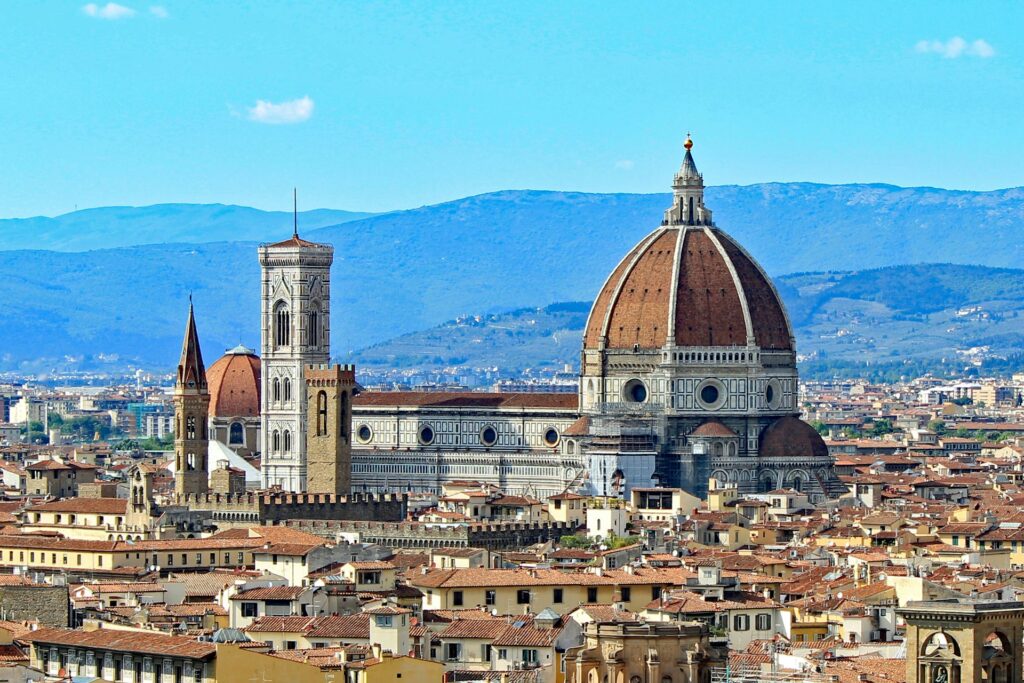
Florence looks to Amsterdam. The City Council approved a motion committing the administration to impose restrictions on or ban advertisements for products that result in high levels of greenhouse gas emissions. The act, while not introducing immediate bans, officially opens the political and technical path toward possible regulation for advertisements in public spaces connected to infrastructure paid for with collective resources such as urban transportation.
The inevitable reference is Amsterdam, the first capital city in the world to pass a structured ban against ads for gasoline and diesel cars, airline flights, and, more generally, emissions-intensive consumption such as steaks. An experience that now enters the Florentine political and cultural debate as a possible model.
Advertising and climate: why we talk about it
The issue is not just about billboards. It raises a deeper question: what kind of messages is it legitimate to promote in spaces that belong to everyone?
Bus shelters, tram, and municipal billboards are not simply commercial surfaces: they are pieces of the city, part of the urban and symbolic landscape.
Those who argue for restrictions start from a clear assumption: advertising is not neutral. It directs desires, normalizes behavior, and reinforces consumption patterns. Continuing to promote SUVs, low-cost flights or high carbon products while climate adaptation plans and initiatives to achieve carbon neutrality proliferate risks appearing contradictory.
This is the same reasoning that has led to the gradual banning of tobacco advertisements over the years: reduce visibility to reduce attractiveness and cultural impact.
In the Tuscan capital there is not (at the moment) a formalized ban like the one in the Netherlands, but the issue has entered into public discussion, among climate activists, environmental associations, and pieces of the local government.
Florence, after all, is not new to urban policies that intertwine environment and quality of public space: sustainable mobility, tramway extension, limited traffic zones, decarbonization strategies. In this framework, advertising becomes an additional piece: coherence between climate goals and urban visual communication.
Economic freedom vs. collective interest
There is no shortage of concerns. The advertising industry and some trade associations point out that billboard space is also revenue for municipalities and that restricting certain types of advertisements could reduce revenues and create contractual disputes.
Then there is the issue of business freedom. Banning advertising of legal products-such as traditional cars or air travel-is a slippery slope, especially in the absence of national or European regulations that provide a clear framework.
On the other hand, those pushing for stricter rules talk about public accountability: if an administration declares a climate emergency and invests in transitional policies, does it make sense for its spaces to promote opposite models?
The Amsterdam effect
This is where Amsterdam, mentioned again and again in the Italian debate, comes in. The Dutch experience functions as a political and cultural precedent: it shows that intervening on fossil advertising is not regulatory science fiction, but an administrative choice that is possible.
Florence may not necessarily follow the same path, nor with the same intensity. But the mere fact that the comparison emerges indicates a change of phase: the climate crisis is coming out of strategy documents and all the way to street posters.
Beyond the legal and economic aspects, the discussion touches on a broader point: what vision of the future do cities want to tell? Limiting the advertising of emission-intensive products means intervening not only in the market, but in the daily narrative that accompanies citizens and tourists. It is a choice that speaks to values, priorities, and direction of travel.
Florence, a city symbolic of art and urban beauty, is thus faced with a very contemporary dilemma: should public space reflect the ecological transition or remain neutral ground for commercial promotion? The confrontation is open. And it is not only about Florence.