The renewables revolution is running faster than expected. IEA and IRENA estimate that by 2027 half of the world’s electricity will be generated from clean sources, a share set to rise to 55 percent by 2030. Leading the race is photovoltaics, which is growing at rates around 15 percent a year and, because of ease of installation, reduced maintenance and falling costs, now has the cheapest kWh on the market: between 3 and 6 cents, depending on latitude and climate.
The power of solar, however, has one obvious constraint: space. Large installations on the ground can conflict with landscape and agricultural land, while rooftops, while valuable, are not enough for significant urban needs and cost more on a grid scale. The idea of moving gigawatts to the desert fascinates, but betrays the spirit of the transition: distributed grids, close to consumption.
One promising solution would be there: bringing
Evaporation is reduced
Then there is a side benefit that becomes central in hot climates and dry seasons: evaporation. By shading the water surface, floating PV can recover an average of about 10,000 cubic meters of water per year per covered hectare, an invisible reserve that supports agriculture and civil uses. The same is true for conventional hydropower plants, which occupy huge areas with their reservoirs: covering even a very small fraction of a reservoir with floating photovoltaics doubles the power output of the plant, while also avoiding the need to build a new electrical connection line.
The global market has realized this. After early trials, floating PV is growing at 30-40% annually and has reached about 10 GW installed by 2024. The push has come from Southeast Asia and China, which have integrated solar on water with agrivoltaics, fish farming, and large hydropower reservoirs, creating dedicated industrial supply chains and economies of scale.
The virtuous cases in Europe
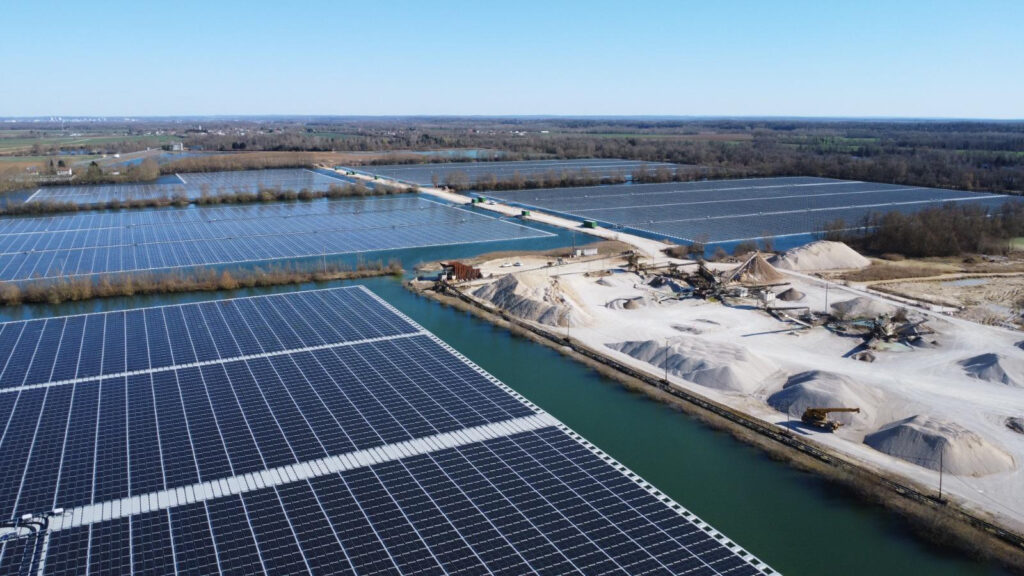
But there are virtuous cases in Europe as well. In France, there is the Les Ilots Blandin (Haute Marne) plant: opened on June 20, 2025, to date it is the largest FPV plant in Europe, built by Q ENERGY and Velto Renewables on 127 hectares of former flooded gravel pits decommissioned in 2020. A major achievement that highlights the scalability of FPV on brownfields and technological maturity. Over 135,000 PV modules distributed in six solar islands now float on these waters, with a total installed capacity of 74.3 MWp. The energy produced will be enough to provide annual electricity for the needs of about 37,000 people. In the Netherlands, on the other hand, there is the Merganser offshore pilot plant, off Scheveningen, which is small in power but interesting because it allows testing the possibilities of larger plants in complex environments such as marine environments, where solid anchorages are needed. It was built by the Dutch-Norwegian company SolarDuck and Germany’s RWE.
Italy was first, then ended up at the bottom of the rankings
In this landscape, Italy is a discordant note. Yet it was a pioneer: in 2013, of 20 plants surveyed in the world, six were in our country. The cultural premises-attention to the landscape, defense of agricultural land-hinted at a natural leadership. Instead we slipped to the bottom of the rankings among advanced economies, surpassed not only by China but also by France, Germany and Spain. In France, the float generated technology exporting companies; here, without a domestic market, entrepreneurs lacked the scale to establish themselves.
The reasons are structural. Energy operators favor concentrated, high-value investments: a 1 GW gas-fired power plant is more attractive than a hundred 10 MW distributed plants. Gas, which covers about 40 percent of Italian electricity generation, continues to dominate despite high costs and inefficiencies of dozens of turbogas plants. On the ground, local protests often stop projects with no significant environmental or health impacts, even along hydroelectric reservoirs where a few hectares covered by panels are contested in the name of landscape or fisheries, after entire valleys have already been transformed by reservoirs.
Then there is the bureaucracy. Permit levels multiply and additional complexities are added for floating plants compared to onshore PV. This is not a detail: two years ago Enel Green Power proposed a 5 GW five-year plan for floating on reservoirs; so far only a few MW have been built, trapped between national regulations and regional constraints. It is the same ballast that helps keep Italy’s energy costs among the highest in Europe.
The obstacles do not end there. Hydrogeological instability, canals to be reactivated, lagoons affected by eutrophication, and poor maintenance of reservoirs and water infrastructure complicate the use of reservoirs for new plants. Meanwhile, capital and talent chase faster and more predictable contexts: large fossil or nuclear futuristic projects attract huge public resources, while abroad renewable supply chains, including floaters, find more linear authorization paths. Not surprisingly, Italian operators themselves build gigawatts outside their borders, but little or nothing at home.
Yet a way forward exists. What is needed is a national proposal that addresses water conservation and management and electricity generation together, with clear lines of development: mapping of suitable basins, shared technical and environmental standards, one-stop shops for permits, targeted incentives where the water benefit is measurable, and integration with hydropower to enhance existing connections. Floating PV is not a utopia, it is a mature technology that does what it promises: more energy, less land, more available water.