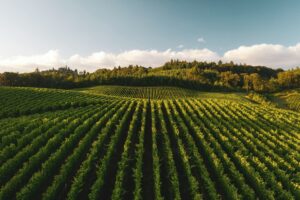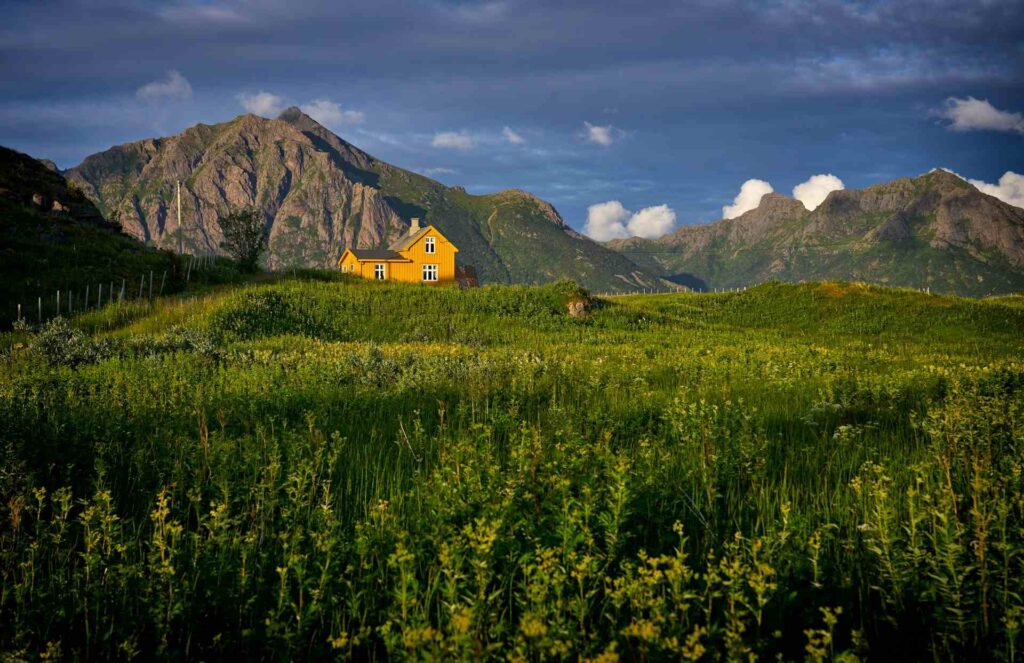
Norway and wine, until yesterday, were words that hardly ended up in the same sentence. Land of fjords, snow and northern lights, certainly not vineyards. Now, however, climate change is slowly rewriting the geography of European wine as well. In recent years, some small Norwegian farms have begun growing grapevines. An experiment that would have been unthinkable just a few decades ago. Milder average temperatures, slightly longer growing seasons, and greater attention to agronomic techniques are opening up vistas where before there were clear climatic limits.
Crops certainly do not extend as far as the eye can see as in Tuscany or Burgundy. They are niche realities, often set in favorable microclimates: well-exposed slopes, areas sheltered from the harshest winds, areas where water from the fjords helps mitigate temperature changes. In summer, then, there is no shortage of light: long northern days offer many hours of sunshine, a valuable factor in ripening grapes.
The main challenge remains cold weather. This is why producers are focusing on hardy varieties, vines selected to tolerate low temperatures and faster growth cycles. These are not always “classic” grapes: modern hybrids, less romantic in name but definitely pragmatic in the field, often come into play.
Not just Norway: wine changes latitude
The Norwegian case is not isolated. Throughout Northern Europe, viticulture is undergoing a phase of expansion. Regions that were once considered too cold are finding new opportunities, while historically vocated areas face opposite problems: excessive heat, drought, and accelerated ripening that alter aromatic profiles and wine balance.
The result is a climatic paradox in the glass: while some traditional appellations seek adaptation strategies-new altitudes, different rootstocks, variety changes-“unlikely” territories begin to produce their first bottles.
To expect powerful reds or large structures would be unrealistic. Nordic wines tend to favor freshness, acidity, and more delicate flavor profiles. Whites and sparkling wines often turn out to be better suited to local climatic conditions. It is not a matter of imitating Bordeaux or Barolo, but of building an identity of one’s own.
And this is where the issue becomes cultural as well as agricultural. Wine is tradition, territory, narrative. A Norwegian label must overcome not only climatic obstacles, but also the skepticism of a market accustomed to associating certain latitudes with certain quality standards.
Climate and terroir: an evolving concept
The phenomenon raises a broader question: what does “terroir” mean in an era of climate change? If climate is one of the foundational elements of a wine’s identity, its transformation inevitably alters the end result as well. History does not disappear, but it is transformed.
Wine, after all, has always been a dynamic product, linked to environmental variations and human adaptability. Today this dynamic accelerates. And it does so before our eyes. Norway will not become a wine superpower. Areas remain limited, volumes small, climatic conditions still complex. But that is not the point.
The interesting fact is symbolic and scientific at the same time: if grapevines take root permanently in these latitudes, it means that the climatic boundaries of viticulture are shifting. It is one indicator, among many, of a deeper change.