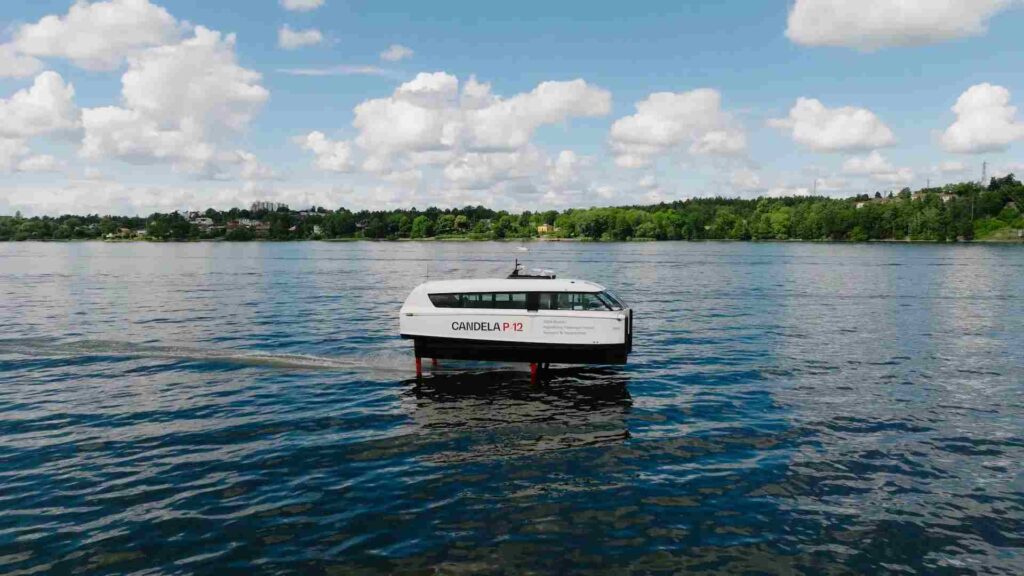
Silent, swift, almost imperceptible in its passage. For a little over a year now, a new vehicle has been plying the waters of Stockholm, changing the way thousands of people cross the city. It is the Candela P-12 Shuttle, an electric ferry equipped with hydrofoils that dramatically reduces friction, fuel consumption and wake by raising the hull above the surface. The results of the pilot project, released by the Swedish Transport Administration, tell of a successful trial: halved times and a net cut in climate-changing emissions.
A fast corridor between the suburbs and downtown
The route between Ekerö, a residential suburb to the west, and the administrative heart of the capital has become an open-air laboratory. Where it used to take about 55 minutes, it now takes just over 30 minutes. The cruising speed, allowed by a special exemption from traditional limits, has turned a slow crossing into a credible alternative to the car and clogged buses. Not coincidentally, passenger numbers have grown by more than 22 percent, a sign of latent demand just waiting for competitive service.
Less emissions, less noise
The environmental benefit is even more obvious. Data collected indicate a reduction in carbon dioxide emissions of around 94 percent compared to diesel ferries of the same capacity. An achievement that weighs in a region where public water transportation contributes significantly to the overall carbon footprint. Noise impact also drops to unusual levels for a vessel: perceived noise is equivalent to that of a car at moderate speed and becomes almost inaudible as early as 25 meters away. The reduced wakes, comparable to those of a small inflatable boat, limit bank erosion and disturbance to ecosystems.
Technology under the hull
At the heart of the system is a set of carbon fiber foils controlled by software that adjusts their tilt in real time. As speed increases, these “wings” generate lift and lift the boat, stabilizing it even in waves or wind. The dramatic reduction in drag allows longer distances to be covered on battery power alone, without sacrificing comfort and regularity of service. In addition, the required charging infrastructure is simpler than that of conventional electric ferries, lowering operating costs.
Beyond Stockholm
Replacing two diesel units with six P-12s would allow departures every 15 minutes, a 150 percent increase in capacity, and socioeconomic benefits estimated at SEK 119 million. Numbers that have attracted the attention of other cities: Berlin, Mumbai, and some tourist destinations between the Maldives and Thailand have already announced orders or plans for adoption.
In the mosaic of ecological transition, the “flying” ferry shows how purposeful innovation can reactivate forgotten infrastructure. Thus, in Stockholm, water once again becomes a fast, clean, and reliable route capable of reshaping the daily geography of urban travel.