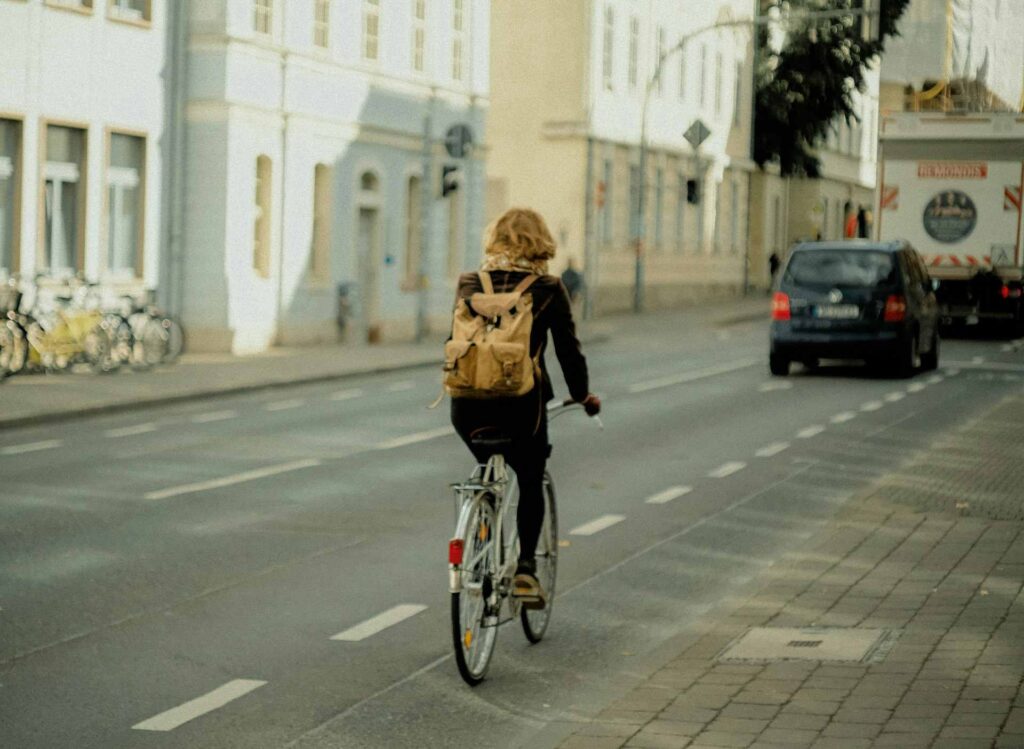
Every day millions of people cross roads designed primarily for automobiles. They walk, pedal, accompany children to school, reach work or neighborhood services moving through the most exposed spaces of urban traffic. It is on this fragile everyday life, often invisible in public policies, that the new bill presented on February 18 at the Chamber of Deputies by MP Valentina Ghio intervenes, with the contribution of FIAB – Federazione Italiana Ambiente e Bicicletta and the technical support of expert Andrea Colombo.
The text stems from a structural fact: more than 28 percent of daily trips in Italy are made on foot or by bicycle, according to the latest ISFORT Report. A share that grows especially in urban contexts, while infrastructure and rules remain strongly oriented to the movement of motor vehicles. The result is a disproportion between actual behavior and the level of protection guaranteed to the most vulnerable users.
A new hierarchy of mobility
The centerpiece of the proposal is the introduction of a mobility hierarchy based on proportional responsibility. The figure of the “stronger user,” who uses heavier, more powerful or faster vehicles, is formally distinguished from the “active mobility user.” This approach is directly reflected in the amendment to Article 2054 of the Civil Code: in the event of a collision, the driver of the heavier vehicle is held liable until proven otherwise.
A choice that aims to rebalance the balance of power in road space and encourage more cautious driving. “This bill stems from a clear fact: more and more people are choosing to move on foot or by bicycle, but often in highly vulnerable conditions. We needed an organic intervention that would update the rules and introduce a hierarchy of mobility centered on the protection of pedestrians and cyclists,” Ghio explained.
Infrastructure, speed and prevention
On the operational level, the text intervenes on some crucial nodes. Sidewalks will have to be at least two meters wide to ensure continuity and accessibility. Overtaking of cyclists will have to be done while maintaining at least five feet of distance. The installation of raised crosswalks, key tools for containing speed in the most critical sections, is simplified, while heavy vehicles will be obliged to be equipped with sensors to detect the lateral presence of pedestrians and bicycles in blind spots.
According to Luigi Menna, president of FIAB, reducing collisions requires systematic preventive action: “Limiting the speed of motor vehicles and expanding safe urban spaces for cyclists and pedestrians is the necessary condition for making cities more livable.”
National direction and dedicated resources
The proposal also introduces a new governance structure. It provides for the establishment of Cipoma, the Interministerial Committee for Active Mobility Policies, supported by a dedicated Directorate General at the Ministry of Infrastructure and Transport. To support local interventions, the National Active Mobility Fund is created, with an initial allocation of 300 million euros over the three-year period.
A specific chapter concerns education and communication: 5 percent of advertising expenditures allocated to vehicle promotion will be used for institutional campaigns on road safety and sustainable mobility. The goal is to affect cultural patterns governing the use of public space, accompanying regulatory changes with a change in habits.
Now the text begins its parliamentary journey. Political confrontation will tell whether this approach will succeed in translating into reform. At stake is a technical update of the Highway Code, but also the possibility of rethinking the way Italian cities distribute space, safety and priorities.