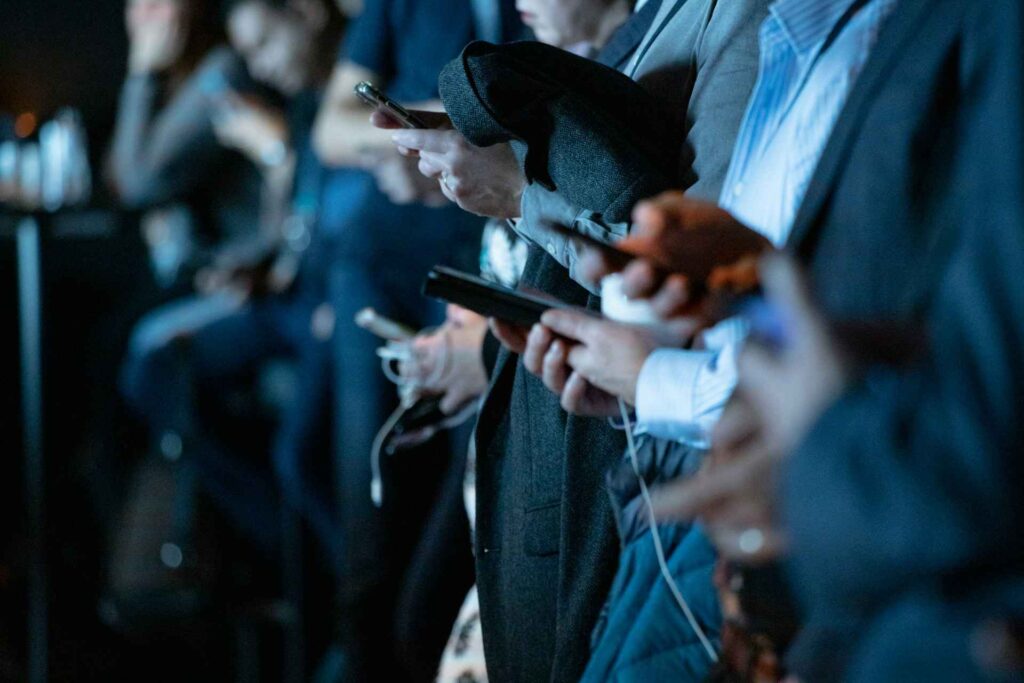
There is a gesture we all perform, dozens of times a day, without even paying attention to it: the “technology shield.” On the bus, in line at the post office, even in the elevator with the landing neighbor. The hand runs to the phone and we raise a drawbridge, between the us and the others.
Yet it is precisely in those brief, seemingly useless exchanges with those we do not know that the heart muscle of our civilized coexistence resides.
The dictatorship of silence
It’s not just a nostalgic feeling. Experts speak of a real“global relational recession,” as Viv Groskop explains in the Guardian. Psychologist Esther Perel points out how talking to strangers is a practice, a constant exercise that strengthens our social muscles. Today, however, we prefer the aseptic perfection of a touchscreen. In fast food restaurants, we order through a monitor so we don’t have to modulate our voices with a cashier; on public transportation, noise-canceling headphones scream a “don’t disturb me” even before someone opens their mouth.
The result? A generation, Gen Z, that, according to neuroscientist Jared Cooney Horvath, is underperforming cognitively. Not because they lack skills, but because they lack training in the unexpected. A conversation with a stranger is an adventure without a parachute: you don’t know what the other person will say, you can’t delete or edit your message.
The paradox of social
Then there is a dark side to the modern attempt to recover this sociality: its showiness. But real contact does not need a camera. As Gillian Sandstrom of the University of Sussex suggests, we should focus on “small humanizing acts.” A comment about the train being late, a joke about the weather that sounds cliché but is instead a bridge. These micro-moments lower society’s blood pressure and remind us that we are not alone in a sea of algorithms.
The risk of rejection vs. the risk of isolation
Why are we so afraid? We fear being pushy, looking crazy, or being rejected. But science (and a University of Virginia study confirms this) tells us that we are chronic pessimists: we overestimate discomfort and underestimate how much, in fact, a brief exchange can brighten the day — ours and others’.
Of course, not everyone wants to talk and not every time is the right time. But the point is to keep the ability to do so alive. Knowing how to read a signal, a smile or a low look is part of that human code we are losing. You don’t need a quest for world peace; a “It’s cold today, isn’t it?” is enough.
Perhaps talking to a stranger will not change our lives, but his total absence will certainly make it poorer, colder, and terribly lonelier.