For decades, the Planet’s coldest oceans have been considered an inevitably hostile realm for large predators such as sharks. Antarctic waters, lapped by the Antarctic Circumpolar Current and with temperatures near zero, seemed to be too extreme an environment for elasmobranchs. Instead, something surprised the scientists: a large shark was captured by a deep-sea camera in these very waters for the first time.
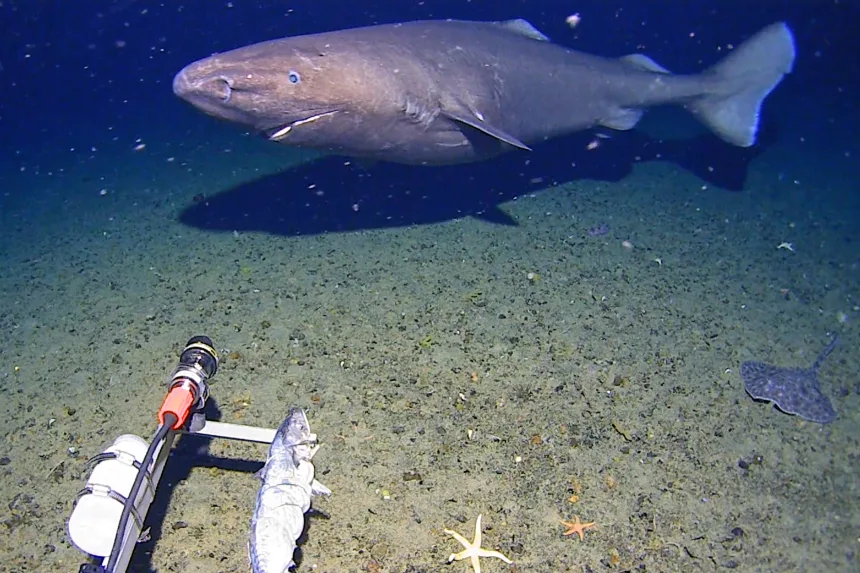
The encounter occurred during a scientific expedition in the Antarctic Ocean off the South Shetland Islands, a series of islands just north of the Antarctic Peninsula. Here an underwater camera equipped with a decoy, lowered to a depth of about 490 meters in water just above freezing point, recorded the unmistakable silhouette of a slow but massive shark moving along the seafloor. The water measured just over a degree centigrade-an environment where, until now, sharks were not thought to be found.
What makes the footage truly exceptional is not only the geographical proximity to the South Pole, the southernmost so far documented for a shark, but also the animal’s tonnage. Experts analyzing the images estimate that the animal’s body was about three to four meters long, a respectable size for a predator of these latitudes.
A denizen of the deep closer than we thought
From the visual characteristics–the stocky body, broad head and a slow gait–researchers believe it may be a “sleeping” or sleeper shark belonging to the family Somniosidae, a group of sharks known for their ability to live in deep, cold waters. Some Somniosidae species had already been recorded in sub-Antarctic waters, but this is the first time that footage clearly shows one of these animals so far south, in waters directly surrounding the Antarctic continent.
Sleeper sharks are among the least-studied large elasmobranchs on the Planet precisely because they live deep and in hard-to-reach areas. Some members of the family can reach considerable size and are capable of withstanding extreme temperatures.
What does this discovery mean?
The sighting has at least partially rewritten our understanding of where sharks can survive. Whether it is an isolated individual or a regularly occurring population in these waters is still unclear: there is little data available, and deep Antarctica remains one of the least explored environments on the Planet. Cameras installed during oceanographic campaigns operate for only limited periods, making it difficult to determine whether there is seasonal behavior or a stable pattern of presence of these predators.
Scientists are cautious: It is possible that sharks have been going that far for some time, but had never been documented due to lack of direct observations. Video baited trap technology, which has been in use for a few years, is opening a previously unseen window into the world of abyssal animals, but it still remains insufficient to paint a comprehensive picture of what lives on the Australian seafloor.
There are also those who speculate that climate change and ocean warming may alter the distribution areas of marine species, pushing originally more temperate organisms into more extreme latitudes. However, in this particular case, this remains a hypothesis to be tested: the paucity of historical data on shark species in the Antarctic Ocean makes it difficult to tell whether what has just been observed is a new phenomenon or simply never before documented.
Depth as a crossroads of discovery
Beyond the biological implications, the discovery underscores how little we know about the great seas and their most mysterious inhabitants. Each new image from the darkness of the deep tells not only about a surprising animal, but reveals a complex ecological system where predators and prey move under extreme conditions.
And if a shark can live there, under ice and frigid currents, then marine life is more resilient and surprising than we have hitherto imagined.