In a cave in Iraqi Kurdistan, a stalagmite has guarded a story for millennia that is now coming to light: that of the climatic changes that accompanied—and in part directed—the birth of agriculture. Reconstructing it is an international study led by CNR-IGG and the University of Milan, published in PNAS, which opens a previously unpublished window on environmental dynamics between 18,000 and 7,500 years ago, a decisive phase in the evolution of human societies.
Climate at the center of a momentous transformation
The stalagmite analysed preserves a continuous record of climatic variations through the end of the last ice age and the onset of the Holocene, just as the first sedentary communities appeared in the Fertile Crescent. Using refined geochemical analysis and high-precision dating, researchers have been able to draw a detailed picture of trends in rainfall, temperature, and environmental dynamics.
The most striking result is the parallelism between the climatic events recorded in Greenland’s ice and those observed in the Middle East region: wetter phases corresponded to periods of global warming, whilst cold episodes—such as the famous Younger Dryas—brought drought, accentuated erosion, and heavy dust transport. In practice, what was happening at the poles was reflected thousands of kilometres further south, profoundly affecting the living conditions of prehistoric communities.
Different human responses, same end point
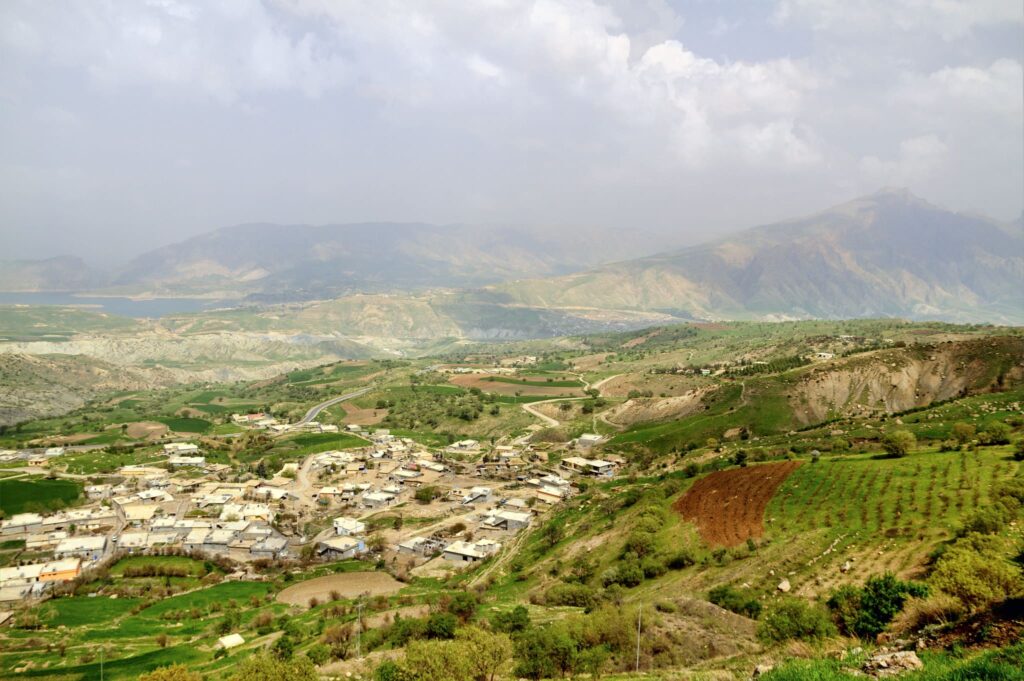
The study points out that the region’s populations did not respond uniformly. In particular, along the slopes of the Zagros Mountains—an area marked by considerable climatic variability even on short scales—communities developed mobile and flexible subsistence strategies. This was a different trajectory than in the Levant, where the transition to sedentariness occurred earlier, and was nonetheless capable of resulting, as the climate stabilised, in the emergence of agricultural settlements. This distinction is one of the central points of the research: there was no single path to agriculture, but a plurality of routes adapted to different environments.
The authors point out that this work complements and extends an earlier study from 2023 devoted to hydrological variations in the area during the first millennia of the Holocene. Taken together, the two papers provide the most extensive and detailed palaeoenvironmental series ever reconstructed for this crucial portion of the Fertile Crescent.
In addition to illuminating the origins of agriculture, the research reaffirms the importance of caves as natural climate archives, capable of returning valuable information to areas where other data are scarce or fragmentary. And it confirms the strategic role of Iraqi Kurdistan in understanding the dynamics that brought human communities from nomadism to settlement.
At a time when the evolving relationship between climate, resources and society once again takes centre stage, these 11,000 years of mineral memory remind us that adaptation has always been part of our journey. And that reading the past, etched in rock, can help us better understand the future as well.