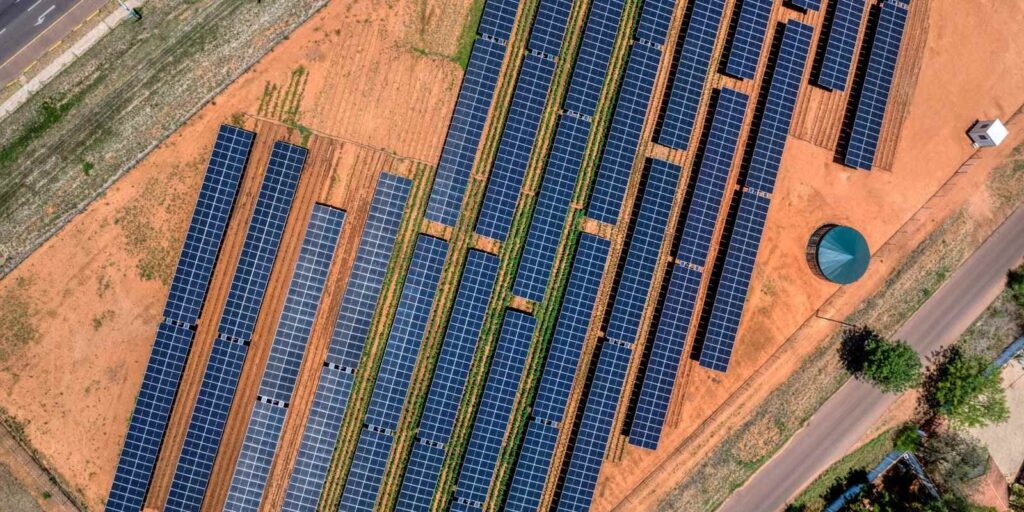
The year 2025 marks a turning point for African solar. According to the new report Africa Market Outlook for Solar PV: 2026-2029 from the Global Solar Council, about 4.5 GW of new PV capacity has been installed on the continent, a 54 percent jump from the previous year. This is the fastest growth on record, a record that also surpasses the 2023 peak and accelerates beyond mid-term forecasts.
It is not just about numbers: the data tell of a market that is changing its skin. Indeed, the push comes from two parallel transitions proceeding at different speeds but in the same direction. On the one hand, large utility-scale installations, supported mainly by public finance and development funds; on the other, a rapidly expanding galaxy of rooftop, commercial and distributed installations, financed largely by private capital, households and businesses seeking reliable and cheaper electricity.
Large markets hold, but solar expands
In 2025, the top ten countries concentrated about 90 percent of new installations, led by South Africa (1.6 GW), Nigeria (803 MW), Egypt (500 MW) and Algeria (400 MW). These are well-established markets that continue to be the locomotive. But the real news is the broadening base: Morocco, Zambia, Tunisia, Botswana, Ghana and Chad have added significant capacity, reinforcing a trend that had already emerged in recent years.
Eight countries surpassed the 100 MW installed threshold in a single year, double the 2024 mark. It is a sign that solar is no longer the preserve of a few pioneers, but is spreading more evenly, making the continental system more resilient and less dependent on individual markets.
The (underestimated) weight of distributed solar
Another key finding concerns the composition of new installations. In 2025, about 56 percent of surveyed capacity comes from large installations, while 44 percent is attributable to distributed solar. But this share, the report warns, is likely underestimated: rooftop and commercial installations are more difficult to track and often escape official statistics.
A comparison of imports and installations shows this. In 2025, Africa imported 18.2 GW of PV modules, a volume that far exceeds the utility-scale installations projected for the next two years. The gap clearly indicates that a substantial portion of the market is made up of distributed systems, mini-grids and captive solutions, driven by growing demand, fragile power grids, rising tariffs and falling technology costs.
Here the critical node emerges. The market is running, but finance is trudging along. Today about 82 percent of clean energy financing in Africa still comes from public and development sources, designed primarily for large, centralized projects. Distributed solar, on the other hand, needs different tools: smaller tickets, shorter timelines, local currency financing. Without these mechanisms, many projects remain more expensive or struggle to access credit, despite buoyant demand. Solar, especially when combined with storage, is not just a clean source, but a development infrastructure.
A decisive window toward 2030
Looking ahead, the report estimates average annual growth of 21 percent through 2029, with the possibility of exceeding 33 GW of new installed capacity by the end of the decade. But the jump is not guaranteed. Without reforms on planning, regulation and access to capital, the risk is that we will slow down just when the potential is greatest.
African solar has shown it can run. Now it is up to policy, finance and regulation to stop walking and adjust the pace. Because 2025 was the record year, but the decisive decade has just begun.