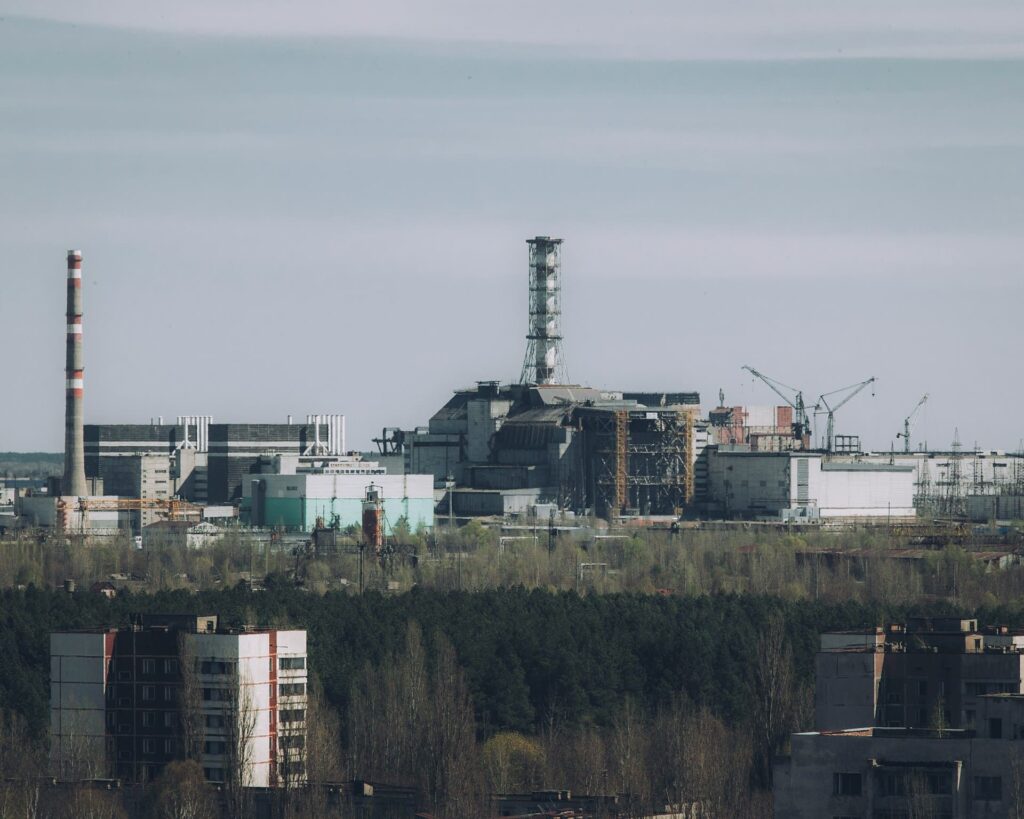
The Chernobyl sarcophagus “has lost its primary safety functions, including its confinement capacity” and needs urgent repair. This is said by the IAEA, the Vienna-based nuclear agency, which has always been cautious in its statements.
Last week, an IAEA team completed a detailed assessment of the New Safety Confinement (NSC) at the Chernobyl site, which was severely damaged by a drone attack in February. This event also caused a serious fire in the outer casing of the massive steel structure built to prevent any radioactive release from the reactor destroyed in the 1986 accident.
“The mission,” the agency says, “confirmed that the NSC had lost its primary security functions, including its confinement capability, but also found that there was no permanent damage to its supporting structures or monitoring systems.”
“Limited temporary repairs have been made on the roof, but timely and comprehensive restoration remains essential to prevent further degradation and ensure long-term nuclear safety,” said Director General Grossi.
Based on the results of the mission, the IAEA “recommends further restoration and protection work on the NSC structure, including moisture control measures and an updated corrosion monitoring programme, as well as an upgrade of the integrated automatic monitoring system of the protection structure built above the reactor immediately after the accident.”
In 2026, with support from the European Bank for Reconstruction and Development (EBRD), the Chernobyl site will undertake additional temporary repairs to support the restoration of the NSC’s confinement function, paving the way for full restoration once the conflict is over.
“At the Chernobyl nuclear power plant,” is written in a confidential IAEA report from last May leaked by Ukrainian sources, “work is underway to assess the extent of damage sustained by the New Security Confinement (NSC) following the drone attack in mid-February. Operations to extinguish the fire caused by the attack lasted several weeks. As a result of the emergency operations, about 330 holes, with an average size of 30-50 cm, were identified on the NSC’s exterior cladding. Preliminary assessments revealed significant damage. The exterior cladding’s stainless steel panels, insulation materials, and much of the membrane designed to protect against water, moisture, and air were compromised. In addition, the NSC’s main crane system, including the garage area for crane maintenance, was also damaged and is currently out of service.”
According to the findings of the May IAEA report, “the NSC’s other systems—radiation and seismic monitoring, decontamination, radioactive waste management, power supply, and fire protection—remain operational. The heating, ventilation and air-conditioning systems are also operational, but are not being used as a result of the accident,” and there is currently no release of radioactivity.
But it is good not to keep running on the edge of the abyss, not least because there is a war going on and new accidents can happen. For example, on 5 October, a sub-station in Slavuitich, which operates a 330 kW power line serving the plant, was hit and knocked out of service. For a full 16 hours the sarcophagus could only operate on two emergency diesel generators before the line was recovered. Once again it went well, but luck is not infinite.