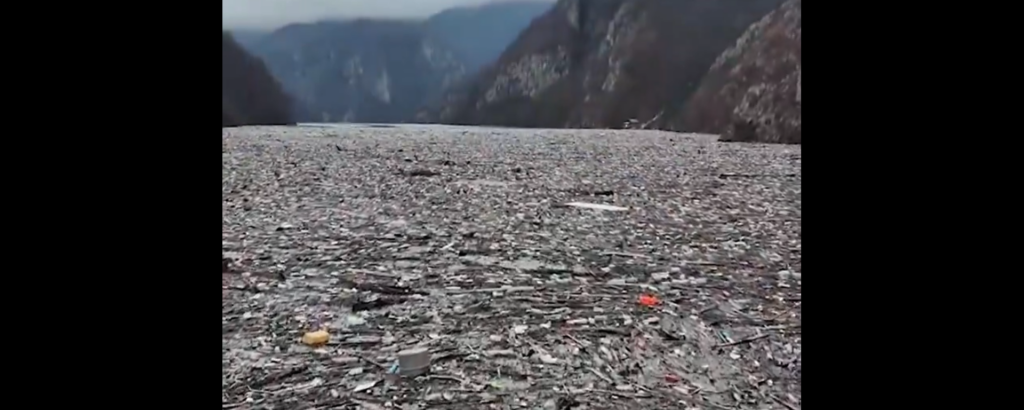
Every winter, when heavy rains and melted snow increase river flows in the Balkans, the same scene returns. In the stretch of the Drina near the Bosnian town of Višegrad, the emerald-colored water of the river turns into an expanse of floating garbage. Plastic bottles, sacks, tires, furniture, household appliances and even sanitary waste reach downstream forming a huge dump on the water. It is a phenomenon that has lasted for years and, despite political promises, continues to recur with impressive regularity.
The accumulation of waste behind the dam.
Where the problem becomes visible is at the barrier installed in front of the Višegrad hydroelectric power plant. Here the river drags everything in its path and blocks it against a protective net designed to prevent debris from damaging the turbines. Within a few weeks, a compact mass of waste forms that can reach between 5,000 and 6,000 cubic meters each season.
Cleanup requires cranes, excavators and barges that work for months. In many cases, operations last well into the summer, because the accumulated material is a huge amount and continues to arrive even as teams of operators remove it. This work has been repeated virtually every year for more than two decades.
Waste from three countries
The Drina flows through and connects Bosnia and Herzegovina, Serbia, and Montenegro, picking up numerous tributaries along the way. It is along these secondary waterways that many illegal or poorly managed landfills are found. When rains cause the rivers to swell, the water drags waste from the banks and carries it into the main course.
Trash can travel dozens of kilometers before stopping at the barrier near the dam. The result is a kind of “floating garbage dump” that covers the surface of the river with plastic, wood, metals, and objects of all kinds, including rusty barrels or household appliances.
An ecosystem under pressure
The Drina is one of the most important rivers in the Balkans. Over 340 kilometers long, it flows through a mountainous region rich in biodiversity and is known for its clear waters and tourist activities such as rafting and fishing. The presence of tons of waste therefore poses a double problem. On the one hand it endangers the river ecosystem and fish fauna, and on the other it damages the local economy based on nature tourism. In addition, part of the recovered waste is often burned in local landfills, with the risk of releasing toxic substances into the air.
A political problem before a technical one
For many environmentalists, the root cause is not technical but political. Institutions from the three countries meet periodically and announce cooperation programs, but on the ground results remain limited. Activists have been complaining for years about a lack of coordination and political will in combating illegal dumping and improving waste management in rural areas.
Possible solutions are well known: map illegal dumping sites, install barriers and surveillance systems along tributaries, improve collection systems, and above all, strengthen cross-border cooperation. Without upstream action, local associations explain, any cleanup operation risks being only temporary.
The environmental challenge of the Balkans
The case of the Drina has become one of the symbols of the environmental difficulties of the Western Balkans, a region that is trying to move closer to the European Union but has yet to catch up with major delays in waste management and water protection.
Meanwhile, work continues along the river to clear the barrier of the mountain of plastic and debris accumulated over the winter. But without structural intervention upstream next winter will bring with it the same spectacle: a river that instead of flowing free seems to be turning, once again, into a floating garbage dump.