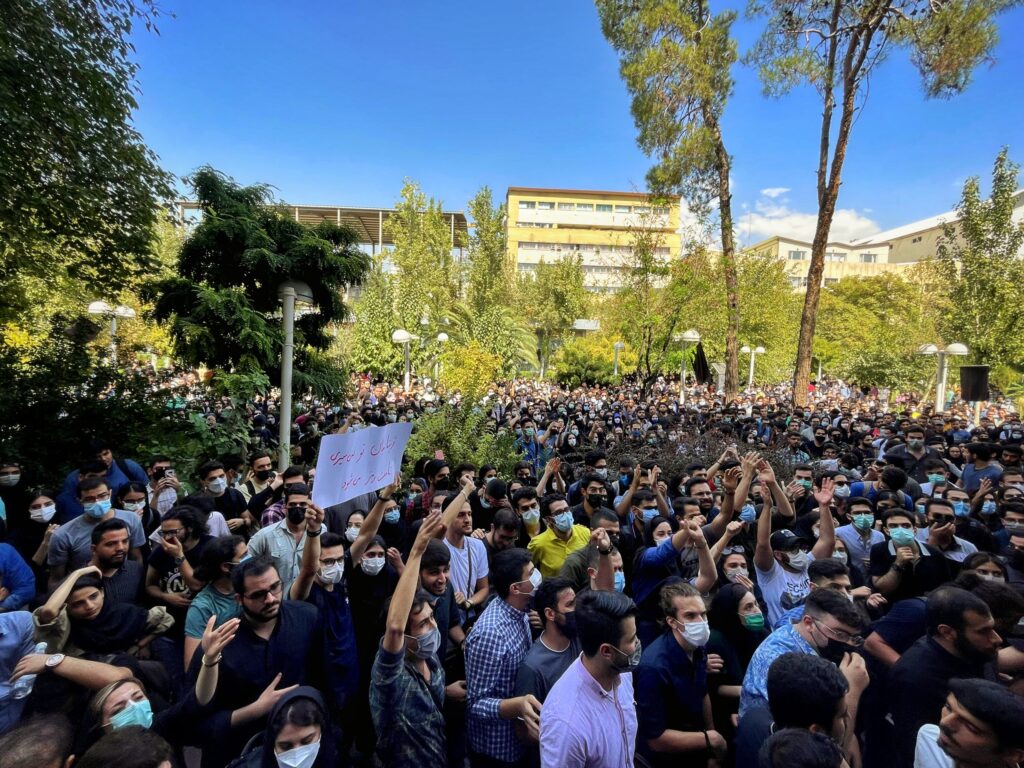
In late 2025 and early 2026,Iran returned to the streets, with demonstrations that saw tens of thousands killed under the extremely harsh crackdown by the regime led by Ayatollah Ali Khamenei. The country, already shaken by protests that erupted in 2022 after the death of Mahsa Amini, now faces an emergency that goes beyond economics and politics: an ecological crisis in which drought, soil subsidence, and air pollution are turning cities and countryside into hostile spaces for life.
Today’s demonstrations are no longer just demanding bread or civil liberties: they are demanding the right to breathe, to walk on stable ground, and to live a viable future. The ecological crisis is intertwined with the economic crisis: the collapse of the currency, galloping inflation and the prices of essential goods have impoverished the middle class, while the poorest families face increasingly extreme living conditions. The protests are thus an alliance of different social classes, united in the struggle for survival.
The Sinking Country
According to the National Cartographic Center, some areas of Iran are losing up to 30 centimeters of soil per year, a rate 40 times higher than the average for developed countries. Isfahan and Tehran show deep cracks in bridges and historical monuments, visible signs of cultural as well as physical collapse. Urban areas such as Varamin and Shahriar are also experiencing subsidence on critical infrastructure such as airports, railways and refineries. National aquifers show a deficit of 130 billion cubic meters, aggravated by inefficient agriculture and energy-intensive industries. Inter-regional water transfer projects generate tensions between provinces and increase the risk of local conflicts.
Toxic air and blackouts
Air pollution is now chronic. Although Iran possesses the world’s second-largest gas reserves, a shortage of clean gas has forced industries and households to burn mazut, a highly polluting fuel. Emissions of sulfur oxides can exceed 10 times legal limits, and in some cities “breathable air” days fall below five a year. According to the Ministry of Health, about 30,000 deaths a year are attributable to air pollution. Prolonged blackouts cripple elevators, water pumps, refrigerators and digital networks, disrupting citizens’ daily lives and incomes.
Social decline and food crisis
The ecological crisis also threatens food security. The drying up of more than 1.5 million hectares of oak trees in the Zagros Range and the transformation of grasslands into deserts have reduced natural water and soil filtration, increasing erosion and contamination. Every year about 100,000 hectares of farmland and pastures are at risk of becoming deserts, with an erosion rate three times the global average, the highest among Middle Eastern countries. The loss of fertile soil corresponds to 10-15% of GDP, national wealth dispersed by erosion. The urban middle class sees the value of their homes shrink, while traditional farmers and ranchers become “soldiers” of the urban periphery, deprived of resources and future.
The new paradigm of protests
The 2026 protests mark a paradigm shift: they are no longer episodic struggles, but a defense of the right to exist in a habitable territory. Each protester is part of an alliance against a ruthless adversary: land that dries up, air that kills, and infrastructure that gives way. In the absence of international investment and real strategies for the climate crisis, silence is no longer just poverty: it is death. In Iran, breathing, walking and living become political actions, and survival has become the most powerful of protests.