And so the“garbage panda” has entered the living room. It’s not just a joke: in the United States, raccoons(Procyon lotor), known to us as wash-up bears, are indeed making a curious evolutionary and cultural leap from garbage cans to home sofas. Telling the tale is a study published in Frontiers in Zoology that notes how urban life is changing not only the behavior but even the appearance of these animals.
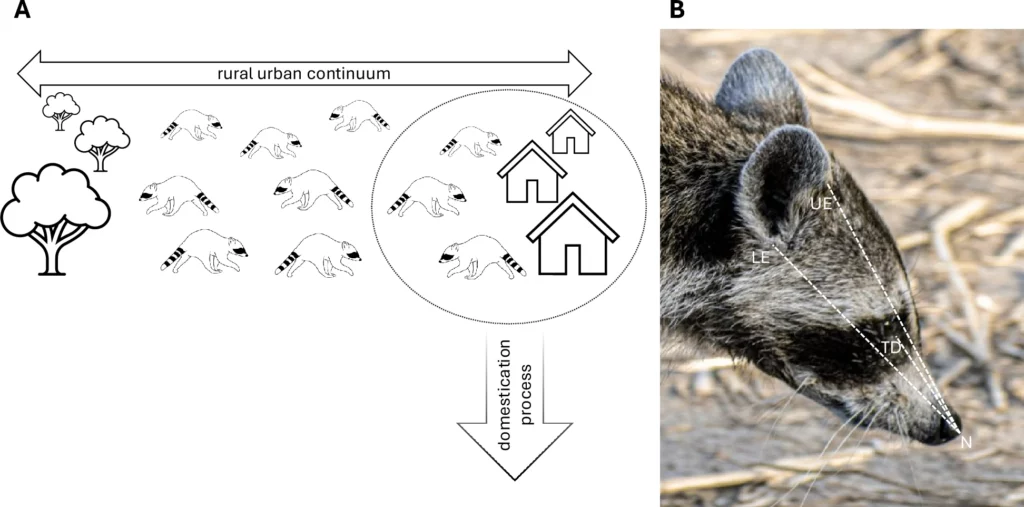
According to researchers analyzing nearly 20,000 photographs, raccoons living in the city show a reduction in snout length compared to their country “cousins.” This is far from a trivial detail: it is the same kind of morphological change that zoologists associate with the early stages of domestication of dogs and cats. In other words, constant proximity to humans would be selecting individuals who are less wary, more tolerant and — incidentally — “cuter” in our eyes.
The driving force behind this transformation, the authors explain, is trash. “Garbage is really the spring,” Raffaela Lesch, co-author of the study and a researcher at the University of Arkansas, tells Scientific American. Wherever there are humans, there is easy food, and wildlife knows that. But taking advantage of it requires a fine balance: bold enough to rummage through bins, not so much that they become a threat and end up driven away (or worse).
This is where what scientists call “attenuation of the flight or fight response” comes into play: the calmer, less aggressive or fearful animals are the ones that are better able to coexist with us. In the long run, this selective pressure can produce the so-called “domestication syndrome phenotype,” a package of traits that includes shorter faces, slightly smaller brains, changes in pigmentation and other changes already known in domesticated animals.
The story of urban raccoons is also interesting because it overturns a widely held belief: domestication would not always and only be a human-driven process. On the contrary, it could begin spontaneously, when some species adapt to the human environment and are “rewarded” by natural selection. Only at a later stage – if at all – do humans actively intervene.
A few interesting facts help to understand why raccoons in particular are so good at this game of adaptation. They are considered among the most intelligent mammals in North America, endowed with extremely sensitive and almost “manipulative” forepaws, capable of opening simple locks, containers and-as many U.S. citizens are well aware-apparently animal-proof garbage cans. Ethology studies have shown that they possess remarkable memory and problem solving skills comparable to those of some primates.
This does not mean, however, that they are ideal pets. In the United States, their presence still oscillates between two extremes: social media stars and cuddly mascots in some neighborhoods, stubborn pests in others. Moreover, close coexistence with wildlife always carries ecological and health risks for both animals and people.
Still, the parable of the urban raccoon remains an excellent example of how our cities are now true ecosystems, capable of influencing the evolution of the species that inhabit them. And perhaps, the next time we hear a suspicious noise coming from the bin under our house, we can ask ourselves if we are not witnessing – live – a new chapter in the long history of domestication.