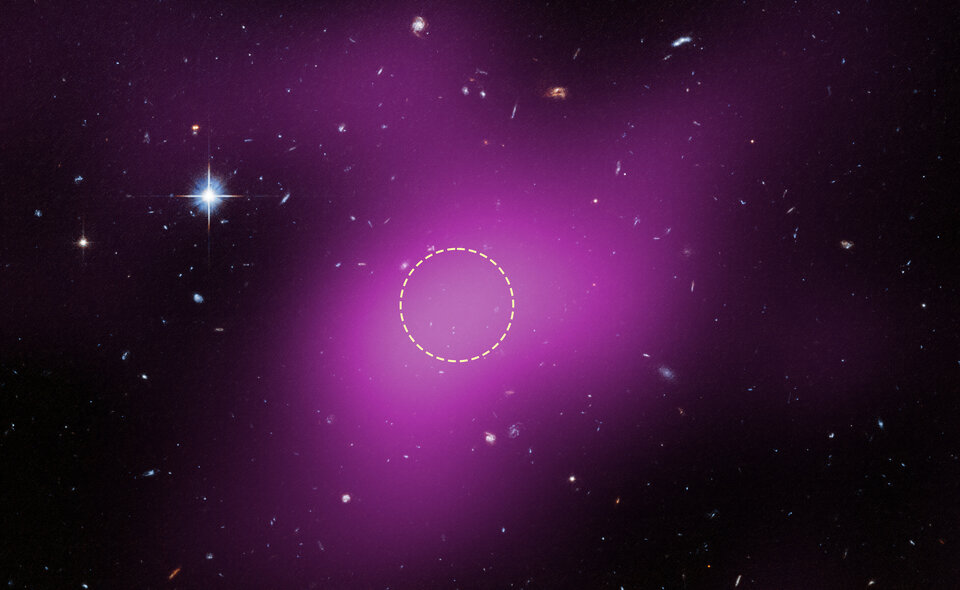
About 14 million light-years from Earth, something has been detected that until now existed only in theoretical models. Close to the spiral galaxy M94 is Cloud-9, an astrophysical object that looks like a galaxy but is, in fact, not a galaxy. It does not shine, emits no visible light and does not even contain a star. This is why it has been dubbed the first “ghost galaxy” ever observed.
The discovery came about almost by accident: an investigation that was not looking for Cloud-9 turned into one of the most important confirmations in recent years for modern astrophysics. Leading the study was University of Milan-Bicocca Physics Department researcher Alejandro Benítez-Llambay, along with an international team of researchers. The results were published in The Astrophysical Journal Letters.
An invisible but real cloud
Cloud-9 was first detected in 2023 by the Chinese FAST radio telescope, which detected faint radio emission from neutral hydrogen, the simplest and most abundant gas in the universe. Subsequent observations with the Very Large Array-a network of large radio antennas working in the United States as a single, giant telescope-confirmed that the object is at the same distance as M94.
The cloud is far from small: it spans about 4,500 light-years and contains a mass of hydrogen comparable to that of many dwarf galaxies. Yet when astronomers pointed the Hubble Space Telescope at its location, the result was surprising. After more than 13 hours of observations, no trace of stars emerged.
“We got confirmation that despite its mass and the presence of gas, Cloud-9 is not a galaxy: not a single star shines in this area,” the researchers explain. The analyses rule out with very high probability the presence of even an extremely faint dwarf galaxy.
When gravity is not enough
Cloud-9 belongs to a category predicted by standard cosmological theory called RELHIC: hydrogen clouds limited by reionization. Simply put, these are dark matter halos that have almost everything they need to become galaxies, except for one key thing: the ability to ignite stars.
According to the ΛCDM model, the universe is dominated by dark matter, which forms invisible structures — halos — within which gas can collapse and give rise to galaxies. But there is a critical mass threshold. If a halo is too light, ultraviolet radiation produced by the Universe’s first stars heats the gas and prevents it from contracting.
Cloud-9 is located exactly in this boundary zone. It is massive enough to hold the gas, but not massive enough to overcome the pressure exerted by the cosmic radiation background. The result is a “stuck” object: full of dark matter and hydrogen, but doomed to remain forever in the dark.
A key test for the cosmological model
The ratio of gas to stars in Cloud-9 is extreme: for every unit of stellar mass there are hundreds of gas, which is enormously higher than in known dwarf galaxies. This makes Cloud-9 a unique case and direct evidence for the existence of failed galaxies.
But its value goes beyond curiosity. Cloud-9 represents an unprecedented natural laboratory: a simple object, devoid of the complex processes associated with star formation, ideal for studying the distribution and nature of dark matter on small scales.
The ghost galaxy, invisible to the eyes but perfectly real, thus becomes a fundamental key to understanding where galaxies are born, where they fail and, ultimately, how the universe we live in is structured.