See under methane. In the study of emissions that increase the greenhouse effect, methane, whose molecule has
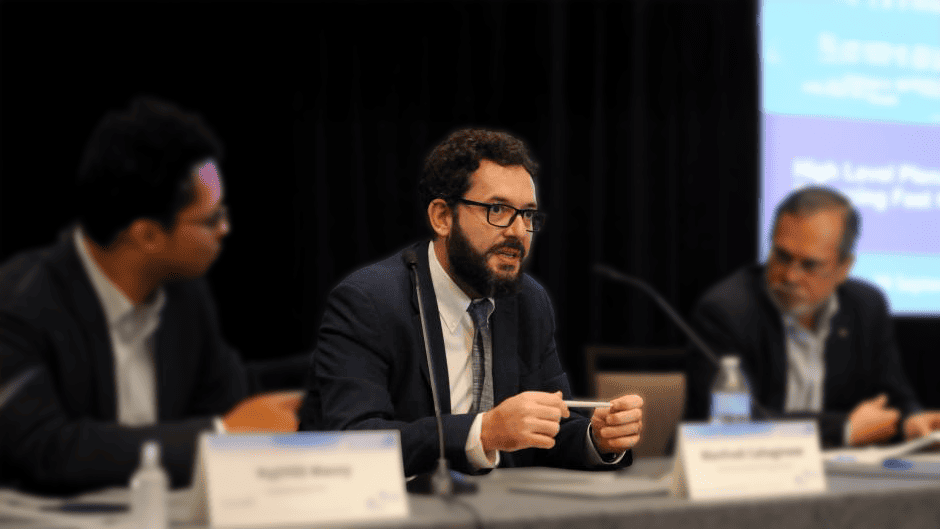
Manfredi Caltagirone, who passed away this spring at the age of less than 50 from pancreatic cancer, was the director of UNEP’s International Observatory on Methane Emissions and fought for transparency and a scientific approach to the methane issue, influencing the first EU legislation on methane emissions and shaping global energy policy.
“A gifted climate specialist who was determined to make a real difference,” notes Inger Andersen, executive director of UNEP, “Manfredi understood that urgent action on critical priorities such as methane could be critical to a safer world. As head of the International Methane Emissions Observatory and UNEP’s Methane Alert and Response System, Manfredi created a community of partners who promoted solutions in difficult and complex areas. He is greatly missed.”
Those on his team describe him with regret and affection. “Manfredi,” recalls Giulia Ferrini, his deputy and now leading the observatory, “was a charismatic guy, passionate about Rome and Roma, great sense of humour and great determination. He had been at UNEP since 2012, after a parenthesis at the Italian Ministry of the Environment. He first worked on clean energy technology transfer to reduce climate-changing emissions, then moved on to non-CO₂ greenhouse gases, including methane. He was always a determined man who had a strong ideal motivation with which he spurred on his colleagues. He often reminded us how little time was left until 2030 when there was a deadline for the methane pledge, the commitment made at COP26 by 156 countries to reduce methane emissions by 30 per cent.”
“We started working together 10 years ago,” his deputy continues, “and there have been many steps forward, he understood that it was important to work with the oil and gas sector to reduce emissions, and so in 2021, thanks to the decisive push of the European Commission, which funded him, a dream of his came true: an observatory, the IMEO, was born, which now has 80 experts, has relationships with 150 global oil companies, and relies on a network of sensors, including satellite ones, which has allowed for a much more accurate picture of methane emissions.”
In 2013 it was a very niche topic, and the big companies themselves underestimated the problem even from an economic point of view: reducing fugitive methane emissions also means avoiding the dispersion of an economic resource, as well as making a valuable action in the fight against climate change. “They were telling us,” Ferrini recalls, “but are we really losing all this money? It was like this. We would show them the data and they understood that it was in their interest to take action.” And they understood because whilst classic reports were based on estimates, Manfredi Caltagirone’s team, a team in the beginning of just a few people, was and is working with real measurements—it was therefore much more credible. “We,” explains Giulia Ferrini, “used to send and even more today send teams of researchers into the field, source by source, and they make measurements to understand the magnitude of the problem, which we have thus seen to be far greater than expected: every time we measure we always find many more emissions than expected, say three to eight times more.”
“Manfredi,” Ferrini concludes, “understood before others that effective reduction of methane emissions is the greatest opportunity for rapid action to reduce global warming. We provided policymakers and climate scientists with much more accurate data. All this work has also helped in the drafting of the European methane legislation on the basis of which from 2027 those who want to export gas to the EU will have to comply with stricter rules. Of course, it is not only his merit, it was a collective effort, but a slice of the credit also goes to him. That’s why the award is more than deserved.”
But Manfredi to the awards, especially in memory, would have preferred results in the field. “UNEP,” promises Inger Andersen, the agency’s executive director, “will honour his legacy by continuing to promote rapid reductions in methane emissions.” And that is what matters most (on a par with the Scudetto to Roma, say Manfredi’s collaborators, who have made his irony their own).