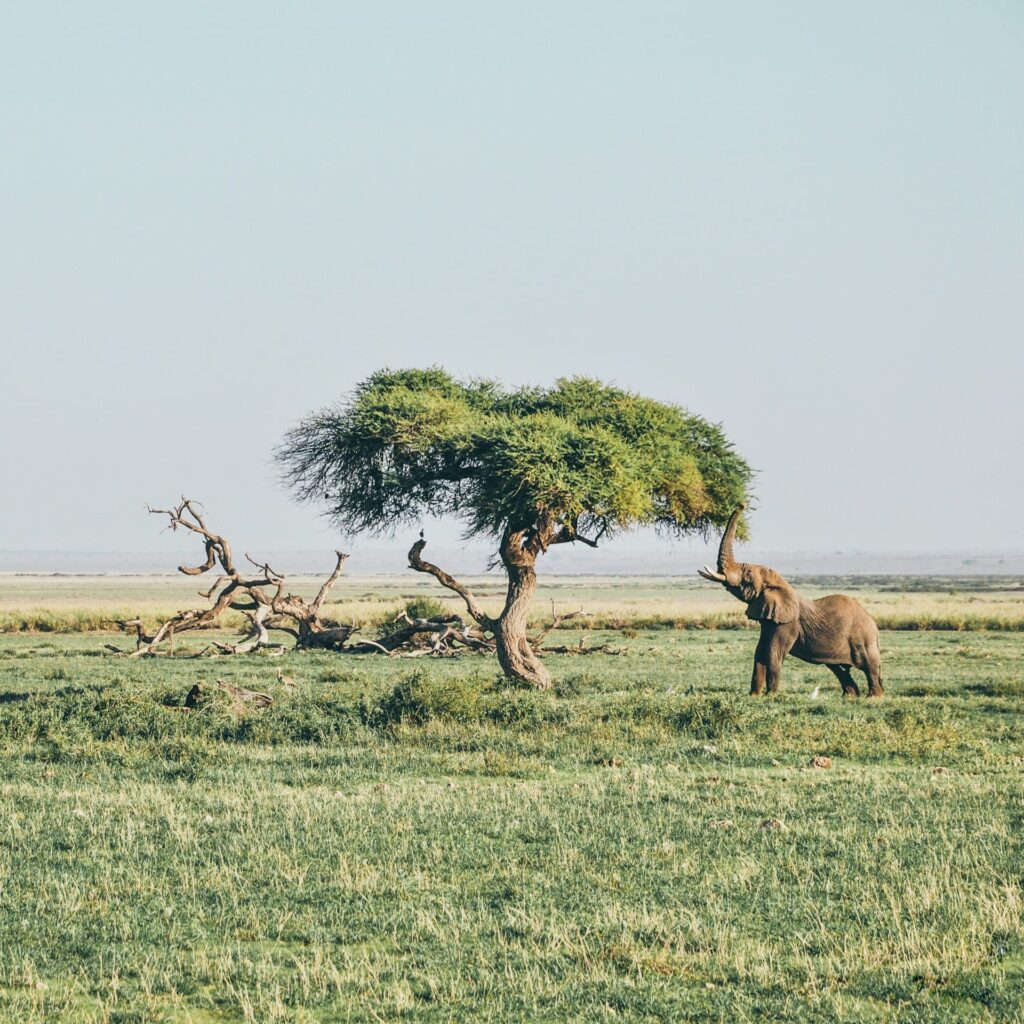
For 40 years Kariba has crossed borders without ever leaving captivity. From Zimbabwe to Europe, from one zoo to another, her existence was punctuated by transfers decided by others and by enclosures that were always too narrow for an animal that, in the wild, travels dozens of kilometers a day. When she found herself alone again in 2022, in Belgium, her story ceased to be just an individual story and became a collective question: where can an adult elephantess raised in captivity go, on a continent that has always been able to exhibit elephants but never offer them a place really thought of?
The answer is taking shape in Alentejo, southern Portugal. Here Pangea is preparing to open Europe’s first sanctuary for elephants from zoos and circuses in 2026: not a park, not a zoo, but a space designed to give back time, land and relationships to animals that cannot return to the wild.
A European vacuum that has become structural
Large elephant sanctuaries exist in Africa, Asia and the two Americas. In Europe, no. Or at least not until now. Yet hundreds of elephants still live in facilities that struggle to meet their physical and social needs, or that would like to stop holding them without, however, proposing viable alternatives. It is into this unresolved space that Pangea fits.
The project is promoted by the nonprofit Pangea Trust, active as a charity in the UK since 2017 and as a Portuguese organization since 2022. It aims to work with zoos, circuses, and institutions seeking a better solution for animals in need: elephants left isolated, from circuses in countries where the use of wild animals is banned, or from facilities in economic crisis.
Why the Alentejo
The choice of site was not random. Pangea Trust conducted a Europe-wide feasibility study, evaluating different countries based on criteria such as climate, availability of large areas, ecological value, accessibility, and long-term sustainability. Alentejo met all these requirements.
The sanctuary covers about a thousand acres between Vila Viçosa and Alandroal, in an area characterized by rolling hills, diverse habitats, and low density of human infrastructure. A setting that provides privacy and tranquility, central elements for animals that often come from decades of forced exposure. The Mediterranean climate also allows elephants to live outdoors for much of the year, moving, foraging and socializing more naturally.
Kariba, the first step
Kariba will be the first female elephant to arrive at Pangea. Her story spans four decades of European captive wildlife management: orphaned in Zimbabwe in the 1980s during an ivory culling campaign, she was transferred as a cub to Germany and then moved between different zoos. By 2012 she had arrived in Belgium, where she found a form of stability alongside Jenny, an elephantess from the circus. Upon Jenny’s death, Kariba returned to live on her own.
It was then that the Pakawi Park team, with the support of the Belgian NGO Gaia, began looking for a new home. Pangea emerged as the only European option that could offer space, companionship and a long-term project.
A different life
Supported by organizations such as Born Free Foundation, Fondation Brigitte Bardot, World Animal Protection and Olsen Animal Trust, Pangea does not promise a return to wild life. It openly acknowledges that for most elephants raised in captivity this is not possible. The goal is to provide living conditions that meet their complex needs: space to move, choices, compatible social relationships.
Elephants will progressively have access to up to 85 percent of the property, with connected habitats and rotations allowing them to explore different environments. Management will be exclusively by the protected contact method: operators and elephants always separated by barriers, no forced contact, no dominance-based training. This is the standard recommended by Eaza guidelines and is already adopted by landmark sanctuaries such as The Elephant Sanctuary in Tennessee and the Elephant Sanctuary Brazil, models from which Pangea draws inspiration.
A relationship to be rebuilt
The project also has an explicit environmental dimension. The partly degraded land will be restored according to rewilding principles, with benefits for local biodiversity. The goal is to create as stimulating an environment as possible for elephants and observe how they interact with a Mediterranean ecosystem, adapting management based on scientific data. Not a final solution, but a finally structured answer to a question that has been left hanging for too long.