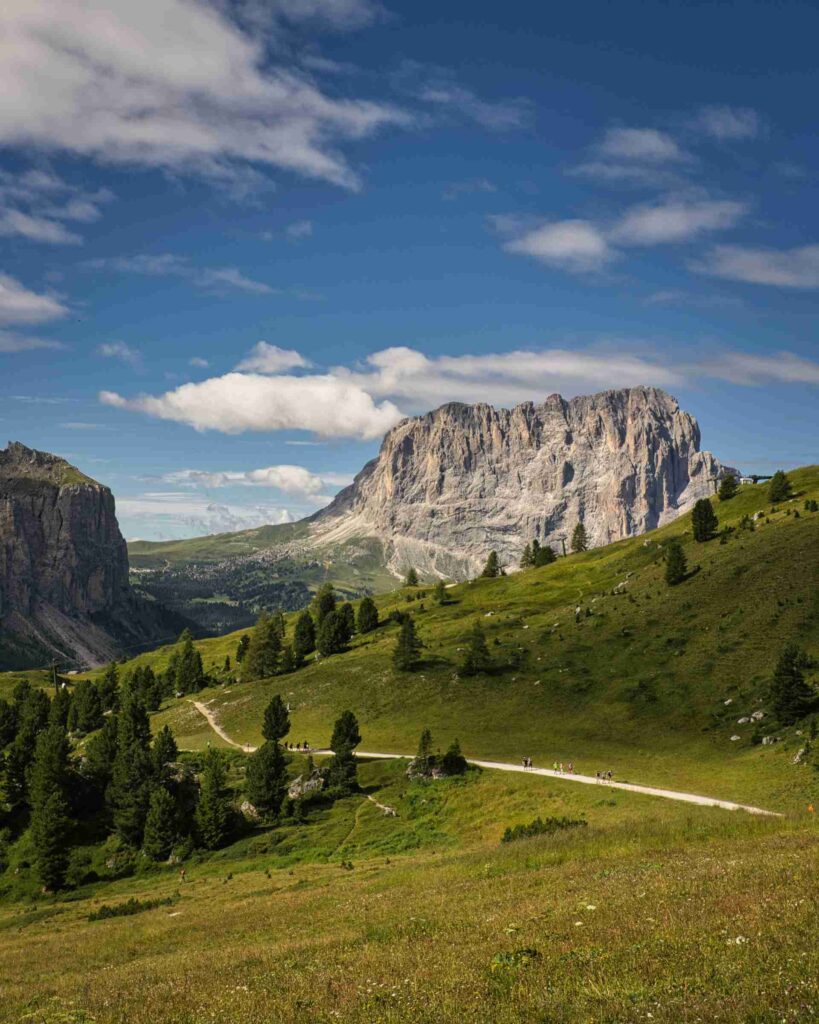
A small revolution is brewing at the Gardena Pass. One of the busiest passes in the Dolomites, a crossroads between Val Gardena and Val Badia, could become a traffic-restricted zone from 2027, with regulated access and greatly reduced during the busiest months. The proposal, which local newspapers such as Alto Adige and other media in the area have been talking about in recent hours, stems from a fact that over the years has become increasingly difficult to ignore: on peak days even 11,000 vehicle passages are exceeded, with a clear impact on landscape, air quality and overall livability.
Reduced access and online reservations
The idea is to intervene decisively, without half-measures. From May to October, traffic would be limited almost exclusively to residents of the two valleys, while access by car would become restricted for visitors. The number of available spaces would be reduced to about 150 parking spaces, all of which would be paid for and bookable online. A deliberately low threshold, designed to discourage private car use and drastically reduce pressure on the pass.
There would still remain some exemptions for those who work in the area, for services and for guests of accommodations along the pass, but the general principle is clear: reverse the current logic, in which the car is the easy choice.
Alongside the bans, the project focuses on strengthening public transportation. The goal is to ensure frequent connections between the valleys, with buses every 15 to 20 minutes during peak travel times. A system that should also integrate with the ski lifts, offering a real alternative to those who today move exclusively by car. Those who will continue to choose the car, on the other hand, will have to factor in longer routes, passing through other passes such as the Sella or Pordoi.
Tourist pressure on the Dolomites
The measure is part of a larger picture. In recent years, the Dolomites have become one of the symbols of Alpineovertourism, with steadily growing numbers and pressure that is increasingly difficult to manage. It is no coincidence that interventions are multiplying: access restrictions, reservation systems, tickets and flow adjustments. However, the Gardena Pass represents an additional step, because action is being taken on one of the main connecting routes and not on a single vantage point.
The project has been finalized at the local level, but it will have to go through the Autonomous Province of Bolzano. And this is where the most delicate game will be played. On the one hand there is the need to protect a fragile and increasingly exposed environment, and on the other the fear of penalizing a tourist economy that has built its strength precisely on those flows.The risk, also raised in the local debate, is that of an increasingly regulated and less accessible mountain. But the alternative, now evident, is to let the numbers continue to grow unchecked.
A possible model
If approved, the Gardena Pass Ztl could become an important precedent for other Alpine areas as well. In any case, the management of tourist flows no longer appears to be an issue that can be postponed. And perhaps, between hairpin bends and postcard views, this is where the future of the mountains lies: less traffic, more rules, and a balance that can no longer be taken for granted.