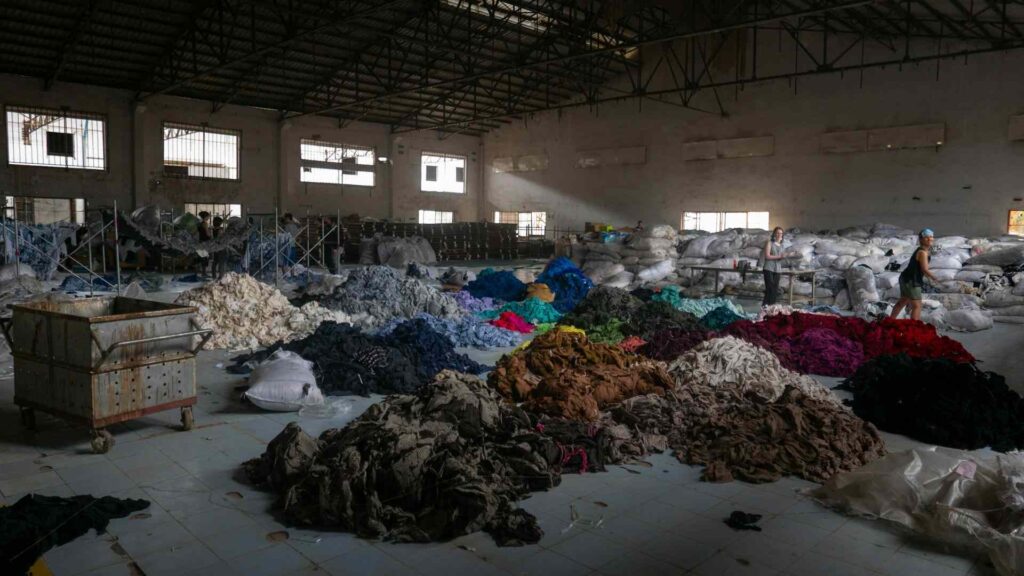
For years it has remained an almost invisible practice, confined to a gray area of budgets: eliminating new garments that were never sold. Today that gray area comes into the crosshairs of Brussels. Under new European Ecodesign rules for sustainable products, from July 19, 2026, large companies will no longer be able to destroy clothes and shoes left in stock. It’s a paradigm shift for an industry that has built part of its balance on overproduction.
From “burning to protect” to “managing to enhance“
The logic that has held up until now is well-known: defend brand positioning, avoid devaluations, make room for subsequent collections. The result, however, has been an environmental short-circuit. According to European Commission estimates, millions of tons of textiles end up in the waste stream in the EU every year; a significant share is still perfectly usable. Meanwhile, global production continues to grow, driven by fast fashion and increasingly rapid cycles. The ban aims to disrupt this linear pattern – produce, sell, dispose – by requiring companies to rethink product planning and end-of-life.
The new regulations do not just ban destruction. They introduce reporting requirements: companies will have to declare how much surplus they generate and how they manage it. This is a cultural revolution before it is a regulatory one. Because what is not measured is usually not governed. And so far, numbers on unsold inventory have been patchy, when not entirely absent.
Those who change right away
Implementation will be gradual. Large companies will have to adapt first; medium-sized companies will have more time, while many small businesses will be exempt. The goal is to prevent the organizational burden from crushing those with fewer resources, while maintaining pressure on the largest waste generators.
If destroying is no longer an option, overproducing becomes more expensive and risky. This is where the standard can trigger real change. There is growing interest in rental, certified resale, repair, reconditioning. No longer green niches, but segments destined to weigh in the bottom line. In parallel, ecodesign is pushing toward more durable, repairable and recyclable garments: design and sustainability are beginning to speak the same language.
The waste knot remains, but the signal is stark
No one thinks a ban is enough to solve the textile emergency. Accumulated waste, mixed fibers that are difficult to recycle, and opaque global supply chains remain open problems. But the political message is clear: excess is no longer just a logistical issue, it is an environmental and industrial issue.
From 2026, what happens in warehouses will no longer be an internal affair. It will become one of the fashion industry’s key indicators of sustainability. And, perhaps, also a credibility test for brands that have long chronicled their green commitment.