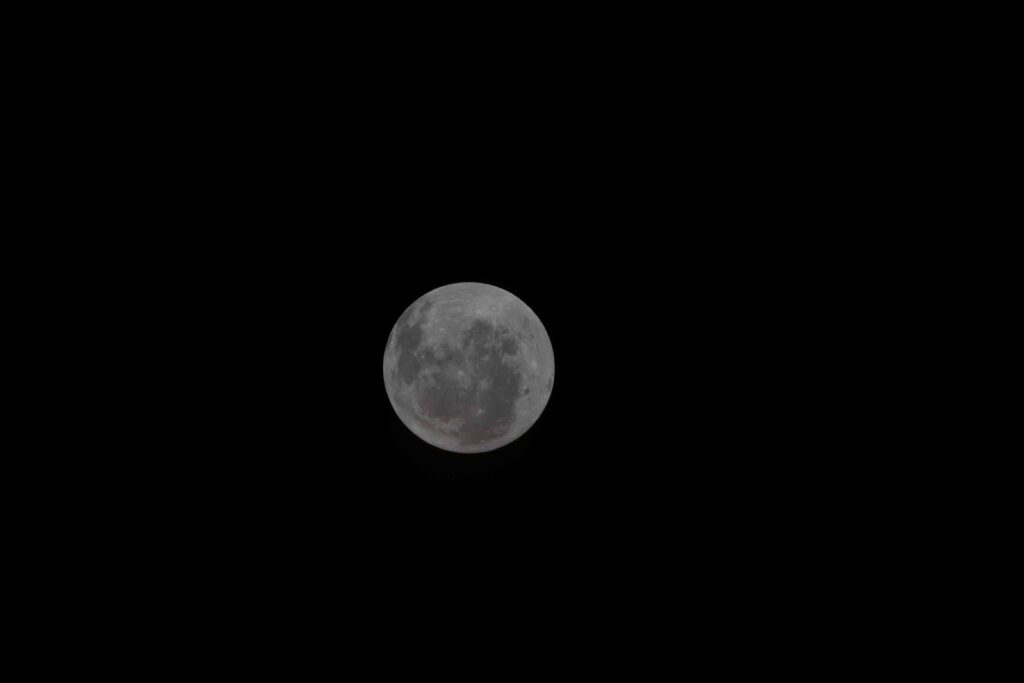
As you are reading this article, four human beings are hurtling through deep space at a distance of more than 400,000 kilometers from us. They are the crew members of the Artemis II mission, who yesterday, April 6, accomplished a feat that has been missing for more than fifty years: flying over the Moon, and in particular its hidden side, the side that remains constantly invisible from Earth.
Why the “hidden side” is so special
Because of a phenomenon called synchronous rotation, the Moon always turns the same “face” toward Earth. For us, the other half has always remained a mystery, observable only by probes. Yesterday, for the first time since 1972, human eyes looked directly at it.
Canadian astronaut Jeremy Hansen confirmed that the landscape is very different from what we are used to: the hidden side is more rugged, lacking those large dark patches (the lunar “seas”) that we see from home, and has a much thicker crust and dense craters. It is, for all intents and purposes, a geological record of the history of our Solar System.
The 40 minutes of silence
The most critical moment occurred during the passage behind the lunar disk. At that stage, the Moon’s mass blocked all radio signals: the astronauts were completely isolated from the world. As Orion slipped into the shadows, the crew witnessed first an “Earthset” – the Earth slowly setting beyond the lunar horizon – and then, after about 40 minutes of tension-filled silence, the Planet’s sunrise: an “Earthrise” that also brought back with it Christina Koch’s voice: “Houston, Integrity, communications check.” The Orion spacecraft – christened for this mission Integrity – was safe and sound.
The “Integrity” and “Carroll” craters.
During scientific observations of the Eastern Basin (a giant impact structure about 3.8 billion years old), the crew spotted two craters not yet surveyed and asked to name them. The first, near the Eastern Basin on the far side of the Moon, will be named Integrity, after their ship. The second is on the boundary between the visible and hidden sides: it will be Carroll, in memory of Commander Reid Wiseman’s wife, who passed away in 2020 after a five-year battle with cancer.
What happens now
The success of the mission was also celebrated by the White House. President Donald Trump congratulated the crew, confirming that the ultimate goal remains to establish a fixed base on the Moon and then aim for Mars. The crew also had the privilege of observing a total solar eclipse from their prime position in space, with the Sun disappearing behind an almost completely dark lunar disk, leaving only the solar corona visible. The astronauts are now on the return trajectory, using the momentum imparted by the flyby to head home.
The re-entry
The date with history is for this Friday, April 10, when the Orion capsule will ditch in the Pacific Ocean off San Diego. It will be the end of a journey of 10 days and about 1.1 million miles-and the new all-time record for distance traveled by humans in space, snatched from Apollo 13, which reached 248,655 miles from home in 1970-but only the beginning of a new era of exploration.