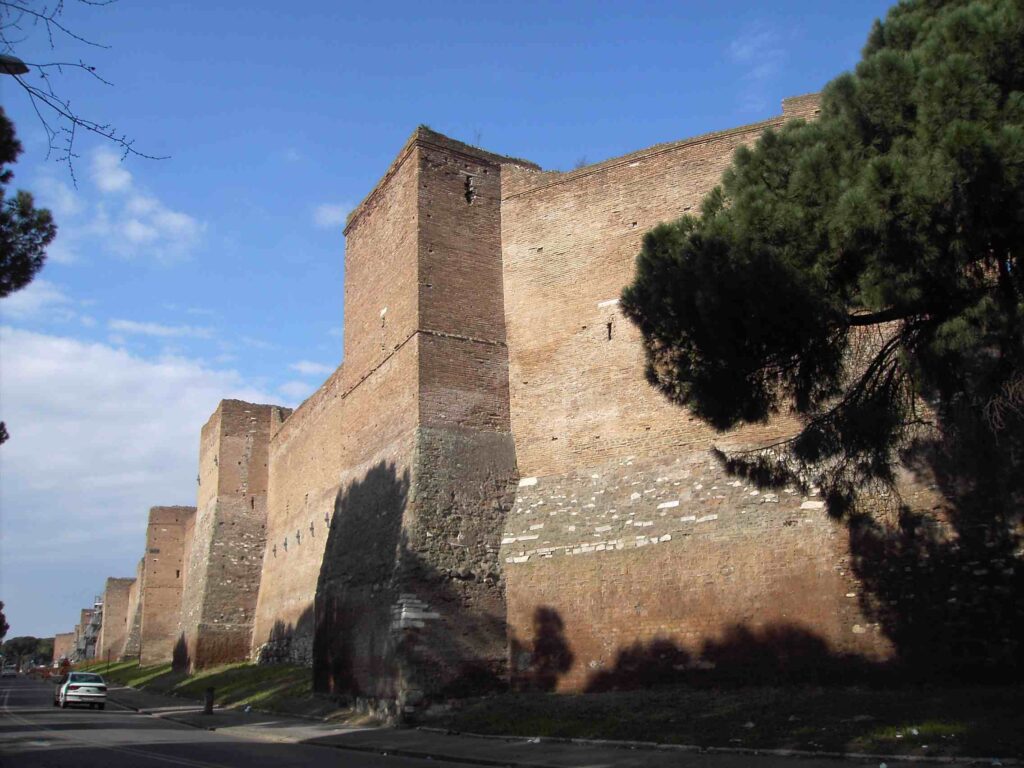
Rome may soon be telling one of its most impressive stories not inside a building, but by traversing the city. This is the idea behind the project of a widespread museum dedicated to the Aurelian Walls, which takes shape from four symbolic gates: Porta San Sebastiano, Porta San Paolo, Porta San Pancrazio and Porta Pia. Four gateways, four epochs, a single narrative spanning almost eighteen centuries of urban history.
The proposal originated in academic and scientific circles, and was put down on paper during a conference promoted by the three Roman universities together with the Capitoline Superintendence. The goal is to transform some of the most significant gates of the Walls into stages of a museum itinerary capable of restoring meaning, continuity and visibility to a monument that, despite being among the largest and best preserved in antiquity, often remains on the margins of the daily gaze.
The narrative thread
The narrative thread would start from Porta San Sebastiano, one of the oldest gates, linked to the original construction of the Walls in the 3rd century AD, and then move on to Porta San Paolo, which recounts the evolution of the imperial and medieval city (as well as one of the most important pages of resistance to the Nazi occupation). Porta San Pancrazio would open a window on the 19th century and the season of the Roman Republic of 1849, while Porta Pia would close the route with the turning point of Rome as capital after 1870.
It is not, however, a matter of “embalming” the Walls or turning them into a relic to be observed from a distance. On the contrary, the idea is to make them a living, accessible cultural infrastructure, integrated into the urban fabric and everyday life. The gates would become places for storytelling, education, and dissemination, but also points of orientation and recognition in a city that is often difficult to read.
12 kilometers
The cultural project is inevitably intertwined with an urgent structural issue: preservation. Of the original 19 or so kilometers of the city walls, today little more than 12 remain, often resting on fragile soils, subject to seepage, subsidence and environmental stress. Climate change, pollution, traffic vibrations and historically patchy maintenance have turned the Walls into a vulnerable giant.
Something has moved in recent years, thanks in part to NRP funds, which financed six interventions on different stretches totaling about 2.5 kilometers. A step forward, but still insufficient compared to the scale of the problem and the archaeological complexity of the sites. Work is proceeding, not without difficulty, amid delays, urban construction sites and interference with private property that in some cases even prevents access to the wall faces.
The widespread museum, in this sense, would not only be a cultural operation, but also a governance tool: making the Walls visible means making them defensible, monitorable, and recognized as a collective heritage. New technologies can also play their part, from three-dimensional surveys to satellite analyses that already measure millimeter displacements and structural deformations.