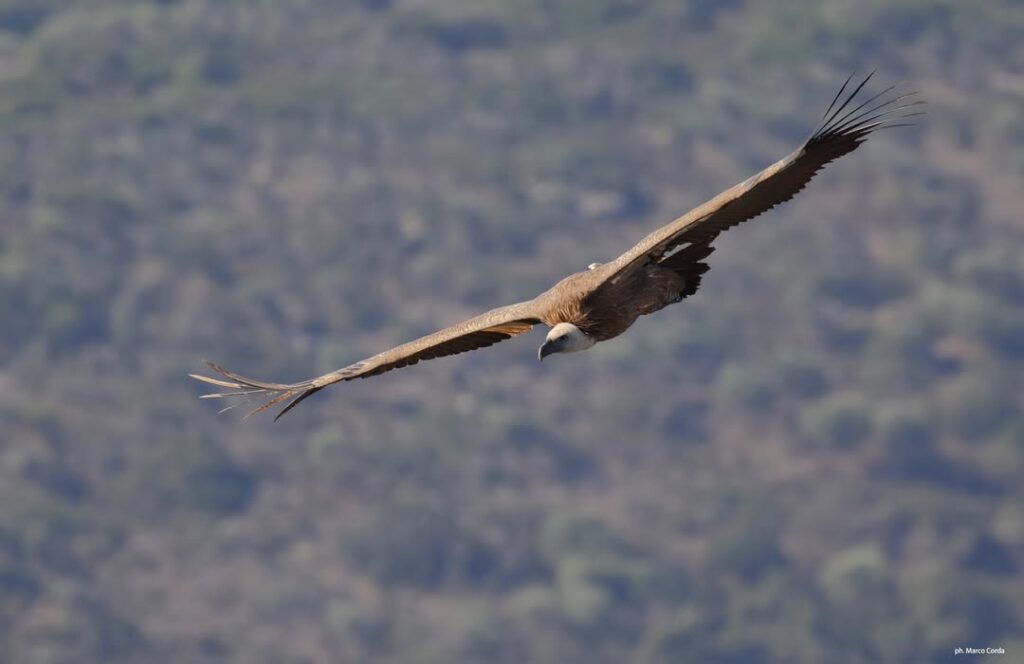
In 2014, Sardinia watched with concern the griffon vulture’s downward parabola. The island population, reduced to about sixty individuals, was confined to a few cliffs between Bosa and Alghero. Today the scenario has profoundly changed: the 2025 census photographed a presence of between 516 and 566 individuals, an increase of more than 21 percent in a single year. A result that places the island among the most significant cases of wildlife recovery in Italy.
The numerical figure alone does not restore the complexity of the journey. Behind the growth is a long-term strategy that has combined direct interventions on the species and constant work on the causes that had led to its decline: accidental poisonings, scarcity of food resources, disturbance at nesting sites, electrocution along power lines.
The changing map
The most significant change concerns distribution. Whereas until a few years ago almost 90% of Sardinian griffon vultures were concentrated in the Bosano, today the population has spread over several areas. Sixty percent remain in the historic core, but the Meilogu now hosts almost a quarter of the individuals, while new stable presences have been detected in Sarrabus-Gerrei and other areas in the central-south. Geographic expansion is a decisive indicator because it reduces the overall vulnerability of the species and strengthens its resilience in the face of critical local events.
This redistribution has been fostered by a network of farm carnai, controlled feeding stations that ensure safe and continuous food, and by targeted release programs of young griffon vultures from rehabilitation centers, mainly in Spain. An action that has allowed the species to colonize territories that had been abandoned for decades.
The thrust of reproduction
Reproductive data in particular contribute to the growth. In the northwest of the island, the only ascertained nesting area, 120 territorial pairs were surveyed, an increase of 14.3 percent over the previous year. Deposition and fledged young also grew, while postnatal mortality declined. For the first time, 100 pairs are exceeded in the Bosano, a symbolic threshold that certifies the consolidation of the colony.
There is no lack of signs of genetic integration: pairs formed by native individuals and reintroduced individuals, as well as griffon vultures recovered and cared for after accidents, have successfully completed the breeding cycle. A biological mosaic that reinforces the variability and future stability of the population.
A model of conservation
The path that led to these results begins with the European project Life Under Griffon Wings and continues with Life Safe for Vultures, active until 2026. In addition to restocking, interventions have included securing power lines, awareness campaigns on the use of lead-free ammunition, and extensive monitoring, carried out with coordinated teams and simultaneous observations to avoid duplicate counts.
This large necrophagous bird performs a crucial ecological function, helping to remove carcasses and reducing the spread of pathogens. Its return signals an overall improvement in environmental balances.
The challenge now is to maintain the trend and accompany the expansion to new nesting areas, until a widespread presence is rebuilt over the entire island.