Aviation is often cited as one of the most difficult sectors to decarbonize. Too many planes, too many distances, few ready technological alternatives. Yet a new analysis published in Nature Communications Earth & Environment makes an interesting provocation: pollution could be cut in half without reducing the number of passengers carried, simply by flying more efficiently with the tools already available today. The crux is not technological, but operational and especially economic.
The study looks at about 27 million commercial flights in a single year, carrying nearly 3.5 billion passengers, and measures how much CO₂ is emitted per kilometer and per passenger. The result is surprising: for the same distance, some flights get to emit nearly 900 grams of CO₂ per passenger and kilometer, while others fall below 30 grams. A difference of almost 30 times, which does not depend on whether a flight is “necessary” or “unnecessary,” but on how it is organized. In theory, all it would take is to concentrate supply on the best aircraft, fill flights more, and rethink the use of space on board to dramatically reduce the industry’s climate impact.
The critical points
The problem is that this climate rationality clashes with business rationality. On the one hand, airlines have no interest in giving up business and first class. Those wide, widely spaced seats with only a few per row are a climate disaster because they multiply emissions per passenger by as much as 8-10 times compared to a well-filled economy seat. But they are also a gold mine: on many intercontinental routes a small share of premium passengers generates a decisive part of the profits. Giving them up would mean radically changing the revenue model.
On the other hand, there is the fleet issue. Flying with new generation aircraft allows immediate fuel consumption reductions of up to 15-20% per single flight, but it requires huge investments and long lead times. Many companies therefore prefer to continue using older, already depreciated, though less efficient aircraft. From a corporate balance sheet point of view, this is a rational choice; from a climate point of view, it is not. Environmental inefficiency, in short, is not a distraction: it is often a calculated decision.
Contrails
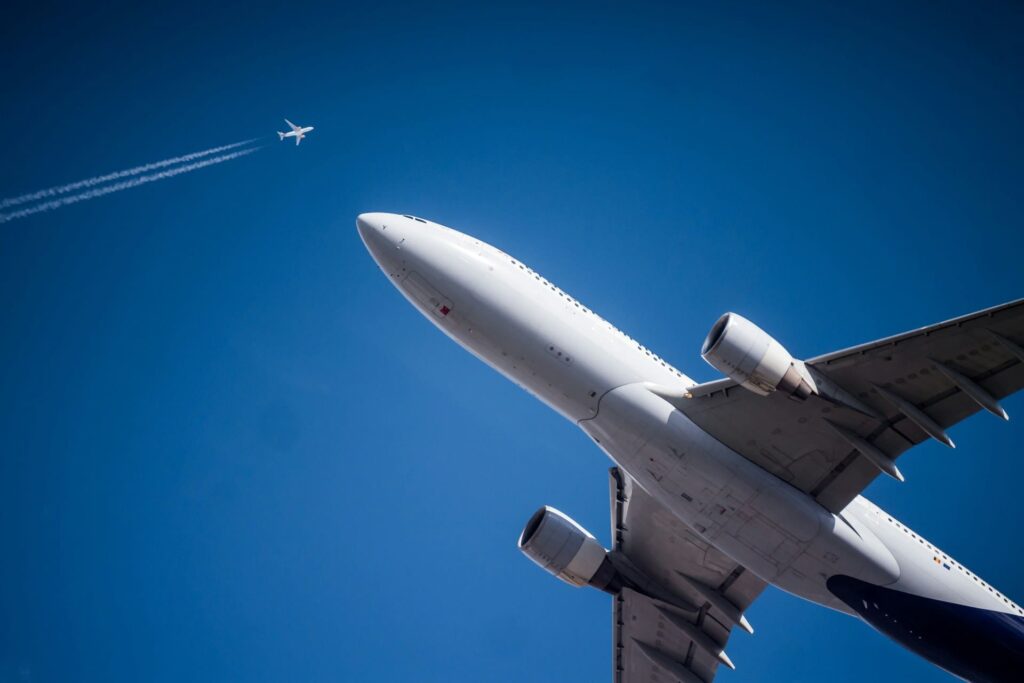
Then there is another little-known aspect that weighs on the climate, besides CO₂: condensation contrails, so-called contrails. They are those white streaks we see behind aircraft at altitude. They form when water vapor from exhaust gases freezes into ice crystals and, under certain atmospheric conditions, remains in the sky for hours. These contrails function like a blanket: they trap heat radiated from the Earth and contribute to global warming. In some cases, their overall climate effect can be comparable to that of the CO₂ emitted by the flight itself.
What is interesting is that contrails can also be reduced with more intelligent flight management. Small changes in altitude or route, avoiding atmospheric layers most conducive to their formation, can limit their persistence without significantly increasing fuel consumption. Here again, however, coordination, planning and public direction are needed, which is still weak today.
In short, aviation could pollute much less already, but doing so would mean rehashing established business models. The halving of emissions assumed by the study is obviously virtual because it does not take into account the economic viability of the model. But even partial optimization would yield important results. And, in combination with the technological leaps in experimentation today, it could profoundly change the overall picture. The entire industry could be reoriented to offer more advanced services at lower environmental costs. But it would need a clear regulatory framework and medium-term goals. Today we are navigating by sight. In a dark sky where the priority of climate defense, a common interest of humanity, is in danger of being erased.