Trillions of insects move every year following precise routes, crossing geographic boundaries that, until recently, seemed out of their reach. It is only now, as a recent Guardian in-depth report recounts, that science is beginning to focus on the true extent of these journeys.
Clouds over the mountains
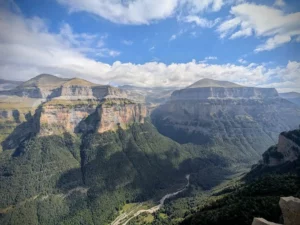
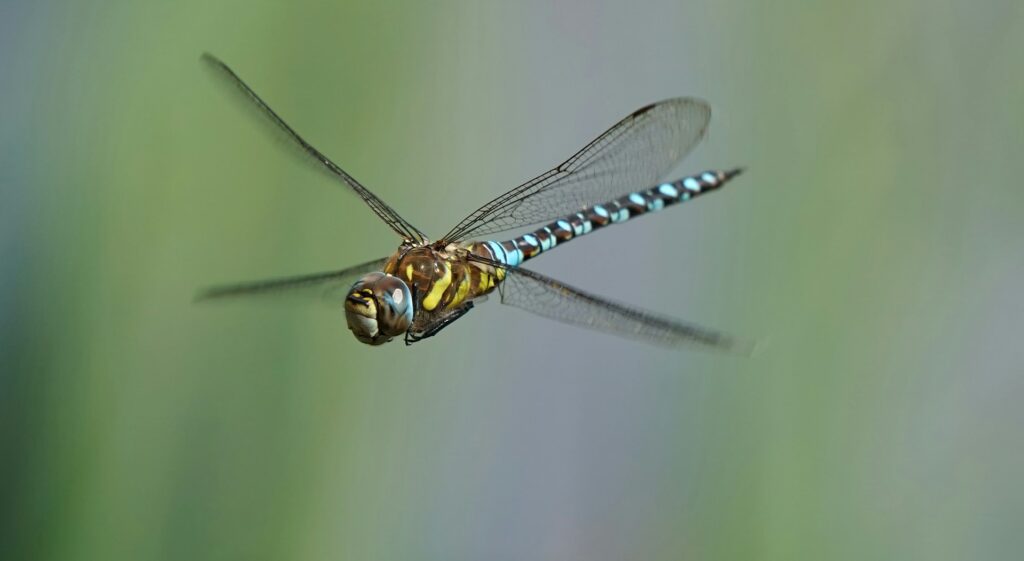
The image that opens this story comes from afar: Pyrenees, 1950s. On a mountain pass, two researchers observe for hours a steady stream of insects. Butterflies, then dragonflies, then a myriad of tiny midges move in an organized, directed current.
Today we know that kind of “living cloud” is far from rare. Recent studies have counted millions of insects transiting the same crossings each year. A mass migration that for decades remained on the fringe of research, too vast to be measured and too minute to be obvious.
Butterflies, much further than we imagine
Among the most surprising discoveries is the one involving the painted lady. A butterfly capable of traveling thousands of kilometers, eventually connecting Europe, Africa and South America.
The turning point came from a chance observation: specimens found on the other side of the Atlantic, where they should not have been. From there, patient work between genetics, isotopic analysis and pollen study reconstructed the journey: more than 7,000 kilometers, propelled by the winds.
They don’t fly all the time. They let themselves be carried. It is a refined energy strategy: harnessing currents to cover impossible distances with their strength alone. A balance between autonomy and dependence on the atmosphere that resembles navigation more than flight.
Sailing at night, reading the sky
If some species rely on the winds for their journey, others rely on an even more surprising system. Bogong moths, in Australia, migrate each year following a precise route. And they do so at night, using the sky as their map.
Experiments have shown this in an almost theatrical way: by changing the arrangement of stars, insects lose direction. The Milky Way, for them, is a bright guide line. When it is not visible, another invisible compass takes over: the Earth’s magnetic field.
A network that holds ecosystems together
These movements are a biological infrastructure. Most migratory insects are pollinators: they carry pollen for hundreds of kilometers, contributing to the genetic diversity of plants.
Others regulate agricultural balances by feeding on pests. Still others become a food resource for birds and mammals. It is a moving chain, linking distant environments together. In some cases, its importance is revealed when it fails. The collapse of bogong moths, for example, had direct effects on species that depend on them for food. A sudden vacuum that spreads.
The paradox of discovery
There is one element that runs through all this research: it comes late. Or rather, they come at a time when insect populations are declining dramatically. Climate change, intensive agriculture, habitat loss, and pesticide use are reshaping these routes, when they don’t wipe them out altogether. Some studies speak of impressive declines in a few decades.
So as we learn to recognize these invisible highways, we also realize how fragile they are. It is not just a matter of numbers, but of connections: disrupting these flows means altering balances that sustain entire ecosystems.
Learning to see the invisible
Perhaps the greatest difficulty is precisely this: becoming aware of something we cannot see. Insects have always migrated, but they do so out of our field of vision, at altitudes and scales that elude everyday experience. Technology – radar, genetic analysis, atmospheric patterns – is finally making this movement visible. But awareness lags behind.
To look up, even to imagine this silent traffic, is already a first step. In that continuous flow, light and tireless, flies a decisive part of the Planet’s balance.