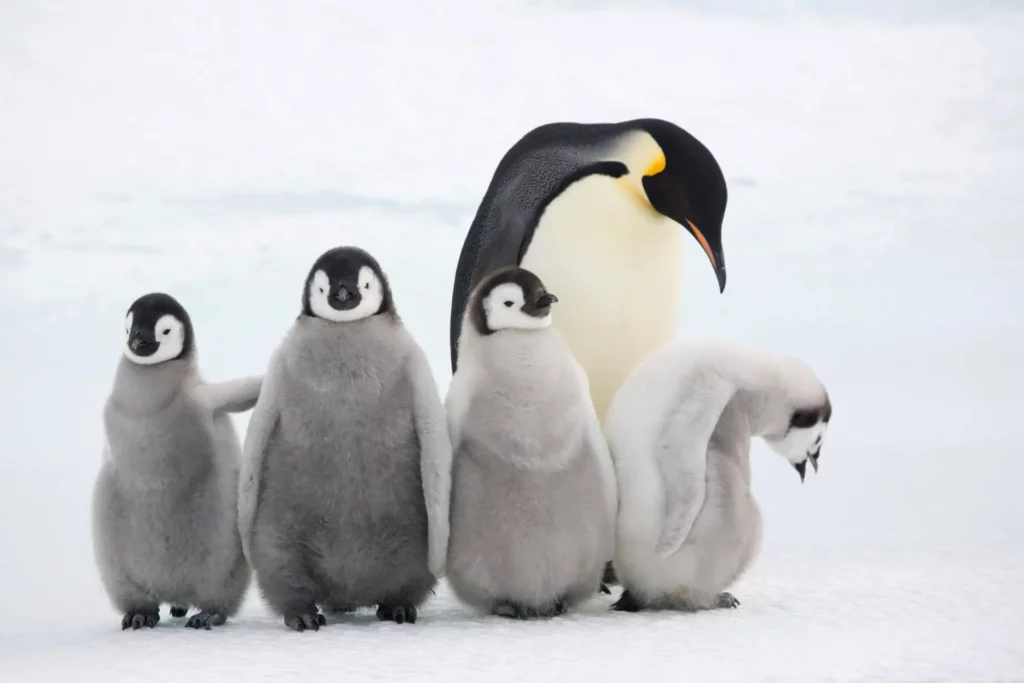
Antarctica has become a fragile system marked by rapid changes that leave no escape for the most specialized species. Among them is the emperor penguin, now officially listed as “endangered” by theInternational Union for Conservation of Nature (IUCN). Soaring chick mortality linked to ice melt and ice floe collapse is rewriting the fate of the species.
When the ice gives way too soon, the chicks die: without waterproof plumage and unable to swim, they drown or freeze.
The ice that no longer holds
For nine months of the year, emperor penguins depend on “stable ice” (fast ice), that which is anchored to the coast. This is where they nest and raise their young. Since 2016, however, the extent of Antarctic sea ice has hit historic lows, meaning that the white blanket forms late, is thin and breaks up early.
In 2022, four out of five nesting sites in the Bellingshausen Sea collapsed, leading to the death of thousands of chicks. A similar event had already occurred in 2016 in the Weddell Sea. Researchers call these catastrophes “bleak and distressing,” terms rare in scientific rigor that testify to strong concern about a system losing its equilibrium.
Numbers and projections
The global emperor penguin population is estimated at about 595,000 adults. There was a 10 percent decline between 2009 and 2018, but IUCN projections indicate a halving by 2080. The mechanism is linear: less ice means less habitat; less habitat means fewer young reaching adulthood. When entire generations vanish, recovery becomes mathematically unlikely.
Martin Harper, chief executive officer of BirdLife International (the world’s largest bird protection federation), explained to the Guardian, “The classification as an endangered species is a warning that climate change is accelerating the extinction crisis before our eyes.”
A sentinel species
The emperor penguin is a “sentinel species”: its status anticipates what will happen to the entire ecosystem. Philip Trathan, a marine ecologist, explained to the British newspaper that anthropogenic global warming is the main threat, as it affects not only reproduction but also the feeding and moulting of these birds.
Indeed, ice decline triggers a domino effect. Antarctic fur seals have halved in number since 1999 (944,000 adults in 2025) due to the reduction of krill, the base of the food chain. Without krill, whales also suffer. Added to this are health threats: avian influenza recently killed more than 90 percent of pups in some southern elephant seal colonies.
Accountability and policy
Reducing CO2 emissions is the only way to stabilize glaciers. In addition to decarbonization, they call for listing the emperor as a “specially protected species” in the Antarctic Treaty to limit tourism and shipping, although these are palliatives to the global climate crisis.
The fate of the species will be decided in the coming decades. If emissions continue at current levels, the decline will be irreversible. The emperor penguin is the test case for the international response: the causes are known and the consequences visible. The challenge is to preserve minimum living conditions in one of Earth’s most extreme ecosystems.