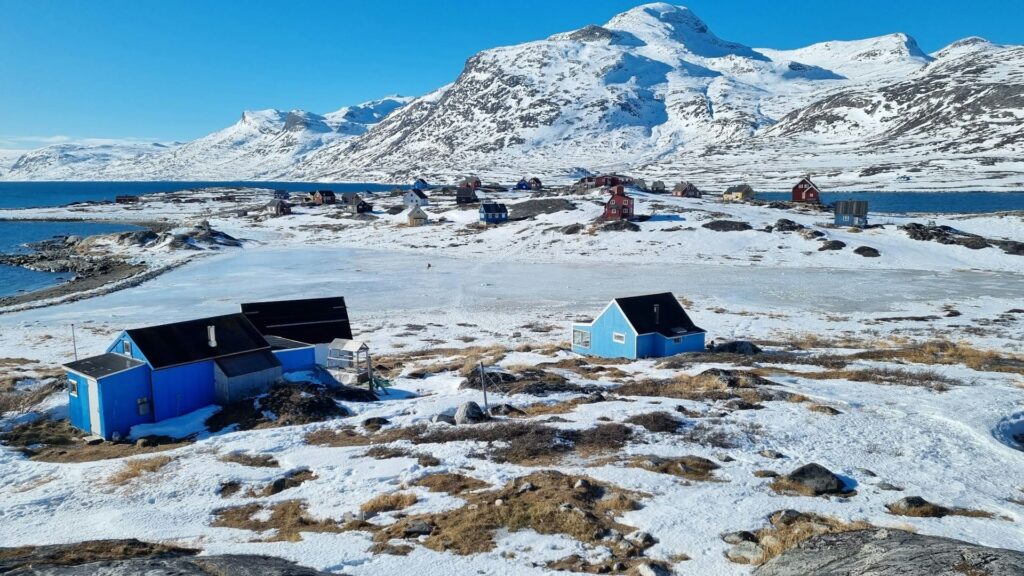
It would cost more than Juventus but less than Real Madrid, more or less the Barcelona quote. One hundred thousand euros to each of Greenland’s 56,000 inhabitants. With 5.6 billion – someone suggests in Washington – you could get the field passage of a territory 7 times the size of Italy; admittedly still frozen, but less and less thanks to the continued acceleration of global warming that will make mines and Arctic routes more accessible. It is Trump’s winter football prospect.
After all, the alternatives being tested to reorder the White House Real Estate (from Alaska to Tierra del Fuego via Greenland) are no longer reassuring. On Greenland Trump has assured that if no agreement is reached, he will do something “whether they like it or not.” On Canada he fondles the prospect of turning it into the 51st state of the US. On Europe he leaves the boon of tariffs hanging in the balance.
These are such violent shocks to the political order that has accompanied Europe for more than 70 years that they are difficult to label. And the center of this difficulty lies in the time factor. We are moving from a perspective that measures time by decades to one that measures it by weeks. But is a sudden reversal possible, a violent stars-and-stripes reconfiguration of the global system leading to subsequent stability?
Let us try to respond by starting with measurable effects, such as those produced by these choices on ecosystems. The systematic demolition of international law ordered by Trump has among its central purposes the increased consumption of fossil fuels, especially those with the greatest environmental impact, such as shale gas and Venezuelan heavy crude reserves. The first increase in production imagined in the launch phase of the dollarization of the Venezuelan economy would already produce more emissions than economies like the United Kingdom and Brazil generate annually.
Blowing up Arctic defense policies to make room for mining, new settlements and trade route development would mean creating what climatologists call positive feedbacks, i.e., mechanisms to accelerate the process. In this case, the process is the climate crisis, which is fed by the reduction of the ice surface (decreases albedo, that is, the ability to reflect solar heat before it is absorbed by the ground); the increase in methane emissions contained in permafrost, the frozen ground that now often tends to collapse; and the increase in sea temperature, which continues to trap some of the excess heat, paying as a price increasing destabilization.
Finally, there is the southern part of the Real Estate. The one where Trump threatens Colombia’s presidency and regrets angel friend Bolsonaro, sentenced to 27 years in prison by Brazil’s Federal Supreme Court for organizing and leading a coup attempt after his 2022 electoral defeat. In this central area of South America, real estate care is aimed partly always at extractive development, but partly at the erosion of tropical forest to make room for soybeans and ranches. And in this way the push to increase the climate crisis is completed in all its forms.
The point is that this is predominantly read as an environmental problem, whereas it forms the basis of an understanding of the shifting political balance. As early as the end of the last century, the U.S. military put climate change at the center of its analysis by developing scenarios in which national defense strategies were closely linked to the environmental variable. Because this variable changed the livability of entire territories, coastlines, energy and water security, therefore social. With the new course of the White House, the perspective has changed. But to disregard these forces is to erase from analysis the movement of tens or hundreds of millions of people along borders. And to underestimate the weight of the industries that are already moving, in a market-driven logic, to respond to these needs by making alternatives to fossil fuels ever cheaper and more convenient.
In this scenario, Europe represents the only bloc moving – albeit too slowly – in the direction of ecological transition while keeping liberal democracies and international law at the center. Until yesterday this seemed an obvious fact. Today, if supplemented with better dialogue with business, the holding of social balances and an all-round negotiating capacity, it could become the factor that makes the difference: an element that helps create a winning pole of technical, cultural, political aggregation. Provided it matures the will to do so. A condition currently lacking.