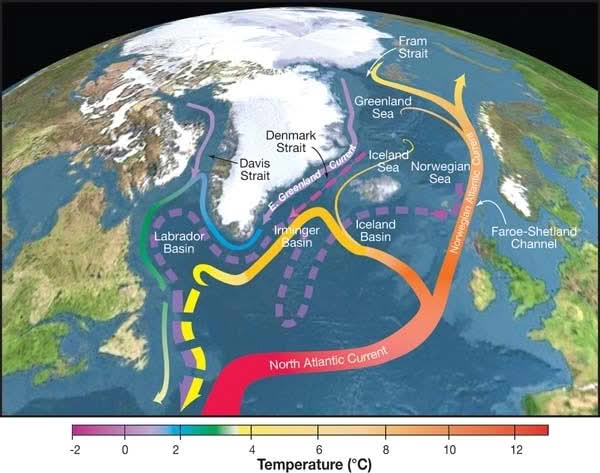
The idea seems like a paradox: the planet is warming, but Northern Europe is in danger of freezing. Yet it is a scenario that has been analyzed many times and now emerges from a new report by the Nordic Council of Ministers, which puts black on white a possibility that is anything but theoretical: the collapse of the Atlantic Meridional Circulation, known as AMOC.
The AMOC is one of the great climatic “pumps” of the Planet. It also includes the famous Gulf Stream and transports huge amounts of heat from the tropics to the North Atlantic, giving Northern Europe an unusually mild climate relative to its latitude. Without this ocean conveyor belt, London would have a climate more like Labrador than it does today. Not exactly ideal for five o’clock tea and weekends in the park.
The current that keeps the North warm
The problem, experts explain, is that climate change is weakening this circulation. Accelerated melting of Greenland’s ice puts large amounts of fresh, cold water into the North Atlantic, making it harder for the warm, salty water that powers the AMOC engine to sink. This is a well-known physical mechanism.
The report warns that any further increase in global temperature from current levels raises the likelihood of a complete collapse. Not tomorrow morning, but the start of the process could occur on time scales that are not reassuring. To continue to warm the Planet is to play with a climate switch whose consequences we do not control well.
Extreme cold in a warmer world
If the AMOC were to stop or reduce dramatically, the effect would be marked cooling in Norway, Sweden, Finland, and Denmark, as well as in the United Kingdom and Ireland. Greenland and Iceland would also experience profound changes. Paradoxically, while these regions would cool, much of the rest of the world would continue to warm.
In recent years some studies have hypothesized extreme scenarios: winter temperatures as low as -20 °C in London and nearly -50 °C in Oslo. Values that seem like science fiction today, but they serve to give a measure of the potential impact. Even without reaching these extremes, an average drop of a few degrees would be enough to disrupt ecosystems, agriculture, infrastructure and economies built on a relatively stable climate.
It is not “The Day After Tomorrow.”
Scientists are keen to point out: we are not talking about a sudden Hollywood blockbuster-style collapse. A progressive weakening, with cumulative effects, is more likely. But that is precisely why the risk is underestimating the problem: no spectacular scenes, just decades of colder winters, more unstable summers, and an increasingly less predictable climate.
Nordic Council of Ministers report and analysis relaunched by Carbon Brief insist on one point: the AMOC is one of the Earth’s great climate stability systems. Weakening it means increasing uncertainty, not only for Northern Europe but for the entire planet.
Climate change is not just “warmer everywhere.” It is a profound reshuffling of the mechanisms that regulate the climate. To think that it is only about heat waves and droughts is a mistake. In a warming world, some regions can cool dramatically.
It is an uncomfortable but useful lesson: reducing emissions is not just about avoiding extreme heat, but also about not extinguishing those delicate balances that have kept a part of the Planet habitable for millennia.