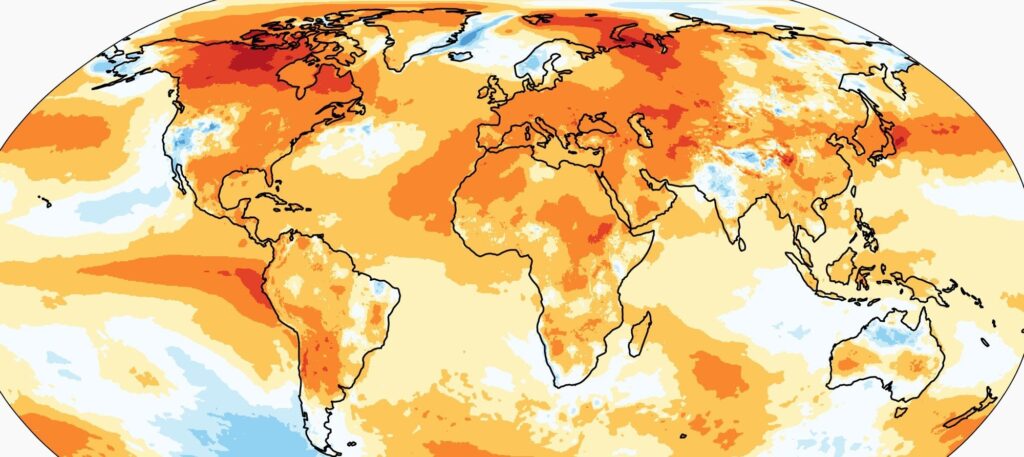
The climate crisis, the phenomenon that Trump sees as a scam, is already costing Italy a doubling of fatalities from heat spikes. There are now 20 people dying every day because they cannot withstand the rising heat pressure. From 2012-2021, our country recorded 7,400 heat-related deaths per year, more than double the number in the 1990s.
In 2024 each Italian was exposed to an average of 46 days of heat waves, and 33 of these days (72 per cent) would not have occurred without climate change. An impact that is also measured in economic terms. Exposure to increasing heat has resulted in a record 364 million lost work hours, or 15 hours per person, an increase of 181 per cent from levels in the 1990s of the last century. The hardest hit sector is construction, which alone accounts for 40 per cent of the losses.
Added to this are the effects of wildfires: between 2020 and 2024, smoke caused an average of 1,100 deaths per year in our country.
These are the figures from the Lancet Countdown on Health and Climate Change 2025, which are also very stark globally: every minute a person dies from extreme heat. Heat-related mortality has reached an average of 546,000 deaths per year. And in 2024, air pollution from wildfire smoke caused 154,000 deaths, the highest figure ever recorded.
Global warming is also expanding the range of tropical diseases: the transmission potential of dengue has increased by 49 per cent since the 1950s.
“A global health crisis.”
The report, compiled by 128 experts from 71 institutions coordinated by University College London and the World Health Organisation, speaks of a “record-breaking health toll” due to the combination of global warming and delays in adaptation. 2024 was the hottest year on record: on average, each person in the world was exposed to 16 days of health-threatening heat, rising to 20 for infants and the elderly.
According to executive director Marina Romanello, “the destruction of lives and livelihoods will continue until we end dependence on fossil fuels and increase adaptation efforts.”
In fact, pollution from burning coal, oil and gas continues to be a major public health threat, with 2.5 million deaths each year. Despite this, governments spent $956 billion on fossil fuel subsidies in 2023.
The positive signs
Despite the alarming picture, the Lancet Countdown recognises some progress: coal reduction has prevented 160,000 premature deaths each year between 2010 and 2022, and renewable energy production has reached record levels. By 2023, more than 16 million people worked in renewables, an increase of 18 per cent in a single year.
The global health sector, amongst the most exposed, has reduced its emissions by 16 per cent between 2021 and 2022, and nearly two-thirds of the world’s medical students have received specific training on climate and health.