Spend a billion to throw a real treasure to the bottom of the sea. That’s the plan currently hatched for the glorious ISS, the International Space Station in Earth orbit: drive it in a controlled plunge into the Pacific Ocean by 2030. Yet up there are 430 tonnes of invaluable prime material—aluminium, titanium, and materials tested to operate in space—an over $1.5 billion asset already where it is needed: in orbit, where it has been shipped over the course of nearly three decades with countless launches and at great expense. Why destroy it, when doing so could conversely usher in space’s first true circular economy?
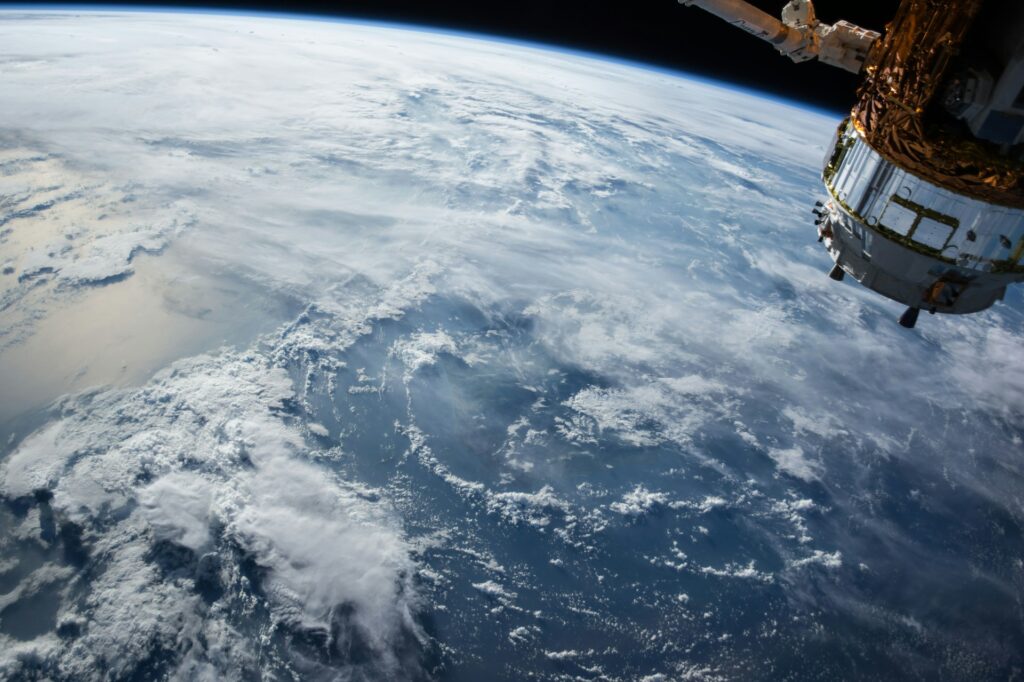
The International Space Station is an orbiting laboratory the size of a football pitch, in low Earth orbit a little less than 400 kilometres away from Earth. The first module (Zarya) was launched as far back as 1998; human presence on board has been continuous since November 2000. It is a joint project of NASA, Roscosmos (Russia), ESA (Europe), JAXA (Japan) and CSA (Canada). It took literally decades of missions to assemble and resupply it: dozens of space shuttle flights (more than 35 dedicated) and more than 100 total launches including modules, Progress/HTV/Cygnus/ATV cargo and manned capsules (Soyuz, Crew Dragon).
The records obtained so far
More than 270 astronauts and cosmonauts from more than 20 countries have lived and worked aboard it, with the longest continuous stay being an impressive 371 days (Frank Rubio, 2022-2023), whilst by total time in orbit Russian Oleg Kononenko has exceeded 1,000 cumulative days on multiple missions. The ISS was instrumental precisely in “inhabiting” space, and figuring out how to deal with the myriad problems of human activity in microgravity. Of course then up there thousands of experiments were conducted in biology, medicine, materials physics, fluids, Earth observation and technology demonstrations (water/air recycling, robotics, re-entry, 3D printing), also enabling the development of commercial manned flights.
Unfortunately, however, nothing is eternal, all the more so a man-made machine that is, in some parts, up to 30 years old. Many areas of hardware have aged far exceeding their design life, the risk of failures and micro-impacts grows, and operating costs increase significantly. Can the Station continue to be used? Theoretically, yes: some functions could be extended or parts retrofitted, but without significant investment in maintenance, upgrades, and risk management, technical and economic sustainability beyond 2030 gradually becomes less justifiable. Hence the idea of envisioning a controlled reentry plan at sea, with NASA commissioning SpaceX to develop a deorbit vehicle (USDV) for controlled reentry to “Point Nemo” in the Pacific early next decade.
An alternative solution
That said, it sure does hurt to literally throw into the sea (and partly burn up in the atmosphere) the largest human artefact ever built in orbit, spending another billion dollars to accomplish this feat to boot. And there are those who are proposing an alternative solution that could revolutionise the space economy. “We’re talking about 430 tonnes of valuable materials—aluminium, titanium and other alloys—that would be worth more than $1.5 billion if kept in orbit,” explains Greg Vialle, founder of Lunexus Space and promoter of the “Recycle the ISS” movement. “On the ocean floor, however, they will be worth nothing.”
Vialle’s proposal is simple and revolutionary: instead of spending $1 billion to destroy the station, why not invest $300 million to develop the technologies needed to recycle it? An approach that would not only preserve a valuable asset but also lay the foundation for a new American space industry, ensuring economic and strategic leadership over other global competitors, China foremost amongst them.
The urgency of this decision is dictated not only by the 2030 deadline, but also by the growing congestion in low Earth orbit. With the exponential expansion of the commercial satellite industry, space around Earth is becoming increasingly crowded, increasing the risks to future spaceflight and the operational costs to the industry.
An automated hub
Vialle’s vision goes beyond simply saving money. His proposal calls for transforming ISS into an automated logistics and manufacturing hub, eliminating the $3 billion in annual operating expenses that NASA currently incurs for crew and maintenance. The technologies developed for this project could then be applied to address the broader problem of space debris, creating what Vialle calls a “circular space economy.”
The cost-benefit analysis leaves little room for doubt. NASA’s current plan calls for an investment of $1 billion, whilst the recycling plan would cost $300 million plus an equal government loan to launch the necessary infrastructure. The projected payback would rise from a modest 100 per cent in 5-10 years to over 1,000 per cent over the same period.
“How can we expect to mine and refine asteroids of unknown composition in deep space if we cannot take advantage of the tonnes of space materials already catalogued and tracked in low orbit?” asks Vialle rhetorically. A question that resonates even louder considering that each kilogramme of material launched into space costs at least $3,500.