Jane Goodall is no more. She passed away at age 91 in California, but her voice continues to accompany us. She was not only a research icon: she held together science and conscience, rigour of analysis and empathy, research goals and civic engagement. With her, ethology came out of the textbooks and met the people, inspiring millions of young people to take action to defend the planet. Of the great three “ape women” (Dian Fossey the gorillas; Jane the chimpanzees; and Birutė Galdikas the orangutans) only the third, perhaps less well known than the other two, remains.
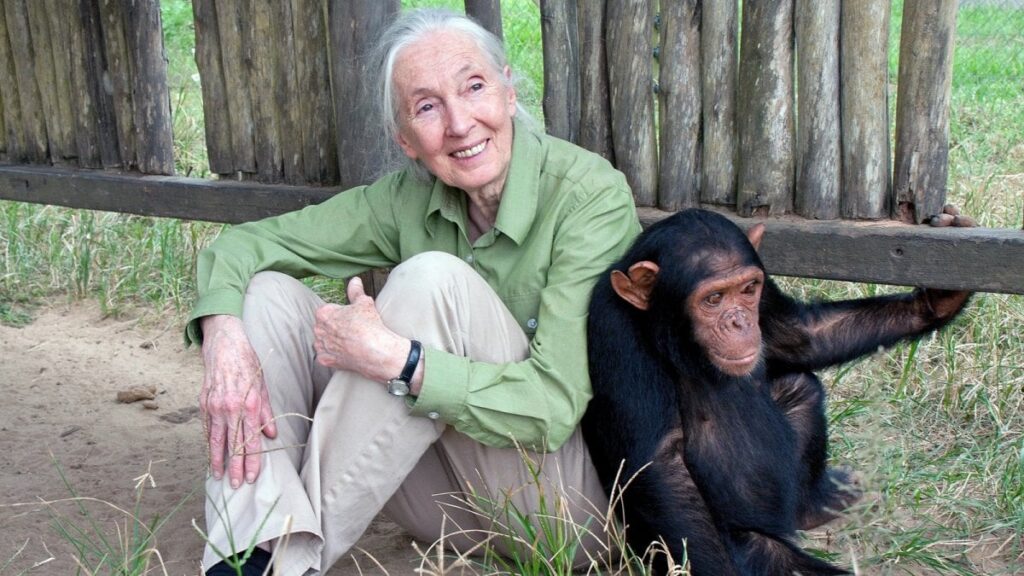
Goodall’s name will remain linked to the forests of Gombe, Tanzania, where she revolutionised the study of primates in the 1960s. By observing chimpanzees in the wild, she showed that they could use tools, experience emotions and transmit cultural behaviours. But the real revolution was not just scientific: Goodall pushed us to recognise a kinship that goes beyond DNA, to see in other animals as subjects with dignity of their own. And to recognise ourselves in them on a deep level.
From the laboratory to the global community
Her career, which began with the support of palaeoanthropologist Louis Leakey, led her to obtain a doctorate from Cambridge without a previous degree, a very rare case in academic history. Her special characteristic was her ability to observe: this is what made her one of the big names in ethological research. But she was never a scientist locked in university classrooms. In the 1970s she founded the Jane Goodall Institute, which today has branches in more than twenty countries, and in 1991 she launched “Roots & Shoots,” an educational programme that involves millions of boys and girls in environmental and social projects.
Goodall knew that the climate crisis and biodiversity loss cannot be addressed with data and graphs alone: empathy, courage and a sense of ownership are needed. It is no accident that she was named a “messenger of peace” by the United Nations and travelled tirelessly for decades, taking her quiet but firm voice everywhere. She often spoke of the need to “listen to nature” and learn to live in its times, remembering that what we lose today cannot be recovered tomorrow.
The strength of a hug
A video that has remained famous shows the embrace of Wounda, a chimpanzee freed from illegal trafficking and returned to life through the work of her team. It is an image symbolic of her thinking: science and conservation can restore freedom and a future when guided by compassion and responsibility.
Jane Goodall’s legacy thus lies not only in books or documentaries, but in the thousands of young people who, thanks to her, have learned that protecting a forest means protecting themselves. In a time marked by ecological crisis and climate instability, her example remains a powerful reminder that we are not masters of the Earth, but one of the species that inhabit it. To really change, to make peace with other human beings and with nature, perhaps reading one of her books can be a good start.