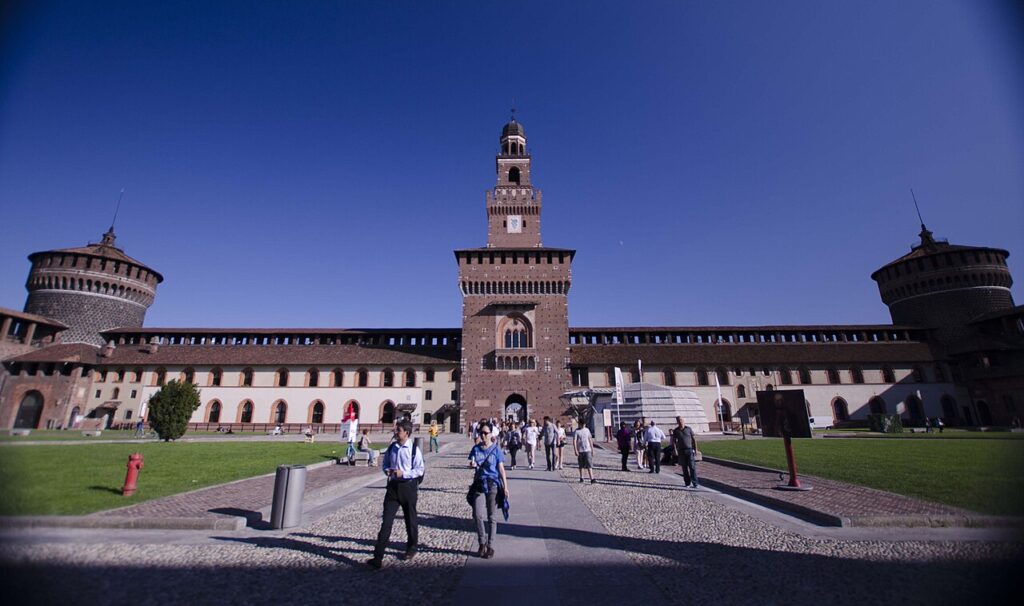
Milan, during the 2026 Winter Olympics, is flanking sports with a cultural program built on concrete interventions. At the center is the Castello Sforzesco, which strengthens its role as a place of study and enhancement of Leonardo da Vinci ‘s work through a coordinated set of restorations, museum upgrades and mediation tools designed for the public.
The Hall of Axes as seen from the construction site
The centerpiece of the initiative is the exceptional opening of the Sala delle Asse, one of the most complex rooms Leonardo created in Sforza’s Milan. During the last phase of restoration, visitors will be able to access the scaffolding and observe the decoration from a few inches away, a possibility usually reserved for restorers and scholars. The vegetal vault, the lunettes and the famous charcoal “monochrome” thus become legible as working surfaces, allowing them to grasp materials, execution techniques and critical conservation issues.
The guided tours, organized by Ad Artem in collaboration with the restorers of SERES s.r.l., include a historical introduction on Leonardo’s presence at the Castle and a time spent on site, with safety devices, that allows a close look at the operational phases of the restoration. An experience that restores the complexity of the intervention without simplifying mediations.
Multimedia storytelling in the Panoramic Rooms
Next to the construction site, a multimedia installation dedicated to the history of the Sala delle Asse and the context of the Sforza court is set up in the Panoramic Rooms of the Castle. The itinerary uses images, documents and reconstructions to relate the different decorative phases, the most recent discoveries and the interpretative hypotheses that have matured over time, offering visitors tools to orient themselves in a long and complex affair.
The Leonardesques in the Pinacoteca
The itinerary extends to the Pinacoteca del Castello, where Room XXI reopens with a new exhibit dedicated to the Leonardo painters, artists trained in Leonardo’s workshop or influenced by his language. Recent restorations, new acquisitions and multimedia apparatus make it possible to follow the spread of Leonardo’s model and its impact on Milanese artistic production, highlighting a shared and enduring process.
The project is promoted by the Castello Sforzesco staff, curated by Fiorella Mattio, Irene Scarcella and Luca Tosi, with the support of the Ministry of Tourism and the contribution of scientific partners. As Culture Councillor Tommaso Sacchi recalls, the goal is to enhance “the places and testimonies that document Leonardo da Vinci’s presence in Sforza’s Milan” through an integrated and accessible itinerary.
Dates, times and tickets mark a precise calendar, but the intervention looks beyond the Olympic period. The opening of construction sites and the updating of museum itineraries make visible work that usually remains hidden, turning the international event into an opportunity for knowledge and direct access to heritage.