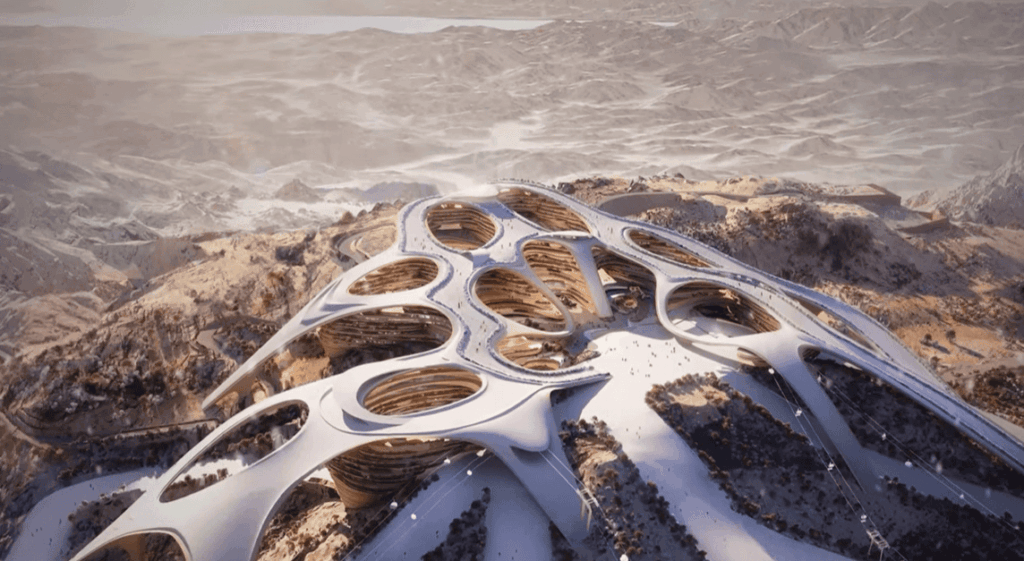
Crown Prince Mohammed bin Salman must face the bitter reality: his ambitious project to build a ski resort in the desert is encountering seemingly insurmountable obstacles. Trojena, the futuristic resort slated to host the 2029 Asian Winter Games, risks becoming yet another symbol of the megalomania that characterises Saudi Arabia’s pharaonic projects.
Of course, this likely failure is great news. In an age of growing environmental awareness, the construction of an artificial ski resort in the desert is a perfect example of unsustainable and environmentally harmful development. The very idea of pumping desalinated water to the top of a mountain to produce artificial snow in a desert climate, with temperatures that rarely drop below freezing, is an affront to common sense and environmental sustainability. Not to mention the energy required to maintain temperature-controlled facilities in an environment where summer temperatures regularly exceed 40 degrees.
The technical challenges are enormous
However, the complex, part of the futuristic city of Neom with an estimated cost of $1.5 trillion, is straining even the kingdom’s immense financial resources. According to sources close to the project, construction is accumulating significant delays and may not meet the projected deadlines for the 2029 Games.
The technical challenges are enormous. How to create and maintain artificial snow in a desert climate? How to pump enough water to the top of a mountain to feed an artificial lake? How to build at high altitude on terrain with complex topography? Questions that still seem to have no convincing answers.
The $19 billion project, initially scheduled for 2026, is highlighting all the limitations of the “nothing is impossible” approach so dear to MBS. Asian Games organisers are monitoring progress with growing concern, to the point that they are beginning to talk about possible alternative plans, including moving the event to another country.
Doubts grow
Trojena’s dream included ski slopes on the roofs of luxury hotels, a lake suspended over a cliff, and a crystal skyscraper as tall as the Eiffel Tower. Reality is proving much more prosaic: despite Neom’s official assurances of “progress according to plan,” work is proceeding slowly and with growing doubts about its feasibility.
The scaling back of Saudi ambitions is already visible in the numbers: the sovereign wealth fund PIF recently wrote down its “giant projects,” including Neom, by $8 billion. A clear sign that even the kingdom’s near-infinite resources have a limit.
The crisis is broad
The crisis is part of a larger context of difficulties for Saudi mega-projects. The Line, the 170-kilometer-long linear city that is supposed to be Neom’s flagship project, has been drastically scaled back: only 2.4 kilometers will be completed by the beginning of the next decade. Even Sindalah, a theoretically easier luxury island to build, remains closed to the public after a grand opening last year.
In 2025 Neom got contracts for only $20 million, a steep drop from the $12.6 billion in 2023. With oil prices around $66 per barrel, well below the $94 needed to balance the budget (or the $111 if Pif expenses are included), the kingdom has to deal with an increasingly stringent economic reality.
Experts are sceptical that the project can be implemented on schedule. “It could happen, but at the very last minute, with people rushing to meet an impossible mandate,” comments Karen Young of Columbia University. “Just enough to get the right people into a hotel room and have enough snow for a good descent and capture the event.”