Milan hosts an exhibition that renounces the traditional exhibition form. From January 29 to April 6, 2026, in Brera, the FAAM Workshop becomes a threshold: not a path to be observed, but a space to be crossed. “Dino Buzzati and the Afterlife” constructs a house that never existed and yet appears recognizable, because it is made of the same material as the fears, landscapes and tensions that run through the work of one of the major protagonists of the Italian twentieth century.
The project, included in the program of theMilan Cortina 2026 Cultural Olympiad and promoted by the Arnoldo and Alberto Mondadori Foundation with the Dino Buzzati Foundation and other institutional and cultural partners, chooses a precise path: to enter Buzzati’s imagination without simplifying it. Each room gives back a fragment, each passage connects different levels of reality. There is no celebratory intent, but a work of staging that makes visible the continuous gap between chronicle and myth, between everyday life and disquiet.
An environment to walk through
The installation curated by Virgilio Villoresi and Lorenzo Viganò takes its starting point from Poema a fumetti (1969), Buzzati’s artistic testament and first Italian graphic novel. From here comes an immersive journey made of handcrafted sets, images and sound suggestions that constantly oscillate between descent and ascent, abyss and summit. The inspiration from Villoresi’s The Eternal Return of Orpheus is stated, but the result avoids illustrative quotation: the myth becomes a key to reading the present, not an exercise in style.
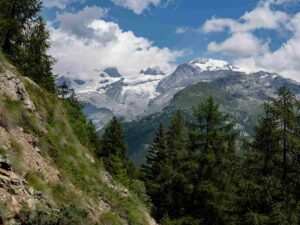
The dual identity of Buzzati – born in Belluno and Milanese by adoption – emerges as a structural tension. On the one hand is modern Milan, recounted in novels and especially in articles for Corriere della Sera, where he was a special correspondent for more than forty years; on the other is the mountain, never reduced to a mere background, but assumed as destiny and as a measure of human limitation. It is Barnabo’s mountain of the mountains and The Secret of the Old Woods, but also that of the civil chronicles, such as the account of the Vajont tragedy, where the landscape becomes responsibility.
Buzzati’s relationship with mountaineering, a discipline that involves endurance, alertness and risk awareness, also finds its place in this unstable balance.
Holding cities and mountains together is a metaphysical dimension that runs through all of Buzzati’s work. Spaces are never just real: they connect the visible with the invisible, the present with an elsewhere that offers no consolation. The most effective synthesis of this vision remains the painting Piazza del Duomo in Milan, where the cathedral is transformed into a Dolomite peak. Not a visual paradox, but a symbolic image that unites urban space and natural landscape, reality and transcendence.
“Dino Buzzati and the Afterlife” asks the visitor to accept the crossing, to inhabit the uncertainty.