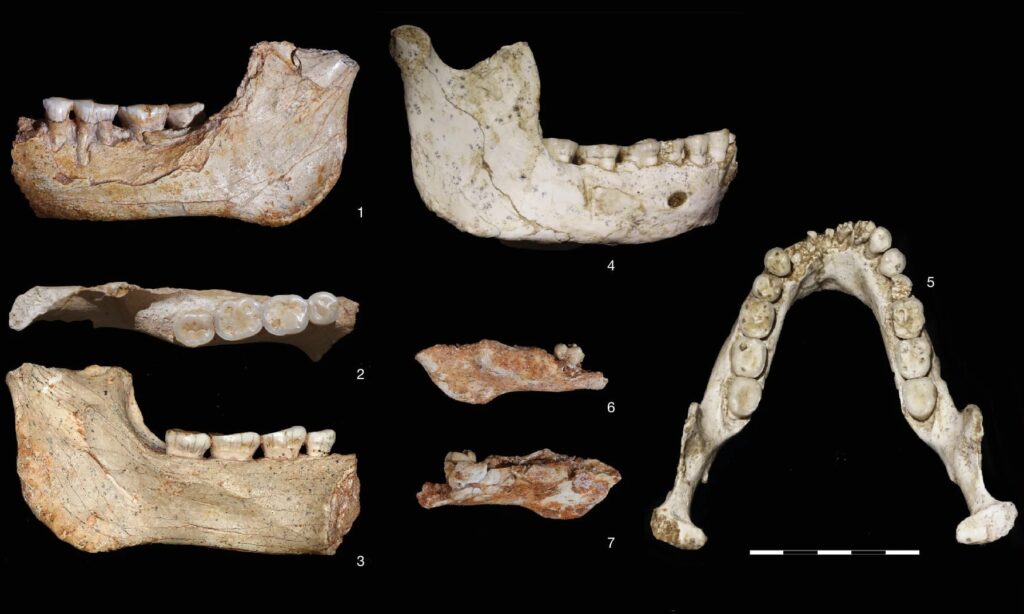
A discovery that has emerged from underground in Morocco is causing international paleoanthropology to debate because it fills one of the critical gaps in the history of human evolution. In a cave near Casablanca, within the complex known as the Grotte à Hominidés, human fossil remains dated to about 770,000 years ago have been found. An age that places them in a key period, when the evolutionary lines from which the different branches of the genus Homo descended were beginning to separate.
A piece in a little-known period
Between one million and 300,000 years ago, the African fossil record is surprisingly sparse. It is a decisive phase, because it is precisely in this interval that the anatomical and biological features that will lead much later to the appearance of Homo sapiens are set. The Moroccan fossils arrive exactly where the story became most uncertain, finally offering a solid reference in terms of dating and context.
The remains found-jawbones, teeth, and parts of the postcranial skeleton-show a combination of traits that does not fit comfortably into any previously known species. They lack the fully modern anatomy of present-day humans, but at the same time they lack some of the more archaic features associated with early Homo erectus. It is an evolutionary mosaic that tells of a transitional population, more advanced than expected for that era, but still far from the physiognomy of modern humans.
The role of northwest Africa
The location of the discovery is far from minor. North Africa, and in particular the area of present-day Morocco, is confirmed as a crucial junction in human evolution. An integral part of a process that probably involved several African regions at once. This discovery reinforces the idea that the origin of modern humans was not a localized event, but the result of a network of interconnected populations spread across the continent.
One of the most robust elements of the study is the dating. The fossils were placed around 773,000 years ago by magnetostratigraphic analysis of the sediments, linked to an inversion of the Earth’s magnetic field. It is one of the most reliable chronologies ever obtained for African human remains of this antiquity and provides a key time anchor for revising the evolutionary models used to date.
Scholars are cautious: this is not to proclaim the discovery of the oldest Homo sapiens. Rather, these individuals seem to belong to a population close to the point of separation between the branches that will lead much later to modern humans, the Neandertals and Denisova. In other words, we are not looking at a new progenitor for sure, but at a close relative that helps to better understand where we came from.