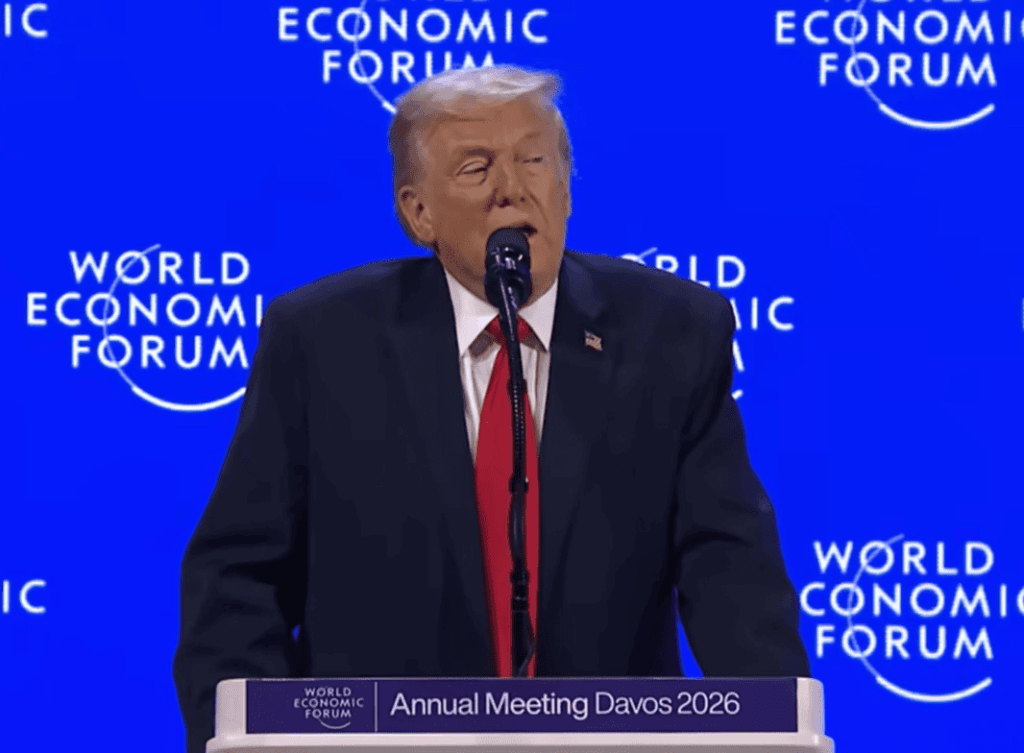
What had seemed like a sudden breakthrough at Davos now looks more and more like an armed truce. Donald Trump‘s speech, which had frozen the Forum with the threat of punitive tariffs against Europe, did not translate-at least for now-into a head-on rupture. But neither did it result in the “historic” agreement that the U.S. president claimed in the heat of the moment. Behind the White House’s muscular narrative, the picture is much more nuanced: the Greenland deal is not closed, the contours remain opaque, and, most importantly, Europe has begun to straighten its back.
Davos was not the site of a concluded barter but the beginning of a process that is still open.
Europe is no longer just a spectator
If in the first hours after the face-to-face meeting between Trump and NATO Secretary General Mark Rutte it had seemed that everything had been resolved along the Washington-Atlantic Alliance axis, as the days passed a different dynamic emerged. Brussels has made it known, in less accommodating tones than in the past, that any discussion on the Arctic and Greenland cannot be reduced to a NATO dossier run solo by the United States.
The European Commission and several capitals have claimed a direct political role: Greenland is Danish, therefore European, territory, and any substantial change in the security arrangements involves the EU as a strategic player, not as a mere ratifier of others’ decisions. This is a significant change of posture from the years when Europe appeared paralyzed between military dependence and fear of trade retaliation.
The message this time is sharper: cooperation yes, but not under blackmail.
Less Rutte, more Europe
Mark Rutte’s role is also downsized. The NATO secretary general remains a facilitator, but not the political guarantor of an understanding that, in fact, does not yet exist. The Atlantic framework is one of the options on the table, not the only one. Above all, it cannot replace the confrontation between Washington, Brussels, Copenhagen and Nuuk.
The idea that the “pact” on Greenland was sealed in Davos clashes with a much more cautious reality: there is no text, there are no binding commitments, it is not clear what military capabilities would be installed, nor what degree of operational control the United States would demand. Talk of a final agreement today is premature.
An understanding with uncertain boundaries
The second big variable is just that: the agreement may never see the light of day. Trump’s triumphalist statements – entrusted as always to Truth – describe a framework “that will last forever,” but in Washington as in Europe there is an admission under the surface that we are in the midst of a complex negotiation, exposed to political stop-and-go.
The project of the so-called“Golden Dome,” the missile defense dome on the island, remains speculative. It has not been clarified whether it would be an extension of NATO assets, an exclusively American presence or a hybrid formula. Even more nebulous is the central issue: what the United States would really have and what Denmark and Europe would concede in exchange for a stop to tariffs.
Blackmail works less than before
In this context, the trade threat loses some of its effectiveness. Europe does not ignore the weight of the U.S. economy, but it no longer accepts that security, trade and territorial sovereignty are merged into a single instrument of pressure. This is where the most relevant political signal that has emerged since Davos comes in: the European willingness to deal on the Arctic is not unconditional.
Greenland remains a crucial strategic node, but not the price to be paid to avoid a trade war. If a deal comes, it will come through a multilateral, slow and technically complex negotiation. If it jumps, Europe will not be the first to break the table.
For now, rather than a turning point, Davos has certified a transitional phase: fewer announcements, more friction. And a Europe that, echoing a very recent adage of the Canadian Prime Minister Mark Carney, tries not to end up on the menu.