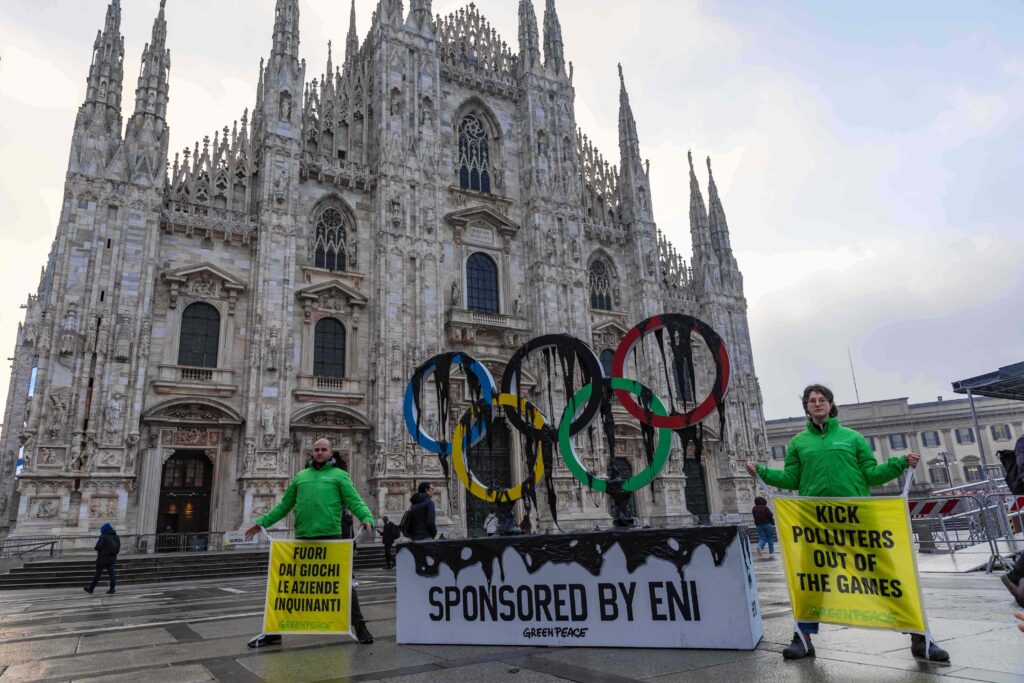
Five Olympic circles dripping oil. This is the image that appeared on the morning of Feb. 5 in Milan’s Piazza del Duomo, where Greenpeace Italy activists set up a symbolic installation just hours before the arrival of the Olympic flame. Next to it, a stark inscription: “Sponsored by Eni.” The message leaves no room for interpretation. The protest targets the presence of the oil and gas giant, among the main sponsors of the Milan Cortina 2026 Olympics and Paralympics.
The action took place before the eyes of citizens and tourists and was removed shortly afterwards by civic assistants. But the image, which was also relaunched by international agencies, has already gone around the world.
Fossil sponsors under indictment
Secondo Greenpeace, il legame tra i Giochi invernali e aziende fortemente dipendenti dai combustibili fossili rappresenta una contraddizione difficile da giustificare. “È assurdo che fra i principali partner dei Giochi Olimpici e Paralimpici figurino aziende che, con le loro emissioni fuori controllo, rischiano di far scomparire il ghiaccio e la neve da cui dipendono le Olimpiadi Invernali. Eni è fra i principali responsabili al mondo della crisi climatica e non è accettabile che le sue operazioni di greenwashing inquinino i valori olimpici del rispetto per le persone e l’ambiente. Chiediamo al Comitato Olimpico Internazionale di interrompere tutte le sponsorizzazioni e partnership con le aziende del gas e del petrolio, a partire da Eni, per salvaguardare i Giochi Olimpici presenti e futuri”, ha dichiarato Federico Spadini della campagna Clima di Greenpeace Italia.
For the environmental organization, Eni’s oil and gas activities contribute significantly to global warming, calling into question the very possibility of hosting snow and ice-related sports competitions. Greenpeace also recalled that it has initiated legal action against the company specifically on the climate front.
Numbers that speak of disappearing ice
In the crosshairs is not only the symbolic value of sponsorship. Greenpeace recalls data directly linking climate-altering emissions to glacier loss. According to estimates cited by the organization, Eni’s global emissions for 2024 alone, amounting to 395 million tons of CO₂ equivalent, could be associated with the melting of 6.2 billion tons of glacial mass. A volume that, when related to the Italian context, would be equivalent to more than half of the Alpine glaciers.
The flame passes, the controversy remains
The protest was intertwined with a key day in the path of the Olympic flashlight, which arrived in Milan after passing through all 110 Italian provinces. The flame was also expected in front of Eni’s headquarters later in the day, as former champions Alberto Tomba and Deborah Compagnoni lit the braziers of the Games.
Eni, for its part, said it shared the urgency of addressing climate change and continuing to invest in the energy transition, reiterating its goal of achieving climate neutrality by 2050.
Greenpeace looks instead to the International Olympic Committee, to which it sent an open letter asking it to exclude sponsorships from oil and gas companies. An appeal that recalls a choice made in the past, when the IOC banned tobacco advertising from the Games. Today, activists argue, what is at stake is the very survival of winter sports.