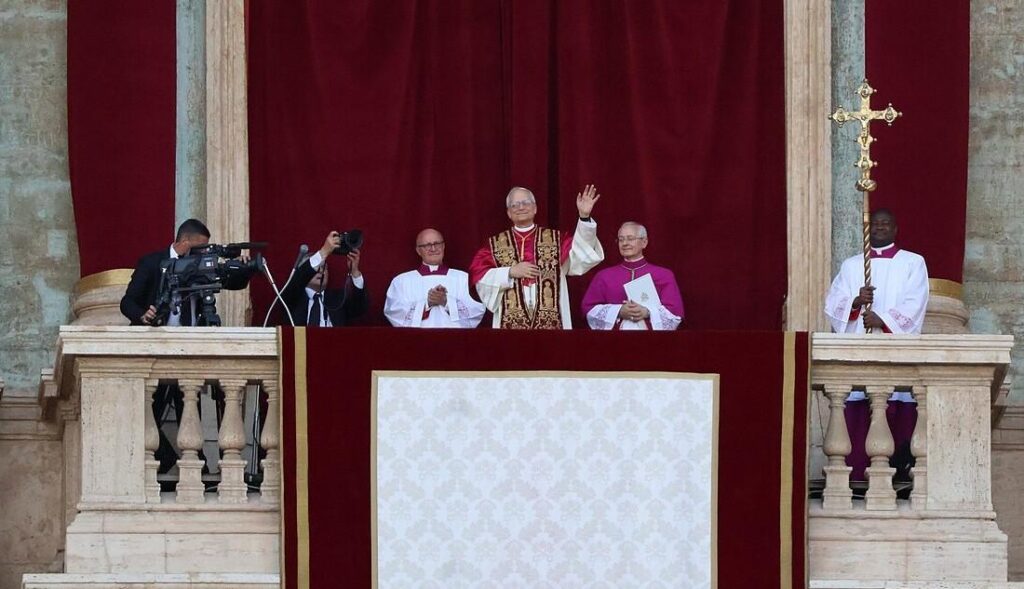
Pope Leo XIV chose strong words to issue a warning to the world: war is a tragedy that, in its violence, is destroying the very fabric of international law, leaving entire cities “in ashes.” It is a powerful image, evoked during a homily that sought to symbolically connect Ash Wednesday to the current suffering of millions of people affected by conflict.
The pontiff’s invocation goes beyond the religious analogy and becomes an ethical and political call: if the international community fails to stop violence and protect civilians, then entire systems of norms governing coexistence between states risk becoming waste paper. “We can today,” the pontiff says, “feel in the ashes that are imposed on us the weight of a burning world, of whole cities disintegrated by war: the ashes of international law and justice among peoples, the ashes of whole ecosystems and concord among people, the ashes of critical thinking and ancient local wisdom, the ashes of that sense of the sacred that dwells in every creature.”
For Leo, international law is the framework within which peace, human dignity and the survival of communities are at stake. When these rules are ignored, the results are evident in the rubble the pope cites, in populations forced to flee, in horizons broken by explosions and bombings.
An alliance between rights and responsibilities
The message is set in a historical context in which armed conflicts around the world – from Gaza to Ukraine, from the Sahel to the Horn of Africa – all show a common trait: the fragility of the norms that are supposed to protect civilians and regulate hostilities. For Pope Leo, it is not enough to evoke the principles of humanitarian law: they need to be applied, strengthened, supported by effective international institutions and shared political will.
The Catholic Church, through this position, also calls individual nations to a responsibility that can no longer be postponed. It is an exhortation to reckon with one’s foreign policy choices, with alliance relations, with the sale and distribution of arms, with the ability to protect those who are most vulnerable. It is a call to action and consistency.
The burden of urban violence
The image of “cities reduced to ashes” is not a distant metaphor. In many contemporary theaters of war, entire urban areas have become battlegrounds, leaving behind razed neighborhoods, uninhabitable infrastructure, and a civilian population trapped between the front lines. In some cases, these destructions have produced profound humanitarian crises, with millions internally and externally displaced, local economies devastated and social scars difficult to heal.
The Pope’s warning draws attention to this very dimension: war does not just kill combatants in the field, but turns entire cities and communities into social catastrophes, with impacts that linger for years, often for generations. It is a topic that raises questions about the role of international organizations, but also of civil societies and churches in promoting concrete ways of peace.
Between religion and global politics
Pope Leo’s address is in a tradition of pontificates that, at times of international crisis, have used the Church’s moral magisterium to intervene in global public debate. This time, the symbolic setting of Lent accentuates the gravity of the message: not just a call for spiritual conversion, but a call for the conversion of international relations.
The challenge emphasized by the Pontiff is twofold. On the one hand, it involves the protection of fundamental rights in crisis areas, with a strengthening of humanitarian law and norms for the protection of non-combatants. On the other, it implies a broader reflection on the meaning of collective security in the contemporary world, where geopolitical balances often prevail over human values.
A call to global consciousness
Pope Leo’s message is addressed not only to governments and diplomatic elites, but to each of us. When he speaks of “ashes imposed by a burning world,” he invites readers and citizens to look beyond the surface of screens and news, to consider the human and material consequences of wars. To measure the value of international norms not with legal formulas, but with the concrete lives of the people who should be protected by them.
At a time when the international community often seems paralyzed in the face of emergencies, this moral voice reminds us that international law is not an abstraction: it is the most fragile and most indispensable barrier against the annihilation of cities and human hopes.