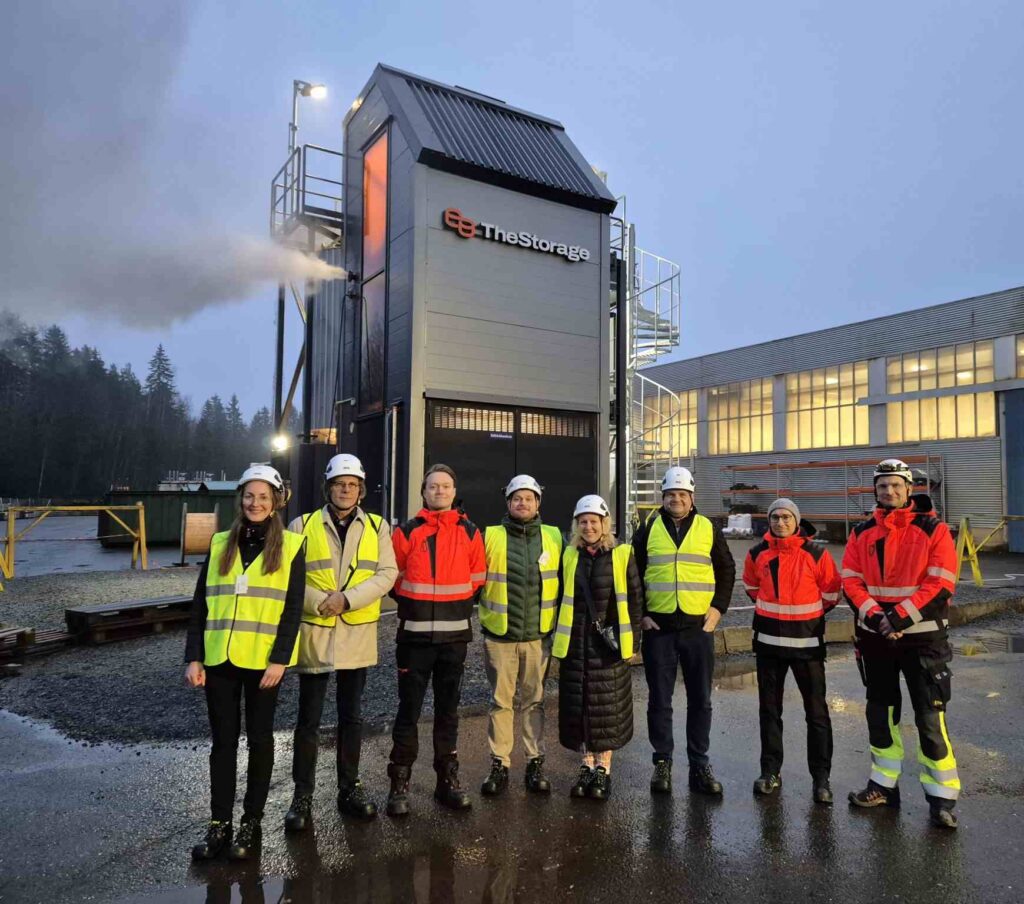
For years, industrial heat has remained at the margins of the energy transition narrative. Less visible than electricity generation, harder to repurpose, it nonetheless weighs heavily on the global climate balance. About one-fifth of the energy consumed in the world is used to generate heat for industry, and much of that need is still met by burning oil and gas. In Finland, a newly launched experiment tries to change the picture by starting with an unsuspected material: sand.
An obligatory passage
Steam is an essential resource for many industries, from food processing to chemicals. Production lines require high temperatures and continuity of operation, conditions that make direct electrification complex. Renewable sources struggle to guarantee a constant supply throughout the year.
About 80 percent of the heat used in factories today still comes from fossil fuels. A figure that explains why the sector is seen as one of the necessary steps to hit Europe’s climate goals, which call for a drastic cut in emissions by 2040.
Thermal storage as a bridge
Finnish startup TheStorage has chosen to address this imbalance by focusing on storage. The principle is to harness renewable electricity when it is available and cheap, turning it into high-temperature heat and storing it for later use. The storage medium is common sand, contained in two insulated silos.
The process involves electrically heating cold sand to about 800 degrees and then transferring it to a hot silo, where the energy remains stored. When the industry needs heat, the material is circulated through an exchanger that produces steam or thermal oil. According to the company, this system allows for much more efficient heat transfer than traditional static solutions.
“Companies have been wanting to decarbonize for years, but there were no viable solutions,” said Timo Siukkola, CEO of TheStorage, explaining that the goal is to make renewable heat economically reliable as well.
From the laboratory to the factory
In January 2026 the system went into operation at a Finnish brewery, the first industrial-scale pilot site. The expected results are ambitious: reduction of energy costs by up to 70 percent and cutting carbon emissions by up to 90 percent. Numbers that, if confirmed by prolonged use, would make thermal sand storage an attractive solution for many manufacturing entities.
It remains to be seen how replicable the model is in different contexts and with more complex production loads. Meanwhile, the Finnish experiment brings attention back to an often overlooked issue: without action on industrial heat, the transition is likely to stop halfway. In this scenario, even simple materials can become strategic tools.